Santuṭṭhi: The Buddhist Practice of Contentment and Simplicity
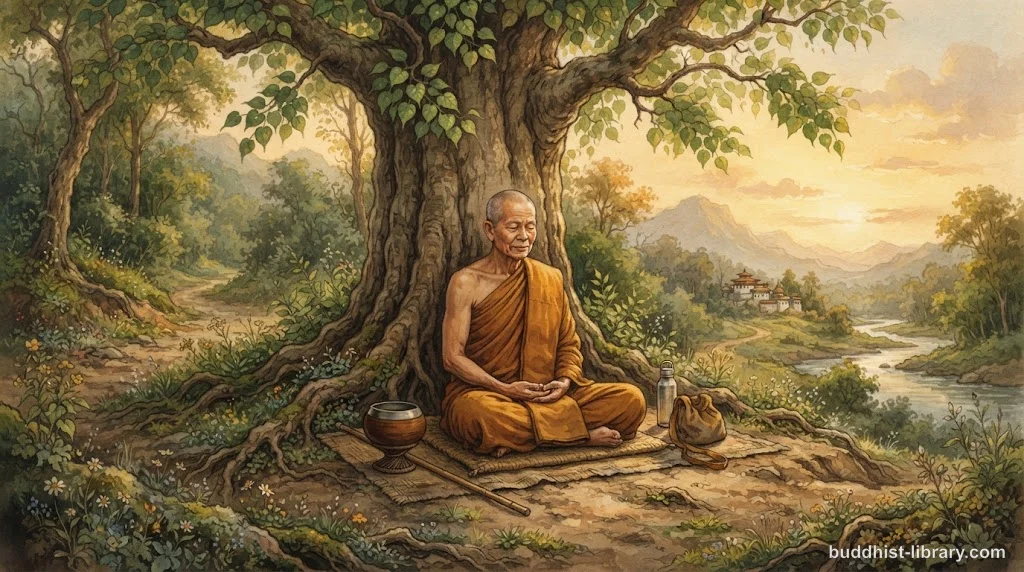
Santuṭṭhi is the Buddhist quality of contentment—a clear-seeing satisfaction that stops the exhausting hunt for happiness in acquisition. It’s the wisdom that knows when you have enough, and the freedom that comes from no longer needing more. In a culture built on perpetual want, santuṭṭhi is both a challenge and a relief.
What Is Santuṭṭhi?
Santuṭṭhi (Pali: santuṭṭhi; Sanskrit: santoṣa) is contentment with material requisites and conditions. Not a vague feeling of satisfaction. A trained mental quality grounded in insight. The Buddha taught santuṭṭhi as a fundamental virtue for monastics and laypeople alike—a foundation for the spiritual life.
In the monastic code (Vinaya), contentment is woven into the structure itself. A bhikkhu is to be content with whatever robes, alms food, lodging, and medicine are offered. No accumulation. No hoarding. No scheming for upgrades. The Pātimokkha training rules enforce this: monks own almost nothing, and even those few possessions are held lightly.
Santuṭṭhi isn’t institutional minimalism. It’s a quality of heart. The Dhammapada says:
“Contentment is the greatest wealth.”
— Dhammapada 204
Wealth measured not in currency, but in the peace of not needing more.
Why Does Contentment Matter in Buddhism?
Because craving (taṇhā) is the second Noble Truth—the cause of suffering. And one of the most relentless forms of craving is the drive for more: more comfort, more security, more status, more stuff. Santuṭṭhi cuts this at the root.
When you’re content with what you have, several things happen:
- Craving loses traction. The mind stops spinning fantasies about what you lack.
- Simplicity becomes possible. You can actually live with less because you’re not constantly feeling the deficit.
- Attention is freed. The energy spent on acquisition, maintenance, comparison, and worry becomes available for practice.
- Renunciation becomes natural. Letting go isn’t deprivation when you genuinely don’t need what you’re releasing.
The Ariyavaṃsa Sutta (AN 4.28) lists contentment among the “noble traditions”—the qualities that mark a practitioner walking the Buddha’s path. Specifically: contentment with robes, contentment with alms food, contentment with lodging, and delight in meditation and abandoning. The structure is clear—material contentment supports spiritual effort.
What Santuṭṭhi Is Not
Before going further, let’s clear up common misunderstandings:
It’s not complacency. Contentment doesn’t mean you stop trying, stop growing, or accept harmful situations. It means you stop the compulsive seeking that confuses accumulation with well-being.
It’s not poverty. The Buddha rejected both luxury and extreme asceticism. Santuṭṭhi is about sufficiency, not deprivation. You have what you need; you’re content with that; you don’t waste life chasing more.
It’s not apathy. A content person can still work skillfully, care deeply, and respond to suffering. What drops away is the driven quality—the restless, never-enough striving rooted in craving.
It’s not spiritual bypassing. You don’t use “I should be content” to avoid addressing real needs, injustice, or responsibility. Santuṭṭhi is about your relationship with material things, not an excuse to ignore suffering.
How Does Santuṭṭhi Work in Practice?
For Monastics
In the monastic context, santuṭṭhi is both a rule and a training. Monks are not allowed to accumulate robes, request special food, or upgrade lodgings. This isn’t punitive—it’s protective. By structuring life around few possessions and simple requisites, the Vinaya removes the material preoccupations that consume most lives.
The training works because it’s consistent. You can’t be content with your robes on Monday and acquisitive on Tuesday. The rule holds you steady until the quality becomes natural.
For Laypeople
Laypeople don’t have the Vinaya structure, but the principle translates. Santuṭṭhi for a layperson might look like:
- Knowing what’s enough. Not “what can I afford?” but “what do I actually need to live skillfully?”
- Resisting automatic upgrades. Does the phone, car, house, wardrobe actually need replacing, or is it just restlessness?
- Simplifying deliberately. Letting go of the excess that clutters both home and mind.
- Appreciating what you have. Not as a gratitude exercise, but as clear seeing: this is enough.
It’s not about a specific number of possessions. It’s about your relationship with them. Do you own things, or do they own you?
Contentment and Renunciation (Nekkhamma)
Santuṭṭhi and nekkhamma (renunciation) work together. Nekkhamma is the letting-go; santuṭṭhi is what makes letting-go feel natural instead of forced.
If you’re not content with little, renunciation is grim. Every simplification feels like loss. But if you’ve cultivated santuṭṭhi, renunciation is freedom. You realize you don’t need what you thought you did, and the relief is immediate.
This is why the Buddha praised contentment so highly. It’s the quality that makes the path walkable. Without it, even generous intentions get tangled in material concerns.
For more on renunciation, see Nekkhamma: Renunciation in Buddhist Practice.
The Opposite of Santuṭṭhi: Restless Craving
The opposite of santuṭṭhi isn’t poverty. It’s mahicchatā (wanting much) and asantuṭṭhi (discontent). These are mental qualities, not economic states.
You can have little and be endlessly discontent. You can have much and be perpetually wanting more.
The Dhammapada warns:
“The greedy have no contentment.”
— Dhammapada 362
Greed here isn’t just hoarding wealth—it’s the mind that never has enough. One more thing, one more achievement, one more upgrade, and then you’ll be satisfied. Except you won’t, because the problem isn’t what you have; it’s the craving itself.
Santuṭṭhi breaks the cycle. It says: this is enough. Not as a resignation, but as a clear-eyed recognition of sufficiency.
Contentment in the Modern Context
We live in economies designed to create discontent. Advertising, social comparison, planned obsolescence, and status signaling all depend on you feeling that what you have is insufficient. Santuṭṭhi is a direct challenge to this.
Practicing contentment today might mean:
- Stopping the scroll. Recognizing that curated feeds are designed to make you feel lacking.
- Opting out of upgrade cycles. Using things until they’re actually worn out, not just outdated.
- Questioning “needs.” Is this actually necessary, or is it craving dressed up as practicality?
- Enjoying what you have. Not as a consolation prize, but as genuine appreciation.
This isn’t anti-consumerism as an identity. It’s a practice rooted in one insight: craving doesn’t end by feeding it.
Santuṭṭhi and Generosity (Dāna)
Contentment also supports generosity. When you’re content with little, you have more to give. If you constantly feel you don’t have enough, sharing feels like deprivation. But if you know you have enough—more than enough—generosity flows naturally.
This is one reason the monastic and lay relationship works. Monastics, content with simple requisites, depend on lay generosity. Laypeople, practicing contentment in their own lives, give without the fear of scarcity.
For more on giving, see Dāna: The Practice and Power of Generosity in Buddhism.
How to Cultivate Santuṭṭhi
Contentment isn’t passive; it’s a practice. Here’s how to develop it:
1. Reflect on Sufficiency
Regularly ask yourself: What do I actually need? Not what you want, not what others have, not what advertisements suggest—what do you genuinely need to live skillfully and practice the Dhamma?
The answer is probably less than you think.
2. Notice Discontent When It Arises
Pay attention to the feeling of “not enough.” What triggers it? A comparison? An ad? A moment of boredom? See it clearly as a mental state, not a fact about your life.
3. Practice Gradual Simplification
You don’t need to give away everything tomorrow. Start small: let go of one thing you don’t use. Decline one unnecessary purchase. Notice how it feels.
Contentment builds through repetition, like any mental quality.
4. Appreciate What You Have
Not as a forced gratitude practice, but as clear seeing. You have food, shelter, clothing, and—if you’re reading this—access to the Dhamma. That’s not nothing. In fact, it’s extraordinary.
5. Study the Teachings on Craving and Letting Go
Understanding taṇhā (craving) and nekkhamma (renunciation) deepens contentment. When you see clearly how craving works—how it promises satisfaction and delivers restlessness—santuṭṭhi becomes the obvious response.
For insight into craving, see What Is Taṇhā? Understanding Craving in Buddhism.
Key Points
- Santuṭṭhi is contentment—the quality of being satisfied with what’s sufficient, rooted in insight into craving.
- It’s not passivity or poverty—it’s the active wisdom of knowing when you have enough.
- For monastics, it’s a rule and a training; for laypeople, it’s a practice of simplifying and appreciating sufficiency.
- Contentment supports renunciation—when you’re content with little, letting go is freedom, not loss.
- The opposite is restless craving—the mind that always wants more, no matter how much it has.
- It’s cultivated through reflection, simplification, noticing discontent, and understanding the teachings on craving.
- Contentment frees attention and energy—what’s spent on acquisition becomes available for practice.
Frequently Asked Questions
Is santuṭṭhi the same as being passive or settling for less?
No. Santuṭṭhi isn’t passivity or complacency—it’s the active wisdom of recognizing what’s genuinely enough. It doesn’t mean you stop growing or striving for skillful goals; it means you stop the exhausting chase for satisfaction in things that can never deliver it. A content person can still work diligently, practice earnestly, and pursue meaningful aims—without the driven restlessness that mistakes acquisition for happiness.
How is santuṭṭhi different from modern minimalism?
While both value simplicity, santuṭṭhi is rooted in insight into craving (taṇhā) and the nature of suffering (dukkha), not just aesthetic preference or efficiency. Minimalism can become another identity to curate or badge to wear; santuṭṭhi is a quality of heart that relinquishes the very need to define yourself by what you own—or don’t own. It’s contentment born from wisdom, not from counting possessions.
Can laypeople practice santuṭṭhi, or is it only for monastics?
Laypeople can and should practice santuṭṭhi. While the monastic rules embody it structurally—owning only robes, bowl, and a few essentials—the quality itself applies to anyone. The principle is the same: learn what’s genuinely sufficient, stop chasing what won’t satisfy, and find peace in having enough. You don’t need to own three robes to practice contentment with what you have.
Doesn’t Buddhism encourage effort and striving? How does that fit with contentment?
The Buddha taught right effort—skillful, wise striving directed toward liberation, not compulsive striving driven by craving. Santuṭṭhi supports right effort because it frees you from the distraction of accumulation. When you’re content with material basics, your energy is available for the real work: cultivating virtue, concentration, and wisdom. Contentment isn’t laziness; it’s focus.
Conclusion
Santuṭṭhi is the practice of enough.
In a world that profits from your perpetual dissatisfaction, it’s a radical stance—and a relief. You stop the chase. You see what you have. You recognize it as sufficient. And in that recognition, you find a peace that no amount of acquisition ever delivered.
The Buddha praised contentment as the greatest wealth—not a consolation prize for those who can’t have more. Worth considering why.
Read more:
- Nekkhamma: Renunciation in Buddhist Practice — Santuṭṭhi and nekkhamma work together; this post explores the practice of letting go and how renunciation becomes natural when contentment is established.
- What Is Taṇhā? Understanding Craving in Buddhism — To understand contentment, you need to understand its opposite—craving; this post explains the second Noble Truth and how taṇhā drives suffering.
- Dāna: The Practice and Power of Generosity in Buddhism — Contentment supports generosity; when you know you have enough, giving becomes effortless and joyful rather than fearful.
📖 Source / license: Dhammapada verses 197, 204, 362; Vinaya, Pātimokkha training rules; AN 4.28 (Ariyavaṃsa Sutta); DN 2 (Sāmaññaphala Sutta)
Frequently asked questions
Is santuṭṭhi the same as being passive or settling for less?
No. Santuṭṭhi isn't passivity or complacency—it's the active wisdom of recognizing what's genuinely enough. It doesn't mean you stop growing or striving for skillful goals; it means you stop the exhausting chase for satisfaction in things that can never deliver it. A content person can still work diligently, practice earnestly, and pursue meaningful aims—without the driven restlessness that mistakes acquisition for happiness.
How is santuṭṭhi different from modern minimalism?
While both value simplicity, santuṭṭhi is rooted in insight into craving (taṇhā) and the nature of suffering (dukkha), not just aesthetic preference or efficiency. Minimalism can become another identity to curate or badge to wear; santuṭṭhi is a quality of heart that relinquishes the very need to define yourself by what you own—or don't own. It's contentment born from wisdom, not from counting possessions.
Can laypeople practice santuṭṭhi, or is it only for monastics?
Laypeople can and should practice santuṭṭhi. While the monastic rules embody it structurally—owning only robes, bowl, and a few essentials—the quality itself applies to anyone. The principle is the same: learn what's genuinely sufficient, stop chasing what won't satisfy, and find peace in having enough. You don't need to own three robes to practice contentment with what you have.
Doesn't Buddhism encourage effort and striving? How does that fit with contentment?
The Buddha taught *right effort*—skillful, wise striving directed toward liberation, not compulsive striving driven by craving. Santuṭṭhi supports right effort because it frees you from the distraction of accumulation. When you're content with material basics, your energy is available for the real work: cultivating virtue, concentration, and wisdom. Contentment isn't laziness; it's focus.