What Is Vicikicchā? Working with Doubt in Buddhist Practice
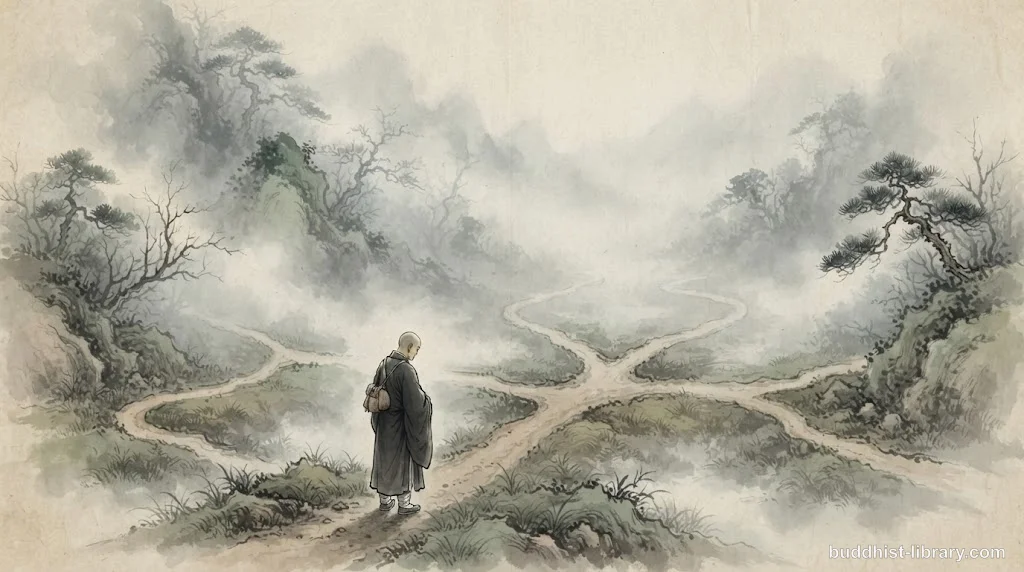
Vicikicchā is skeptical doubt that freezes you at the threshold of practice — questioning whether the path works, whether you’re doing it right, whether you should try something else instead. Unlike healthy inquiry, which investigates and moves forward, vicikicchā circles endlessly without commitment. The Buddha taught it as one of the five hindrances to meditation and the first fetter to be abandoned on the path to stream-entry.
What Does Vicikicchā Mean?
The Pali term vicikicchā is often translated as “doubt” or “skeptical doubt,” but it’s more specific than everyday uncertainty. The word combines vi- (apart, asunder) and cikicchā (thought, deliberation) — a mind split by indecision.
In Buddhist psychology, vicikicchā refers specifically to paralyzing doubt about:
- The Buddha — whether he was truly awakened
- The Dhamma — whether the teaching actually leads to freedom
- The Saṅgha — whether practitioners can actually achieve the fruits of the path
- The training — whether the practice you’re doing is correct or effective
- Your own capacity — whether you personally can succeed on this path
This isn’t the same as ordinary questions or healthy skepticism. Vicikicchā is the doubt that keeps you stuck, perpetually on the fence, unable to commit or practice wholeheartedly.
Why Did the Buddha Call Doubt a Hindrance?
The Buddha identified five hindrances (nīvaraṇa) that block meditation and obscure clear seeing. Doubt is one of these five, alongside sensual desire, ill will, sloth-torpor, and restlessness-worry.
Doubt is a hindrance because it paralyzes investigation. When vicikicchā is strong, you can’t settle into practice — you’re always second-guessing, comparing methods, wondering if you should be doing something else. This prevents the sustained, consistent effort needed for results.
In the Saṃyutta Nikāya (SN 46.51), the Buddha uses similes for each hindrance. For doubt, he offers the image of water stirred up and muddy, making it impossible to see your own reflection. When vicikicchā clouds the mind, you can’t see clearly what’s actually happening in your experience.
How Is Doubt Different from Healthy Inquiry?
Here’s the crucial distinction: the Buddha didn’t want blind followers. He actively encouraged investigation.
In the Kālāma Sutta, he told villagers not to accept teachings based on tradition, scripture, or even his own authority — but to test them against experience. The Buddha valued intelligent questioning.
The difference lies in outcome:
Healthy inquiry (dhamma-vicaya, investigation of phenomena) leads to:
- Active testing through practice
- Learning from direct experience
- Refinement of understanding based on results
- Forward movement on the path
Vicikicchā (paralyzing doubt) leads to:
- Endless research without practice
- Constant comparison between methods
- Changing techniques before giving any a fair trial
- Stagnation disguised as caution
A practitioner with healthy inquiry asks, “Does this work?” and then practices consistently to find out. A practitioner caught in vicikicchā asks, “Does this work?” but never commits long enough to know, always switching to the next thing.
How Does Doubt Arise in Practice?
Vicikicchā typically arises in several situations:
At the beginning — “Is this the right practice for me? Should I be doing vipassanā or samatha? Should I follow Mahāsi Sayadaw’s method or Pa Auk’s? What if I’m wasting my time?”
During difficulty — “This is hard. Maybe I’m not cut out for this. Maybe I should try a different approach. Other people seem to progress faster — what am I doing wrong?”
When comparing — “That teacher says one thing, this teacher says another. Which is the true Dhamma? How do I know I’m not being misled?”
Before commitment — “Should I take the precepts? Should I go on retreat? What if I fail? What if it’s not for me?”
The common thread: doubt prevents full engagement. It keeps you hovering at the edge, never diving in.
What Does the Buddha Say About Overcoming Doubt?
The traditional antidote to vicikicchā is investigation paired with commitment.
Investigation (Dhamma-Vicaya)
One of the seven factors of enlightenment is investigation of phenomena — actively examining your experience rather than theorizing about it.
The way through doubt isn’t more thinking. It’s direct investigation through practice. When you wonder whether mindfulness works, the solution isn’t reading ten more books on mindfulness — it’s sitting down and being mindful, consistently, and observing what happens.
Commitment to a Practice Period
The traditional advice is to commit to one method for a specific period — traditionally three months — without changing course. This isn’t blind faith; it’s a practical experiment. You’re not promising to believe forever; you’re promising to test this thoroughly before concluding it doesn’t work.
When vicikicchā arises during that period, you note it (“this is doubt”) and return to your practice, honoring your commitment. This trains you to work through doubt rather than letting it derail you.
Recollection of the Triple Gem
When doubt about the path arises, traditional practice includes recollection of the Buddha, Dhamma, and Saṅgha — not as dogma, but as inspiration and evidence.
You recall: others have walked this path and found freedom. The teachings are coherent and testable. You’re not inventing this path; you’re following one that has been walked successfully by countless practitioners over 2,500 years. This provides context that can steady the mind when doubt arises.
Association with Wise Friends
The Buddha emphasized kalyāṇamitta (spiritual friendship) as essential. Doubt spirals when you practice in isolation. But when you practice with others — or even just maintain connection with those further along the path — you gain perspective that cuts through what your own mind can’t see past.
Working with Doubt in Meditation
When vicikicchā arises during meditation:
1. Recognize it clearly. Label it: “doubting.” Don’t argue with it or try to think your way out. The content of doubt doesn’t matter — “maybe I should be doing body scan instead of breath” or “maybe I’m not doing this right” — the process of doubting is what you need to see.
2. Notice its characteristics. What does doubt feel like in the body? Often there’s a tight, contracted quality, or a restless, seeking energy. By investigating the experience of doubt rather than its content, you defang it.
3. Return to your object. You made a commitment to practice breath meditation (or whatever method you chose) for this session. Honor that commitment. Gently but firmly return attention to the breath.
4. Don’t feed it. Doubt loves to be entertained. If you start debating whether you should switch methods, you’re feeding it. The time to evaluate your practice is at the end of your commitment period, not in the middle of a sitting.
5. Soften around it. Sometimes doubt is tight and hard. You can meet it with a quality of loving-kindness or equanimity. “It’s okay that doubt is here. This is part of practice. I don’t need to solve this right now.”
Doubt as a Fetter
In the Buddha’s teaching on the ten fetters — the bonds that tie beings to continued suffering and rebirth — vicikicchā is the second fetter (after identity-view).
This doubt is completely abandoned at stream-entry, the first stage of awakening. Why? Because a stream-enterer has directly seen the Dhamma for themselves. They may not yet be fully liberated, but they’ve had enough direct experience of the path’s effectiveness that paralyzing doubt can no longer arise.
Before that point, vicikicchā can keep you from even stepping onto the path. After that point, you still have questions — you’re not omniscient — but you have verified confidence (saddhā based on experience, not blind faith) that this path leads where the Buddha said it leads.
Key Points
- Vicikicchā is paralyzing doubt that prevents wholehearted practice, distinct from healthy inquiry.
- The Buddha encouraged investigation, not blind belief — but investigation through practice, not endless theorizing.
- Doubt is one of the five hindrances to meditation and the second fetter abandoned at stream-entry.
- The antidote to doubt is commitment to a practice period and direct investigation through consistent effort.
- In meditation, recognize doubt when it arises, return to your object, and don’t engage with its content.
- Doubt dissolves through results — small confirmations from practice build verified confidence that no argument can provide.
Conclusion
Vicikicchā is the voice that says, “Maybe this won’t work. Maybe I should try something else. Maybe I’m not capable.” It’s one of the most common reasons people quit meditation before giving it a real chance.
The Buddha’s insight: you can’t think your way out of doubt. You practice your way through it. Commit to a method, practice it consistently, observe what happens. Small results — a moment of calm, a flash of insight, a slight shift in how you react — start building verified confidence that no intellectual argument can match.
The path doesn’t ask for certainty at the start. It asks for willingness to find out. When doubt arises, acknowledge it and return to the work. Give the practice a fair trial. Over time, as direct experience accumulates, vicikicchā loses its grip.
Read more:
- The Five Hindrances (Nīvaraṇa): Overcoming Obstacles to Meditation — Vicikicchā is one of five mental states that block meditation and clarity; this article covers all five hindrances and how they interact in practice.
- The Kālāma Sutta: The Buddha on Independent Inquiry and Free Thinking — The Buddha’s famous teaching encouraging skepticism and personal investigation, showing how healthy inquiry differs from paralyzing doubt.
- What Is Stream-Entry (Sotāpanna)? The First Stage of Buddhist Awakening — Stream-entry permanently removes vicikicchā; understanding this stage clarifies what it means to have doubt fully resolved through direct experience.
📖 Source / license: Saṃyutta Nikāya 46.51, Nīvaraṇa Sutta
Frequently asked questions
What is the difference between doubt (vicikicchā) and healthy inquiry?
Doubt is paralyzing skepticism that prevents action — you question everything endlessly without investigating. Healthy inquiry, encouraged by the Buddha in the Kālāma Sutta, is active investigation that tests teachings through practice and experience. Doubt says 'this might not work, so I won't try.' Inquiry says 'let me test this and see.'
Is doubt always bad in Buddhism?
Not all questioning is bad. The Buddha encouraged intelligent skepticism and investigation (dhamma-vicaya). What's problematic is vicikicchā — chronic, paralyzing doubt that stops you from practicing. Questioning that leads to investigation is wisdom. Questioning that leads to paralysis is a hindrance.
How do I know if I'm experiencing vicikicchā?
Vicikicchā manifests as constant second-guessing: 'Is this the right practice? Should I try something else? Can I actually do this?' It keeps you hovering at the edge of commitment, changing methods before giving any a fair trial, or endlessly researching rather than practicing. If your doubt prevents consistent practice, it's likely vicikicchā.
Can you practice Buddhism if you have doubts about rebirth or other teachings?
Yes. The Buddha didn't demand blind faith. Many contemporary practitioners focus on the directly observable aspects — suffering, its causes, and the path to its end — while setting aside cosmological teachings they can't verify. What matters is honest practice. Doubt becomes a hindrance only when it paralyzes all practice, not when it relates to specific doctrines you haven't verified for yourself.
What's the fastest way to overcome doubt in meditation?
Commit to one method for a set period (traditionally, at least three months) without changing course. Doubt thrives on comparison and switching. When vicikicchā arises, acknowledge it ('this is doubt'), recall your commitment, and return to the practice. Results from consistent practice — even small ones — naturally dissolve doubt better than any intellectual argument.