Anattā (Non-Self): What the Buddha Really Meant
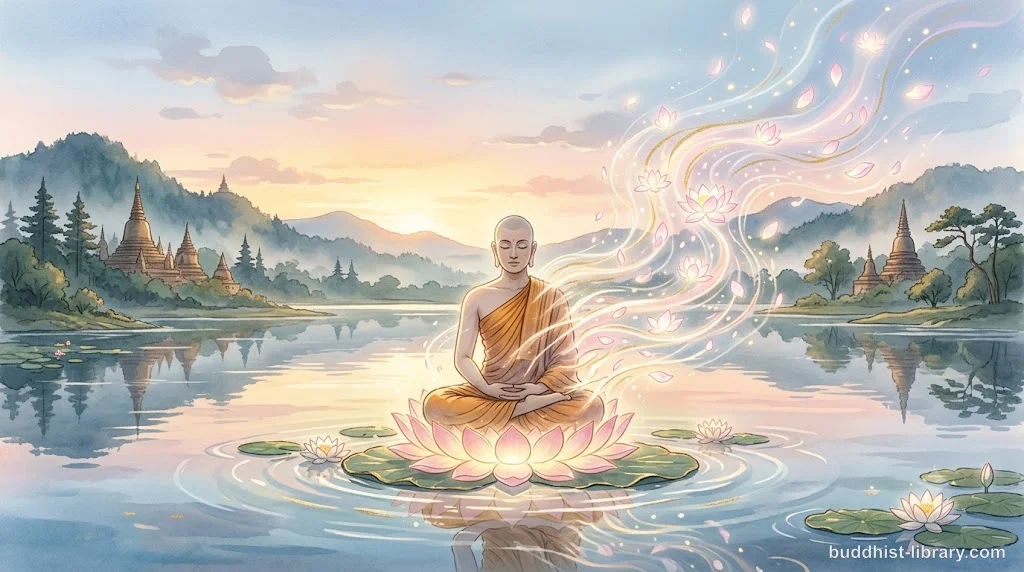
Anattā (non-self) doesn’t mean you don’t exist. It means there’s no permanent, unchanging essence called “I” or “mine” that survives scrutiny. The Buddha taught that clinging to any experience as self leads to suffering — and that releasing this grip brings profound freedom.
The teaching of anattā stands at the heart of Buddhist insight, yet it’s among the most misunderstood. Many hear “non-self” and think the Buddha denied personal existence entirely. Others worry it leads to nihilism or paralysis. But the Buddha’s actual teaching, preserved in the earliest texts, reveals something far more practical and liberating.
What Did the Buddha Actually Teach About Self?
In the Anattalakkhana Sutta (SN 22.59) — the second discourse after his awakening — the Buddha didn’t begin with abstract philosophy. He asked five monks to examine their direct experience through the lens of the five aggregates (khandhas): form, feeling, perception, mental formations, and consciousness.
His method was systematic. For each aggregate, he posed three questions:
- Is it permanent or impermanent?
- If impermanent, is it satisfactory or unsatisfactory?
- If impermanent and unsatisfactory, is it fitting to regard it as “This is mine, this is I, this is my self”?
The monks answered honestly: each aggregate is impermanent, therefore unsatisfactory, therefore not fit to be regarded as self.
This wasn’t a denial that bodies, feelings, and thoughts exist. It was a challenge to the assumption that any of them constitutes a stable, controlling entity. The Buddha’s point: nothing in your experience — body, emotions, thoughts, consciousness itself — can serve as the permanent “self” we habitually claim it to be.
Why Do We Believe in a Self?
The belief in an enduring self arises from a natural cognitive habit. We experience continuity of memory, recognize our reflection, and use “I” in language thousands of times daily. The sense of being a unified agent navigating the world feels undeniable.
But the Buddha distinguished between conventional truth (sammuti-sacca) and ultimate truth (paramattha-sacca). Conventionally, “I” is a useful linguistic tool. “I’m walking to the store” communicates clearly. The problem arises when we reify this convention — when we take the mental construct “I” and project it onto experience as a metaphysical fact.
Consider your body five years ago. Different cells, different weight, different appearance. Which version is the “real you”? Or your opinions at age fifteen versus now. If the self were permanent, it couldn’t change. If it changes, what makes it the same self?
The Buddha’s genius was showing that what we call “self” is a process masquerading as a thing — a dynamic flow of aggregates we freeze-frame and label “me.”
What Are the Five Aggregates (Khandhas)?
The Buddha analyzed experience into five categories, the pañca-khandhas:
- Form (rūpa) — physical body, material elements
- Feeling (vedanā) — pleasant, unpleasant, or neutral tones of experience
- Perception (saññā) — recognition, labeling, memory
- Mental formations (saṅkhāra) — volitions, intentions, habitual patterns
- Consciousness (viññāṇa) — awareness through the six sense doors (eye, ear, nose, tongue, body, mind)
None of these five, individually or collectively, qualifies as a permanent self. Each arises dependent on conditions and ceases when those conditions change.
Form depends on food, air, temperature. Feelings depend on contact with sense objects. Perceptions depend on past experiences. Mental formations depend on habitual conditioning. Consciousness depends on sense organs and objects meeting.
Where in this conditional flow is the independent, unchanging “I”?
The Buddha’s answer: nowhere. And clinging to any part of this flow as “me” or “mine” is the root of suffering (dukkha).
Common Misconceptions About Anattā
”Buddhism teaches you don’t exist”
This misreading confuses anattā with annihilationism. The Buddha explicitly rejected nihilism in the Kaccānagotta Sutta (SN 12.15), where he explained that existence and non-existence are both extremes. The Middle Way recognizes that experience happens — sensations, thoughts, actions occur — but they don’t belong to a permanent owner.
You exist as a process. You don’t exist as a fixed thing.
”Anattā means everything is an illusion”
The aggregates are real. Pain is real. Joy is real. What’s illusory is the story we add: “This pain is happening to me, a separate self who shouldn’t have to suffer.”
The illusion isn’t experience itself but the self-construct we impose on it.
”If there’s no self, moral responsibility disappears”
This concern assumes that only an eternal soul can bear moral weight. But the Buddha taught karma and rebirth through causal continuity, not soul-transmigration. Actions have consequences precisely because the stream of consciousness carries forward patterns.
Think of a river. Yesterday’s water isn’t today’s water, yet we call it the same river because of continuity. Likewise, this life’s choices shape future conditions, even without a soul passing between them.
How Anattā Leads to Freedom
Understanding anattā intellectually is one thing. Realizing it directly is liberation.
When you stop identifying with the aggregates, three transformations occur:
-
Suffering decreases. You still feel pain, but you don’t add the second layer: “Why is this happening to me?” The pain remains; the suffering around it softens.
-
Clinging releases. Opinions become preferences. Possessions become tools. Even pleasant experiences stop feeling like “mine to keep.” This non-clinging doesn’t breed apathy — it breeds freedom to engage without desperation.
-
Compassion expands. When “I” isn’t a fortress to defend, others stop being threats. The boundaries blur. What harms others harms the flow you’re part of; what helps them helps the whole.
The Dhammapada (verse 279) puts it simply: “All phenomena are not-self. When one sees this with wisdom, one turns away from suffering. This is the path to purity.”
Practicing Anattā: From Concept to Insight
Insight into anattā rarely arrives as a sudden revelation. It deepens through patient investigation.
Meditation on the Aggregates
Sit in meditation and observe each aggregate arising and passing:
- Notice physical sensations (form) — tingling, pressure, warmth. None lasts. None obeys your command to stay or go.
- Notice feelings (vedanā) — pleasant, unpleasant, neutral. They flicker based on conditions, not your will.
- Notice perceptions and thoughts (saññā, saṅkhāra) — mental chatter, planning, remembering. They arise uninvited. Are they “you”?
- Notice consciousness itself — the knowing of experience. Even awareness comes and goes (you weren’t aware during deep sleep). Where is the permanent knower?
Ask with each: “Is this me? Is this mine? Is this my self?” Let the question rest in experience rather than rushing to an answer.
Daily Life Investigation
Throughout the day, catch the moments of identification:
- Someone criticizes your work. Notice the contraction: “They’re attacking me.” Is the work you? Or is it a product of conditions (training, time, tools)?
- You achieve something. Notice the inflation: “I did this.” Trace the causes — teachers, opportunities, genetics, luck. How much belongs to a separate “I”?
- You feel anxious. Notice the thought: “I am anxious.” Is anxiety a fixed identity? Or is it a passing state in the aggregate of feeling?
This isn’t about denying conventional language. It’s about seeing through the reification — recognizing the difference between “Anxiety is present” and “I am an anxious person.”
The Three Marks Together
Anattā is one of the Three Marks of Existence (ti-lakkhaṇa):
- Anicca (impermanence) — all conditioned phenomena change
- Dukkha (unsatisfactoriness) — clinging to the impermanent brings suffering
- Anattā (non-self) — no unchanging essence can be found
These three reinforce each other. If something is impermanent, it can’t be a reliable self. If it’s unreliable, clinging to it as “mine” causes suffering. And suffering itself is not-self — it arises from conditions and ceases when those conditions change.
Contemplating all three together reveals the pattern: grasping at stability in a flowing process is the mechanism of suffering.
Anattā Across Buddhist Traditions
While anattā originates in the Pāli Canon’s Theravāda tradition, later schools developed the insight further.
Mahāyāna: Śūnyatā (Emptiness)
Mahāyāna Buddhism expanded non-self into śūnyatā (emptiness) — the teaching that all phenomena, not just persons, lack inherent existence. In texts like the Heart Sutra, this extends to dharmas (mental and physical events) themselves.
But the practical aim remains consistent: release from clinging by seeing that nothing possesses independent, intrinsic being.
Vajrayāna: Illusory Body
Vajrayāna practices visualize the body and self as illusory, using deity yoga to dismantle fixed identity. The method differs from Theravāda analysis, but the insight is the same: the self we habitually cling to is a fabrication.
Zen: Mu and No-Mind
Zen koans like “Does a dog have Buddha nature? Mu!” cut through conceptual self-construction. The practice of shikantaza (just sitting) allows thoughts and sensations to arise without claiming them as “mine.”
Each tradition uses different skillful means, but all point to the same liberating truth: the self you defend doesn’t exist the way you think it does.
Anattā and Modern Psychology
Contemporary psychology offers intriguing parallels to anattā, though with different frameworks.
The Default Mode Network
Neuroscience identifies the brain’s “default mode network” (DMN) — regions active during self-referential thinking. Meditation studies show that insight practices reduce DMN activity. Experienced meditators exhibit less self-referential processing, correlating with reports of non-dual awareness.
The Buddha didn’t know about neural networks, but he recognized the pattern: the habit of constructing a self-center is learned, not intrinsic — and it can be unlearned.
Psychological Flexibility
Acceptance and Commitment Therapy (ACT) teaches “self-as-context” — observing thoughts and feelings without identifying as them. “I’m having the thought that I’m worthless” differs from “I am worthless.”
This aligns with the Buddha’s teaching: experiences arise, but they don’t define an essence.
The Narrative Self
Research distinguishes the “narrative self” (the story we tell about who we are) from the “experiential self” (the raw feel of being). Buddhist practice emphasizes returning to the experiential, letting narratives form and dissolve without grasping them as truth.
Frequently Asked Questions
Does anattā mean there is no self at all?
Not exactly. Anattā means that what we call “self” is not a permanent, unchanging essence. The Buddha taught that clinging to any part of our experience as “me” or “mine” leads to suffering. It’s a teaching about freedom from identification, not a metaphysical claim that nothing exists.
If there’s no self, who is reborn?
The Buddha taught that rebirth happens through a process of causal continuity (dependent origination), not the transmigration of a soul. What continues is a stream of consciousness shaped by karma, similar to how a flame passes from one candle to another — the second flame isn’t the first, but it wouldn’t exist without it.
How do I practice anattā in daily life?
Start by observing moments when you take things personally. Notice the impulse to defend “my” opinion, “my” reputation, or “my” comfort. In meditation, observe sensations, thoughts, and emotions arising without claiming them as “mine.” This gradual loosening of identification reduces suffering.
Is anattā the same as emptiness (śūnyatā)?
They’re related but distinct. Anattā specifically addresses the absence of a permanent self in the five aggregates. Śūnyatā (emptiness), developed more fully in Mahāyāna Buddhism, extends this to all phenomena. Both point to the same liberating insight: clinging to fixed identities causes suffering.
Conclusion: The Freedom of No Fixed Self
The Buddha’s teaching on anattā remains as radical today as it was 2,600 years ago. It challenges the deepest assumption most of us carry: that somewhere inside is a core “me” separate from experience, observing it, controlling it, owning it.
But investigation reveals no such entity. There’s seeing, but no permanent seer. Thinking, but no fixed thinker. Suffering, but no eternal sufferer.
And in that absence lies liberation. When the illusion of self relaxes, so does the suffering built on defending it. What remains is fluid, responsive, compassionate engagement with life as it unfolds — no longer burdened by the question, “But what about me?”
As the Buddha concluded in the Anattalakkhana Sutta, after teaching his five companions about non-self, their minds were freed from clinging. Not because they disappeared, but because they stopped mistaking the flow for a fixed thing.
That freedom is available now. Not as a metaphysical belief to adopt, but as a direct seeing into the nature of your own experience.
Look closely. Where is the unchanging self? And what happens when you stop grasping for it?
Further Reading:
- The Four Noble Truths: The Heart of the Buddha’s Teaching
- What Is Dependent Origination (Paṭiccasamuppāda)?
- Impermanence (Anicca): Why Everything Changes
External Sources:
📖 Source / license: Anattalakkhana Sutta (SN 22.59), Bhikkhu Bodhi's Connected Discourses of the Buddha, Thanissaro Bhikkhu's translations on Access to Insight
Frequently asked questions
Does anattā mean there is no self at all?
Not exactly. Anattā means that what we call 'self' is not a permanent, unchanging essence. The Buddha taught that clinging to any part of our experience as 'me' or 'mine' leads to suffering. It's a teaching about freedom from identification, not a metaphysical claim that nothing exists.
If there's no self, who is reborn?
The Buddha taught that rebirth happens through a process of causal continuity (dependent origination), not the transmigration of a soul. What continues is a stream of consciousness shaped by karma, similar to how a flame passes from one candle to another — the second flame isn't the first, but it wouldn't exist without it.
How do I practice anattā in daily life?
Start by observing moments when you take things personally. Notice the impulse to defend 'my' opinion, 'my' reputation, or 'my' comfort. In meditation, observe sensations, thoughts, and emotions arising without claiming them as 'mine.' This gradual loosening of identification reduces suffering.
Is anattā the same as emptiness (śūnyatā)?
They're related but distinct. Anattā specifically addresses the absence of a permanent self in the five aggregates. Śūnyatā (emptiness), developed more fully in Mahāyāna Buddhism, extends this to all phenomena. Both point to the same liberating insight: clinging to fixed identities causes suffering.