What Is Upāya? Understanding Skillful Means in Buddhist Teaching
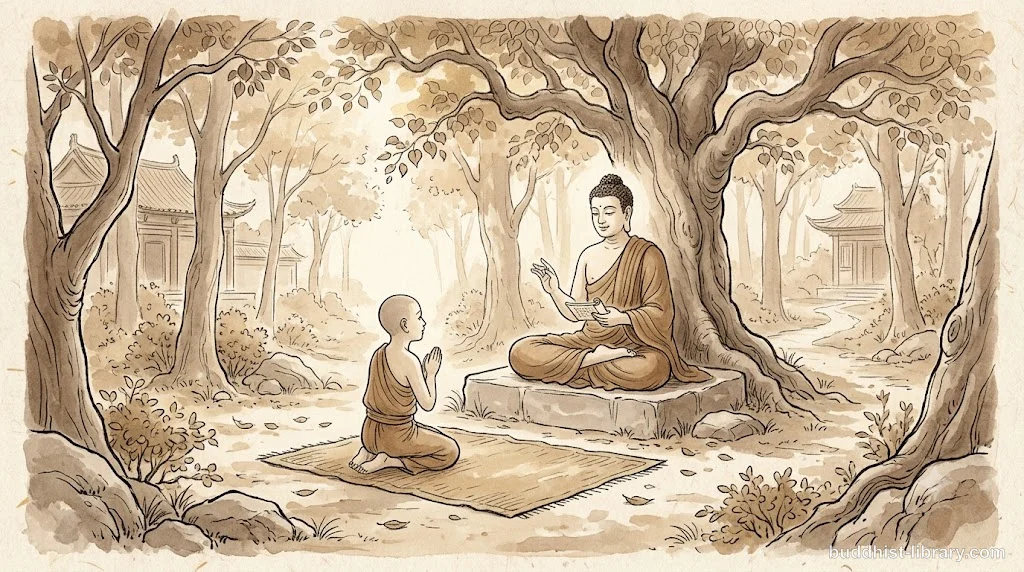
Upāya (Sanskrit) or upāya-kauśalya (“skillful means”) is the Buddhist teaching that the Dharma must be adapted to each student’s capacity, circumstances, and spiritual maturity. While the Buddha practiced this adaptive teaching throughout the Pali Canon—adjusting his message to suit different audiences—Mahāyāna Buddhism named the practice, systematized it as a doctrine, and made it central to its understanding of how enlightened beings teach.
What Does “Skillful Means” Actually Mean?
The Sanskrit term upāya means “means, expedient, or device,” while kauśalya (Pali: kosalla) means “skill.” Together, upāya-kauśalya describes the skill in choosing the right method or approach to guide someone toward awakening.
The core idea is simple: truth is one, but the paths to it are many. A skilled teacher recognizes that people have different temperaments, capacities, and starting points. What illuminates one person may confuse another. Skillful means is the wisdom to meet each student where they are.
In the Tevijja Sutta (DN 13), the Buddha demonstrates this perfectly. Two young brahmins ask him about the correct path to “union with Brahmā”—a theistic goal the Buddha doesn’t personally accept (his goal is the atheistic extinction of nibbāna). Rather than rejecting their question, he retains their religious terminology and gradually guides them from Vedic theism toward his own teaching on the brahma-vihāras (divine abodes). He adapts the Dharma to their conceptual framework, leading them step by step.
Did the Buddha Use Skillful Means?
Yes—constantly. Though the term upāya-kauśalya as a pedagogical doctrine is primarily Mahāyāna, the practice saturates the Pali Canon.
The Brahma Request Story
After his awakening, the Buddha initially hesitated to teach. He feared the Dharma was “too subtle, deep, and difficult to see” for people “dyed in lust, wrapped in darkness.” Only after Brahmā Sahampati’s eloquent plea—that some beings have “little dust in their eyes” and would understand—did the Buddha survey the world with compassion and resolve to teach.
His solution? Skillful means. He would adapt his teaching to accommodate students “with keen faculties and with dull faculties… easy to teach and hard to teach.”
Gradual Instruction (Anupubbi Katha)
The most common form of skillful means in early Buddhism is anupubbi katha—gradual or progressive instruction. The Buddha begins with preparatory teachings (generosity, ethics, the dangers of sensual pleasure) before advancing to complex philosophical points (the Four Noble Truths, dependent origination).
This sequence appears repeatedly. For example, in teaching the householder Upāli:
“Then the Blessed One gave the householder Upāli progressive instruction, that is, talk on giving, talk on virtue, talk on the heavens; he explained the danger, degradation, and defilement in sensual pleasures and the blessing of renunciation. When he knew that the householder Upāli’s mind was ready, receptive, free from hindrances, elated, and confident, he expounded to him the teaching special to the Buddhas: suffering, its origin, its cessation, and the path.”
The Buddha waits. He reads the student’s readiness. Only when the ground is prepared does he plant the seed.
Where Does the Term “Upāya” Appear in the Pali Canon?
The Pali term upāya-kosalla does appear in the early canon, but in a different sense than the Mahāyāna doctrine.
In the Saṅgīti Sutta (DN 33), Sāriputta lists three skills:
- Āya-kosalla (skill in progress)
- Apāya-kosalla (skill in regress)
- Upāya-kosalla (skill in means)
Bhikkhu Sujato notes in his translation that “these passages… are the earliest appearances of the phrase ‘skill in means’ (upāyakosalla) that would become famous in later Buddhism.”
However, the context here is skill regarding wholesome mental states—knowing how to cultivate them, how to abandon unwholesome states, and skillful methods for spiritual progress. It’s not explicitly about pedagogical adaptability, though the seed is there.
How Did Mahāyāna Develop the Doctrine?
Mahāyāna Buddhism took the Buddha’s adaptive teaching practice and made it a central philosophical and ethical principle. The doctrine of upāya-kauśalya reaches its fullest expression in the Lotus Sutra, particularly Chapter 2 (“Skillful Means”) and the famous Parable of the Burning House (Chapter 3).
The Burning House Parable
A father sees his children playing inside a house engulfed in flames, but they refuse to leave—they don’t understand the danger. So he tells them there are wonderful carts outside (goat carts, deer carts, ox carts). The children run out to claim the toys, and once safe, the father gives each child an even greater gift: a magnificent cart drawn by white oxen.
Did the father lie? Mahāyāna says no—he used skillful means. The promise of lesser rewards motivated beings to escape suffering; once they did, they discovered the true reward was far greater. The Buddha’s “lesser” teachings (Hīnayāna vehicles) were not false—they were appropriate means to lead beings toward the One Vehicle (ekayāna) of full awakening.
This parable grounds the Mahāyāna claim that the Buddha sometimes taught provisional doctrines suited to particular audiences, with the ultimate truth revealed later to those ready for it.
What’s the Difference Between Theravāda and Mahāyāna Views?
The core difference isn’t whether the Buddha adapted his teaching—both traditions agree he did—but how far that adaptation can go.
Theravāda Perspective
In Theravāda, skillful means is primarily pedagogical flexibility within ethical boundaries. The Buddha chose different explanations, examples, and sequences of teaching to suit different audiences, but he didn’t contradict the Dharma itself or break precepts to teach it.
The gradual instruction (anupubbi katha) is skillful means. Using Vedic terminology to teach brahmins (as in the Tevijja Sutta) is skillful means. Emphasizing different aspects of the teaching for monastics versus laypeople is skillful means.
But the underlying truth—impermanence, non-self, suffering, dependent origination—remains consistent.
Mahāyāna Perspective
Mahāyāna extends upāya further. Some Mahāyāna texts suggest that, out of compassion, an enlightened being might:
- Teach “provisional truths” as stepping stones to ultimate truth
- Use seemingly contradictory teachings for different audiences
- In extreme cases, even break precepts if it genuinely saves beings from greater suffering
The Vimalakīrti Sūtra, for instance, praises a layman who uses unconventional, even transgressive methods to awaken others. The Lotus Sutra claims earlier teachings were expedient means, with the full truth reserved for those ready.
This is debated and controversial. Critics argue it risks relativizing truth and ethics. Defenders say compassion sometimes requires going beyond conventional rules—but only for those with perfect wisdom and pure motivation.
How Is Upāya Practiced Today?
Modern Buddhist teachers across all traditions practice skillful means, whether they name it or not:
-
Language and Culture: Translating “Dharma” as “the way things are” for secularists, or “God’s law” for Christians exploring Buddhism, adapts the teaching without changing its essence.
-
Secular Mindfulness: Programs like MBSR (Mindfulness-Based Stress Reduction) strip Buddhist meditation of religious language to make it accessible in hospitals, schools, and corporations. Is this skillful means or dilution? Opinions differ.
-
Different Emphasis for Different Students: A teacher might emphasize mettā (loving-kindness) for someone struggling with anger, samatha (calm-abiding) for someone restless, or vipassanā (insight) for someone philosophically inclined.
-
Parables and Stories: Like the burning house parable, modern teachers use metaphors that resonate with contemporary life—addiction recovery, therapy, neuroscience.
The line between skillful adaptation and distortion is delicate.
Done well, upāya illuminates. Done poorly, it obscures.
What Are the Risks of Skillful Means?
1. Relativism
If every teaching is provisional, is there any ultimate truth? Mahāyāna answers yes—the ultimate truth is śūnyatā (emptiness) or Buddha-nature—but critics worry the doctrine invites anything-goes eclecticism.
2. Ethical Loopholes
Claiming “compassionate motivation” can justify breaking precepts opens the door to abuse. Who decides when a transgression is genuinely compassionate versus self-serving? Only an enlightened being has the wisdom; ordinary practitioners risk self-deception.
3. Infantilizing Students
If teachers withhold “ultimate truths” because students aren’t ready, when are they ready? And who decides? This dynamic can create dependency rather than awakening.
4. Fragmentation
If teachers adapt the Dharma endlessly to different contexts, do we still have a coherent tradition? Or a thousand mutually contradictory “Buddhisms”?
Theravāda tends to emphasize fidelity to the suttas as a safeguard. Mahāyāna tends to emphasize realization over doctrine, trusting awakened beings to adapt appropriately.
How Does This Relate to Other Buddhist Teachings?
Skillful means connects to several core Buddhist principles:
-
The Four Noble Truths: Upāya is the method; the Four Noble Truths are the content. The Buddha adapts how he teaches the Truths, not the Truths themselves.
-
Compassion (Karuṇā): Skillful means is compassion in action. It arises from the wish to alleviate suffering by meeting beings where they are.
-
The Middle Way: Just as the Middle Way avoids extremes of indulgence and self-mortification, skillful means avoids the extremes of rigid literalism and ungrounded relativism.
-
Wisdom (Paññā): Upāya requires discernment. A teacher must understand both the Dharma and the student deeply enough to choose the right door to open.
Conclusion: One Truth, Many Doors
The map is not the territory. The Buddha’s teachings are fingers pointing at the moon, not the moon itself.
A skilled teacher knows which finger to point with—and when to stop pointing and let the student see directly.
Call it upāya-kauśalya, anupubbi katha, or simply “good teaching”—the principle is ancient. Wisdom locked away helps no one. Compassion without skillful action may harm as much as heal.
The Buddha’s genius wasn’t just what he taught, but how. He adapted the deathless Dharma to a world of endlessly varied students, each walking their own crooked path toward the straight one.
Read more:
- The Tevijja Sutta: The Three Knowledges and the Path to Brahmā — A canonical example of the Buddha using skillful means to teach brahmins by meeting them in their own conceptual framework.
- Right Speech (Sammā Vācā): The Power of Wise Communication in Buddhism — How ethical communication and skillful speech are foundational to Buddhist practice—upāya applied to daily life.
- The Kālāma Sutta: The Buddha on Independent Inquiry — The Buddha’s teaching on testing claims for yourself, rather than accepting them on authority—a complement to the trust required in skillful means.
📖 Source / license: Saṅgīti Sutta DN 33 (trans. Bhikkhu Sujato, SuttaCentral), Tevijja Sutta DN 13, Lotus Sutra Chapter 2 (Mahāyāna), scholarly analysis from BuddhaNet
Frequently asked questions
Is upāya only a Mahāyāna concept?
No. The Buddha practiced skillful means throughout the Pali Canon, adapting his teaching to each audience. Mahāyāna Buddhism named this practice 'upāya-kauśalya' and made it a central doctrine, especially in the Lotus Sutra.
Does the Pali Canon use the term 'upāya'?
Yes, but rarely and in a different sense. The Saṅgīti Sutta (DN 33) mentions 'upāya-kosalla' (skill in means) as one of three skills, referring to skill regarding wholesome mental states—not the pedagogical doctrine Mahāyāna developed.
What is 'anupubbi katha' and how does it relate to upāya?
Anupubbi katha means 'gradual instruction'—the Buddha's method of teaching preparatory lessons before advanced topics. This is the basic form of skillful means in early Buddhism: adapting the Dharma to the student's spiritual maturity.
Can skillful means justify breaking precepts?
This is debated. Some Mahāyāna texts suggest compassionate motivation can override precepts in extreme cases. Theravāda tradition emphasizes that the Buddha's skillful means operated within ethical bounds—he adapted his explanation, not the truth itself.