The Aṅgulimāla Sutta: From Violence to Arahatship
The Aṅgulimāla Sutta tells one of Buddhism’s most dramatic stories: a mass murderer who became an enlightened monk in a single lifetime. The sutta demonstrates that genuine transformation is always possible, that past evil doesn’t determine future awakening, and that while karma’s consequences continue to ripen, liberation from suffering remains achievable for anyone who walks the path.
What Is the Aṅgulimāla Sutta?
The Aṅgulimāla Sutta (MN 86) is the 86th discourse in the Majjhima Nikāya (Middle Length Discourses) of the Pali Canon. It recounts the Buddha’s encounter with Aṅgulimāla, a violent criminal who terrorized the kingdom of Kosala, and his subsequent ordination, practice, and achievement of arahatship.
The sutta’s title comes from the protagonist’s name. “Aṅguli” means “finger” and “māla” means “garland.” He wore a necklace made from the fingers of his victims. Yet the discourse shows his complete transformation through the Buddha’s teaching.
This is one of the most psychologically compelling suttas in early Buddhism because it refuses to dodge hard questions. Can anyone change? Is redemption possible for those who have committed terrible acts? How does karma work when someone transforms completely?
The Story: Encounter and Transformation
The Chase That Couldn’t Succeed
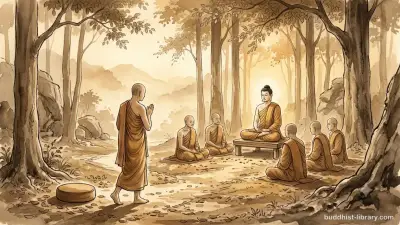
The sutta opens with King Pasenadi warning the Buddha about a dangerous bandit terrorizing the countryside. The Buddha continues his journey anyway. On the road, he encounters Aṅgulimāla.
When Aṅgulimāla sees the Buddha, he decides to kill him. But something extraordinary happens. Aṅgulimāla runs with all his strength, yet he cannot catch up to the Buddha, who is simply walking at a normal pace.
Exhausted, Aṅgulimāla calls out: “Stop, recluse! Stop!”
The Buddha replies: “I have stopped, Aṅgulimāla. You stop too.”
This paradoxical exchange becomes the turning point. The Buddha explains: “I have stopped forever, abstaining from violence toward living beings. But you have no restraint toward living things. That is why I have stopped and you have not.”
The Teaching of True Stopping
This “stopping” (Pali: ṭhita) represents more than physical stillness. The Buddha has stopped causing harm to living beings, creating new karma that leads to suffering, running in circles of craving and aversion. He has stopped the cycle of birth and death.
Aṅgulimāla, though physically running, has never truly stopped. He’s been driven by delusion, hatred, and the momentum of his own violent conditioning.
The Buddha’s words pierce through Aṅgulimāla’s armor. For the first time, he sees an alternative to the cycle of violence he’s been trapped in.
Ordination and Practice
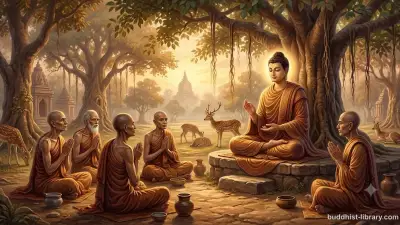
Moved by the Buddha’s fearlessness and teaching, Aṅgulimāla asks for ordination. The Buddha simply says: “Come, bhikkhu” — and Aṅgulimāla becomes a monk.
The sutta then describes his diligent practice:
“Then the Venerable Aṅgulimāla, living alone, withdrawn, diligent, ardent, and resolute, by realizing it for himself with direct knowledge, in this very life entered and dwelt in that supreme goal of the holy life for the sake of which clansmen rightly go forth from the home life into homelessness. He directly knew: ‘Destroyed is birth, the holy life has been lived, what had to be done has been done, there is no more coming back to any state of being.’”
He achieved arahatship — full liberation — becoming one of the Buddha’s enlightened disciples.
Karma Still Ripens: The Consequences of Past Actions
The sutta doesn’t present enlightenment as erasing the past. After his transformation, Aṅgulimāla goes on alms round and faces the karmic consequences of his former life.
People throw sticks and stones at him. They dump garbage on him. They strike him with weapons.
He returns to the Buddha with a broken bowl, torn robes, and a bleeding head. The Buddha tells him: “Bear it, brahmin! Bear it! You are experiencing here and now the result of deeds because of which you might have been tortured in hell for many years, many hundreds of years, many thousands of years.”
This is one of the sutta’s most profound teachings: spiritual liberation doesn’t erase karmic consequences. The fruit of past actions continues to ripen. But the enlightened mind experiences these results without creating new suffering, without the second arrow of mental anguish added to physical pain. (To understand how karma and rebirth actually work in Buddhism, see our detailed guide.)
The Truth-Act: A Protected Statement
Later in the sutta, a pregnant woman suffering from difficult labor asks Aṅgulimāla for help. He consults the Buddha, who teaches him a “truth-act” (saccakiriyā) — a solemn declaration of truth that carries protective power.
Aṅgulimāla says to the woman:
“Sister, since I was born with the noble birth, I do not recall intentionally depriving a living being of life. By this truth, may there be well-being for you and well-being for the fetus.”
This is startling. How can someone who killed many people make such a statement?
The key is “born with the noble birth” — meaning since his ordination as a monk, since his rebirth into the Dhamma. From that moment forward, he has not taken life. This isn’t a denial of his past but an affirmation of his complete transformation.
The truth-act works. The woman and child are delivered safely. This passage later became the Aṅgulimāla Paritta, a protective verse still chanted in Theravada Buddhism for the safety of mothers and infants.
What the Commentaries Add (and What’s in the Sutta)
It’s important to distinguish between what the canonical sutta contains and what later commentaries added:
In the sutta itself:
- Aṅgulimāla is a violent criminal wearing a garland of fingers
- The Buddha encounters and converts him
- He achieves arahatship through practice
- He faces violent retaliation from the public
- He performs the truth-act for the pregnant woman
From the commentaries (not in MN 86):
- His birth name was Ahiṃsaka (“harmless”)
- He studied under a corrupt teacher
- The teacher, jealous of his abilities, commanded him to kill 1,000 people
- He had killed 999 people and needed one more finger when he met the Buddha
- His mother was coming to warn him, and he would have killed her to complete the thousand
These dramatic details appear in the Dhammapada Commentary and other later sources. They make the story more vivid but aren’t part of the canonical sutta. When studying early Buddhist texts, this distinction matters — canonical suttas carry different authority than commentarial elaborations.
Key Teachings from the Sutta
1. Transformation Is Always Possible
No one is beyond redemption. Even someone who has committed the most horrific acts can achieve complete awakening in this very life. The past doesn’t lock you into a fixed identity.
2. Stopping Means Ending Harm
True “stopping” isn’t about physical stillness but about ceasing to cause harm, ceasing to create new karma, ceasing to be driven by greed, hatred, and delusion.
3. Karma Continues Even After Enlightenment
Liberation doesn’t erase past karma. The results of previous actions continue to ripen. But the enlightened mind experiences them without creating new suffering.
4. The Noble Birth
Spiritual rebirth — taking refuge in the Buddha, Dhamma, and Sangha — creates a genuine new beginning. While the consequences of past actions remain, the person has fundamentally changed.
5. Truth Has Power
The saccakiriyā (truth-act) demonstrates that sincere transformation, clearly stated, has protective and beneficial power.
How This Sutta Applies Today
For Those Struggling with Their Past
If you carry guilt, shame, or regret about past actions, the Aṅgulimāla Sutta offers a radical message: your past doesn’t determine your future. Genuine transformation is possible. While you may still face consequences of past actions, you can fundamentally change who you are.
For Those Working with Difficult People
The sutta challenges us to see the potential for change in everyone. The Buddha didn’t reject Aṅgulimāla, didn’t condemn him as irredeemable. He saw the possibility of awakening even in someone actively engaged in violence.
Understanding Karma Properly
The sutta clarifies that karma isn’t about cosmic punishment or reward. It’s about cause and effect. Past actions have consequences that ripen over time. But creating new wholesome karma, transforming one’s mind, and achieving liberation are always possible — regardless of the past.
The Practice of Bearing Consequences
“Bear it, brahmin! Bear it!” When facing the results of our past actions, the practice is to accept them without creating additional mental suffering, without the second arrow of blame, shame, or resentment.
The Paradox at the Heart of the Sutta
There’s a paradox here worth sitting with. Aṅgulimāla’s past was terrible, his karma heavy, his future seemingly dark. Yet through encounter with the Dhamma and committed practice, he achieved the highest goal in a single lifetime.
This suggests that the depth of past suffering can become the fuel for deep practice. Someone who has experienced the full horror of delusion and hatred may practice with an urgency and sincerity that leads to rapid awakening.
The sutta doesn’t romanticize his past crimes. It doesn’t minimize the harm he caused. It insists that transformation is real, that the path to liberation remains open to everyone.
Conclusion: The Finger-Garland Monk
The Aṅgulimāla Sutta remains one of Buddhism’s most powerful testimonies to the possibility of change. A man who wore a garland of his victims’ fingers died to his old self and was reborn as a follower of the Buddha. He practiced with diligence, faced the consequences of his past with equanimity, and achieved complete liberation.
His story asks us: Who is beyond redemption? Who cannot change? Who is excluded from the path?
The Buddha’s answer, demonstrated through action, is clear: no one.
If Aṅgulimāla could stop, transform, and awaken, then the path remains open to all of us — regardless of our past, regardless of what we think defines us, regardless of the garlands we’ve worn.
The question is simply: Are we willing to truly stop?
Read more:
- What Is Dependent Origination (Paṭiccasamuppāda)? — Understand the chain of causation that traps beings in suffering and how breaking even one link can lead to liberation, as Aṅgulimāla did when he encountered the Buddha.
- Karma and Rebirth in Buddhism: How They Actually Work — Explore the mechanics of karma and rebirth to understand why Aṅgulimāla still faced violent retaliation even after achieving arahatship and how past actions continue to ripen.
- The Dhammapada: An Introduction to the Buddha’s Verses — Discover the collection of the Buddha’s most memorable teachings, which includes verses about transformation and the power of changing one’s mind.
📖 Source / license: Majjhima Nikāya 86 (MN 86), translated by Bhikkhu Bodhi (The Middle Length Discourses of the Buddha) and Thanissaro Bhikkhu (available at Access to Insight / dhammatalks.org)
Frequently asked questions
Who was Aṅgulimāla before meeting the Buddha?
Aṅgulimāla was a serial killer who had killed many people. The sutta itself doesn't specify the exact number, though later commentaries mention 999 victims. He wore a garland of fingers from his victims, which is what his name means: 'finger-garland.'
Can someone who has committed terrible crimes achieve enlightenment?
Yes. The Aṅgulimāla Sutta demonstrates that even someone who has committed the most heinous acts can achieve full awakening (arahatship) in a single lifetime through sincere practice and transformation. Past actions don't prevent future liberation.
Why did people still fear and attack Aṅgulimāla after his ordination?
The sutta shows that while spiritual transformation is possible, the karmic consequences of past actions still ripen. People continued to fear and attack him because they remembered his crimes. This illustrates that enlightenment doesn't erase the results of past karma, though it ends future suffering.
What is the 'truth act' (saccakiriyā) that Aṅgulimāla performed?
When a woman in difficult childbirth sought his help, Aṅgulimāla performed a declaration of truth, stating: 'Sister, since I was born with the noble birth, I do not recall intentionally depriving a living being of life. By this truth, may there be well-being for you and well-being for the fetus.' This truth-act brought relief to the woman.