The Nivāpa Sutta: The Buddha's Teaching on Māra's Snares and Freedom

The Buddha taught that Māra sets snares for contemplatives just as a hunter baits deer. Most spiritual seekers, despite clever strategies, remain trapped. Only those who develop the jhānas dwell where Māra cannot reach—a freedom beyond avoidance or indulgence.
What Is the Nivāpa Sutta?
The Nivāpa Sutta—“Bait” or “Poison-grass”—is the 25th discourse in the Majjhima Nikāya.
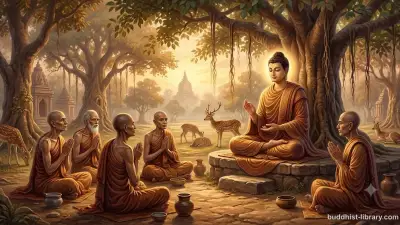
It’s a parable. Four herds of deer. One poison-grass sower. The spiritual landscape mapped through metaphor.
Direct instruction? Not here. This teaching works through metaphor, showing monks the terrain itself: where practitioners get caught, why strategies fail, what real freedom looks like.
The teaching targets contemplatives. People who’ve already committed. People who practice seriously but haven’t found a way out of Māra’s reach yet.
Who Is the Poison-Grass Sower?
The poison-grass sower doesn’t scatter his bait because he wants deer to “be long-lived and handsome.” He does it so they’ll become intoxicated. Heedless. So he can do with them as he likes.
This sower is Māra, the Evil One.
Not exactly a devil in the Western sense. Māra personifies death, delusion, and everything that keeps beings cycling in saṃsāra. His followers represent the forces that distract, confuse, trap.
The poison-grass? The five strings of sensuality—sights, sounds, smells, tastes, tactile sensations. Not inherently evil, but alluring enough that beings become intoxicated and forget what they’re doing.
The unsettling part is the intention. Māra doesn’t tempt out of cruelty. He baits because it works. Sense pleasure is strategic bait, not random temptation. Most of us take it willingly.
What Happens to the First Herd?
The first herd ventures straight into the poison-grass. Eats without caution.
They become intoxicated. Then heedless. Then the sower does with them as he likes.
The Buddha identifies this group as contemplatives who “venture unwarily into the poison-grass and baits of the world.” They indulge in sense pleasures, lose their way, fall entirely under Māra’s control.
This isn’t about laypeople living ordinary lives. It’s about spiritual seekers who set out to train but never establish the discipline that makes freedom possible. They may wear robes, sit in meditation halls, call themselves practitioners. But they’re eating the bait.
No elaborate escape strategy.
Just heedlessness.
How Does the Second Herd Fail?
The second herd watches the first get trapped. Decides: total avoidance.
They refuse all poison-grass, flee to the wilderness, subsist on wild foods—greens, millet, hide-parings, moss, rice-bran, fallen fruits. Withdrawal will save them, they think.
But the hot season comes. Grass and water dry up. Their bodies grow gaunt. They lose strength. They lose concentration. Eventually, weakened and desperate, they return to the poison-grass.
The Buddha describes this group as extreme ascetics. They avoid “the baits of the world,” practice severe austerities, but never develop the jhānas. When conditions turn harsh, they lose their meditation (the text says they “lost their awareness-release”). Craving pulls them back.
Deprivation without depth doesn’t work. You can’t starve Māra out.
You need something to stand on.
What About the Third Herd?
The third herd is more sophisticated. They study the first two failures. Decide on a middle approach.
Live near the poison-grass but don’t venture into it unwarily. Eat carefully. Stay restrained.
It works—for a while. They don’t become intoxicated or heedless. Māra can’t trap them with craving.
Then they start speculating.
Is the cosmos eternal or not? Finite or infinite? Is the soul the same as the body? Does a Tathāgata exist after death or not?
These contemplatives get tangled in metaphysical views. The poison-grass sower and his followers surround the area with stick snares, discover where they hide, trap them anyway.
This group represents practitioners who develop restraint, even some concentration, but substitute philosophical speculation for direct insight. They live carefully, avoid gross indulgence, but get caught in conceptual tangles—the very views the Buddha warned against in suttas like the Brahmajāla Sutta.
Cleverness isn’t freedom.
How Does the Fourth Herd Escape?
The fourth herd takes up residence “where the poison-grass sower and his followers cannot go.”
Not in the wilderness. Somewhere beyond reach.
They eat without venturing unwarily, don’t become intoxicated, don’t become heedless. Māra and his followers try to find them. Fail.
So Māra leaves them alone. “If we scare them off, they’ll scare off the others. Why show concern for this herd?”
That’s how the fourth herd escapes Māra’s power entirely.
The Buddha doesn’t spell out the location directly, but the teaching is clear from context and commentary: the fourth herd represents contemplatives who develop the jhānas—states of meditative absorption outside the range of sensual craving.
The jhānas aren’t avoidance. They’re alternative nourishment.
When a practitioner can access deep concentration and inner rapture (pīti) and happiness (sukha), external pleasures lose their grip. You’re not resisting the bait through willpower. You’re simply not interested anymore.
Māra can’t follow you there. The sower and his followers “cannot go” where the fourth herd dwells. Sensual craving doesn’t operate in jhāna. Speculation doesn’t arise.
You’re off the board.
The Dvedhāvitakka Sutta describes the Buddha’s own path this way: abandoning thoughts of sensuality, ill will, and harm in favor of renunciation, goodwill, and harmlessness—then deepening into concentrated states where even wholesome thoughts quiet down.
What Are the Key Takeaways?
The Nivāpa Sutta maps four responses to Māra’s snares:
Indulgence leads to intoxication and capture. No matter how sincere your intention, heedlessness in sense pleasure traps you.
Asceticism without concentration fails under pressure. You can’t out-deprive Māra. Willpower alone runs out.
Restraint plus speculation still gets you caught. Living carefully but getting lost in views is a sophisticated trap. Still a trap.
Only the jhānas put you beyond Māra’s reach. Not through suppression. Through accessing a deeper satisfaction that makes the bait irrelevant.
The teaching isn’t about moral superiority. It’s strategic.
If you’re serious about freedom, you need concentration deep enough that Māra’s preferred tools—craving, distraction, conceptual proliferation—lose their function.
That’s where Māra gives up. Not because you’ve fought hard enough. Because you’ve moved somewhere he can’t operate.
Why Does Māra Leave the Fourth Herd Alone?
This detail is striking.
Māra doesn’t exhaust himself chasing the fourth herd. He deliberately ignores them.
“If we scare off the fourth herd, they’ll scare off others, and then all the herds will abandon this poison-grass.”
Tactical retreat. Māra knows he can’t reach practitioners who’ve established themselves in jhāna. Pursuing them would advertise that there is a way out—which might inspire the others.
Better to let a few escape quietly than to make liberation look achievable to everyone still nibbling at the bait.
This isn’t paranoia. It’s a sober look at how craving and delusion operate.
The path isn’t hidden because some cosmic force is concealing it. It’s obscured because most beings never try the one thing that actually works: sitting still, calming the mind, developing concentration until the pull of sense pleasure becomes irrelevant.
The fourth herd doesn’t defeat Māra through force.
They simply stop playing his game.
How Does This Apply to Practice Today?
If you’re reading this, you’re probably not in the first herd. You’re not indulging heedlessly. You know sense pleasure can trap you.
But which of the other three are you in?
The second herd tries to escape through extreme restraint—strict diets, isolation, rigid discipline—without developing samādhi. When life gets difficult (injury, illness, loss, burnout), the restraint collapses. Old cravings resurface.
The third herd practices moderately. Avoids gross indulgence. But spends energy on debates, views, theories. They read endlessly about enlightenment, argue about meditation techniques, analyze consciousness. Rarely sit long enough to touch jhāna.
The fourth herd sits.
They develop ānāpānasati, mettā, or another concentration practice until the mind settles into stillness. They taste the rapture and peace of the first jhāna, then the second, and so on. Once they know that inner nourishment, working with sense desire becomes straightforward—not because they’re resisting harder, but because they’re no longer hungry for what the world offers.
The sutta suggests that true freedom isn’t about better willpower. It’s about better food.
When the mind has access to the bliss of concentration, the five strings of sensuality stop being irresistible. They’re still there. But they’re not compelling.
Māra’s bait remains, but you’re already full.
Conclusion: Where Māra Cannot Go
The Nivāpa Sutta doesn’t promise the path will be easy. Doesn’t promise Māra will give up trying.
It promises something simpler: there is a place Māra cannot reach.
Not a physical location. Not a philosophical position.
A state of mind.
The jhānas aren’t the end of the path. They’re the refuge that makes the rest of the path navigable. From that stable ground, you can develop the insight (vipassanā) that leads to full awakening.
But if you never establish that ground—if you keep trying to defeat Māra through better ideas, stricter rules, stronger willpower—you’ll likely end up like the first three herds.
Clever, sincere, and still trapped.
The fourth herd escaped not because they were more virtuous. Because they went where Māra’s tools don’t work.
That place is open. It’s where the Buddha himself dwelled before his awakening, and where he pointed every serious practitioner afterward.
You can go there too.
Read more:
- The Dvedhāvitakka Sutta: Two Kinds of Thought Before Enlightenment—the Buddha’s own account of how he sorted wholesome from unwholesome thinking and developed the concentration that led to awakening.
- What Are the Jhānas? Understanding Meditative Absorption in Buddhism—a complete guide to the states of deep concentration the Nivāpa Sutta points toward as the refuge beyond Māra’s reach.
- Working with Sense Desire in Buddhist Practice—practical guidance on how to skillfully relate to the very craving Māra uses as his primary snare.
📖 Source / license: MN 25, translated by Ṭhānissaro Bhikkhu (dhammatalks.org)
Frequently asked questions
What is the Nivāpa Sutta about?
The Nivāpa Sutta (MN 25) is a parable the Buddha taught using four herds of deer and a poison-grass sower to illustrate how different groups of contemplatives respond to sense pleasures—Māra's bait. It shows why only those who develop the jhānas truly escape Māra's power and control.
Who is the poison-grass sower in the parable?
The poison-grass sower represents Māra, the personification of death and delusion in Buddhism. The poison-grass symbolizes the five strings of sensuality. Māra doesn't want practitioners to be happy—he wants them trapped in heedlessness so he can "do with them as he likes."
What do the four herds of deer represent?
Each herd represents a different type of contemplative or spiritual seeker. The first three herds fail to escape Māra despite different strategies—indulgence, extreme asceticism, and middle-way restraint coupled with metaphysical speculation. Only the fourth herd, dwelling in the jhānas (where Māra cannot reach), finds true freedom.
What are the jhānas and why can't Māra reach them?
The jhānas are states of deep meditative absorption characterized by refined concentration and inner peace. The Buddha describes them as a place "where the poison-grass sower and his followers cannot go"—beyond the range of sensual craving and distraction that gives Māra his power.
Does this sutta mean all sense pleasure is wrong?
Not exactly. The sutta teaches that indulgence in sense pleasure leads to intoxication and heedlessness, but total renunciation without developing concentration leads practitioners back to craving when conditions get difficult. The skillful response is to develop jhāna—inner nourishment that makes external pleasure irrelevant rather than forbidden.