The Bhayabherava Sutta: The Buddha on Overcoming Fear and Terror
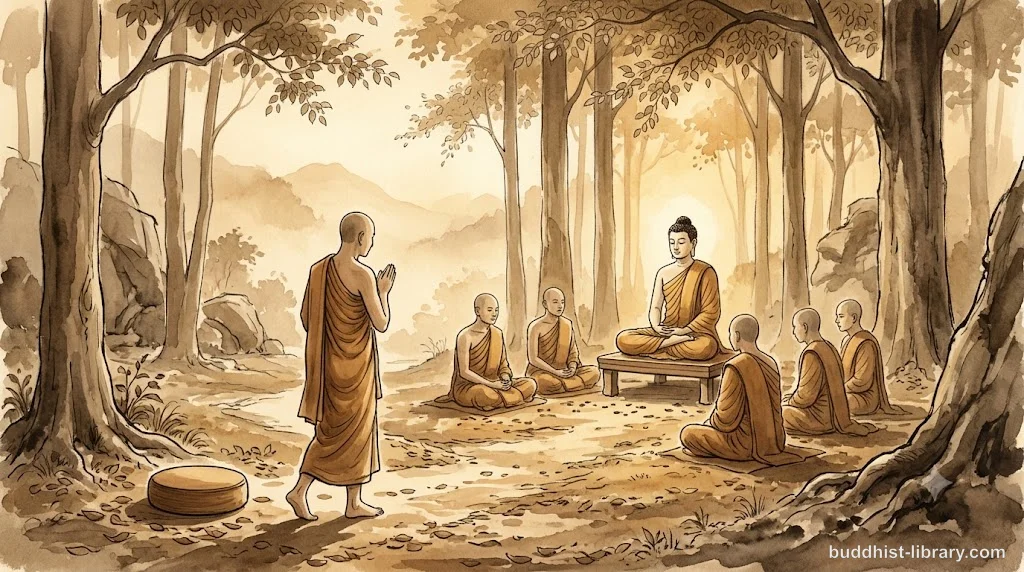
Before the Buddha’s enlightenment, he spent months alone in terrifying wilderness places — ancient charnel grounds, hollow trees, remote forests where even seasoned renunciants fled in panic. The Bhayabherava Sutta (MN 4) records how he systematically faced and transcended paralyzing fear, not through suppression or bravery, but through clear seeing and presence. His method offers a practical map for working with any terror that freezes us.
What Is the Bhayabherava Sutta?
The Bhayabherava Sutta — literally the “Discourse on Fear and Terror” — is the fourth discourse in the Majjhima Nikāya (Middle Length Discourses). It’s one of the rare suttas where the Buddha speaks autobiographically, recounting his intensive practice before his awakening under the Bodhi tree.
The setting: the Buddha is teaching a brahmin named Jāṇussoṇi, who asks how someone of noble birth could leave the household life and not fall back into complacency. The Buddha responds by describing a specific training he undertook — deliberately seeking out the most frightening places in the wilderness and staying there until all fear dissolved.
This isn’t metaphor. The text names specific locations: empty huts in cremation grounds, roots of trees in dense jungle, caves in remote hills. These were places where wild animals prowled, spirits were said to roam, and solitude pressed down like a physical weight.
Why Did the Buddha Practice in Fearsome Places?
The Buddha explains his motivation clearly: he wanted to understand fear at its root, not avoid it. He’d observed that many renunciants practiced in comfortable settings, and when unexpected fear arose — in the wilderness, in illness, facing death — they were unprepared. Their composure crumbled.
So he made fear his teacher. He writes (in Ṭhānissaro Bhikkhu’s translation):
“Whatever posture I was in when fear and terror came upon me — whether walking, standing, sitting, or lying down — I would not change that posture until I had subdued that fear and terror right there in that posture.”
This is radical. Most of us, when fear hits, immediately do something — flee the situation, distract ourselves, rationalize it away. The Buddha’s method was the opposite: stay exactly where you are, in the posture you’re in, and watch the fear until it exhausts itself.
How Did the Buddha Overcome Fear? The Three Foundations
The sutta describes three conditions that allowed the Buddha to face terror without collapsing:
1. Ethical Purity (Sīla)
The Buddha first establishes that he had “purified his bodily conduct” and “purified his verbal conduct” — meaning he’d kept the precepts impeccably and harbored no remorse. This is the foundation.
Why does ethics matter when facing fear? Because most human anxiety has a component of guilt or anticipated consequence. We fear being found out, punished, exposed. When your conduct is blameless, that entire layer of fear vanishes. You face the raw sensation without the story.
As he puts it: “When a bhikkhu’s bodily conduct is purified… verbal conduct is purified… mental conduct is purified… he obtains gladness. For one who is gladdened, rapture arises.”
The sequence: purity → gladness → rapture → tranquility → concentration. The ethical foundation generates the mental strength to face fear.
2. Concentration Practice (Samādhi)
The Buddha had already developed deep concentration through jhāna practice (meditative absorption). When terror arose in the forest — sounds, shadows, the sheer weight of isolation — he had the internal anchor of samādhi to return to.
Concentration doesn’t eliminate fear, but it gives you a stable base. You can feel the heart racing, the chest tightening, the impulse to flee, and simultaneously remain unshaken in awareness. The fear passes through you instead of carrying you away.
3. Understanding the Nature of Fear
This is the insight layer. The Buddha observed that fear arises from the mind’s unwholesome states — specifically from sensual desire, ill will, sloth-torpor, restlessness, and doubt (the five hindrances).
When you’re gripped by craving or aversion, everything feels threatening. The rustle in the bushes becomes a predator; the silence becomes abandonment; solitude becomes unbearable. But when these mental states are temporarily abandoned — even for a moment — the fear has no foothold.
The Buddha’s realization: “I thought, ‘When a deer or peacock treads on a twig and it snaps, fear and terror arise in me. Why don’t I subdue that fear and terror while remaining in whatever posture it arises?’”
He turned fear into a laboratory.
What Happened When the Buddha Stayed with Fear?
The sutta describes the process with clinical precision:
- Fear arises — a sound, a shadow, the feeling of being watched, the sheer strangeness of being utterly alone.
- The impulse to flee — the body wants to move, to change posture, to leave.
- He stays — walking if he was walking, sitting if he was sitting, lying down if he was lying down.
- He observes the fear — its physical sensations, its mental component, its impermanence.
- The fear subsides — not because he “conquered” it with willpower, but because he gave it nothing to grip onto.
Repeated hundreds of times across weeks and months, this process rewires the nervous system. The fear doesn’t stop arising, but its authority dissolves. It becomes just another phenomenon — unpleasant, yes, but not a command.
Eventually, the Buddha reports, he could stay in those fearsome places all night, unmoved by any terror.
The Four Stages of Confronting Fear
Buried in the sutta is a practical roadmap:
Stage 1: Recognition — Name the Fear Clearly
The Buddha doesn’t say “I felt uneasy.” He says “fear and terror arose” — bhaya and bherava, two distinct Pali words. Bhaya is the background dread, the creeping unease. Bherava is the acute spike, the panic.
Naming fear precisely robs it of some power. “I feel afraid” is vague and overwhelming. “I feel a tightness in my chest and an impulse to flee” is specific and workable.
Stage 2: Examination — Is the Danger Real or Imagined?
The Buddha was alone in the wilderness, yes, but he wasn’t actually in imminent danger most of the time. Wild animals are more frightened of humans than vice versa. The “spirits” he might have feared were cultural stories, not present threats.
He realized: “This fear is arising from my own mind, not from the external situation.”
Most human fear is anticipatory. We’re afraid of what might happen — rejection, failure, illness, death — not what is happening right now. The Buddha learned to distinguish between the two.
Stage 3: Presence — Stay with the Sensation
This is the core instruction: don’t change your posture. If you’re sitting, keep sitting. If you’re walking, keep walking. Don’t flee, don’t distract, don’t rationalize.
Just feel the fear — the rapid heartbeat, the cold sweat, the tightness in the throat — and let it be there. Fear is an energy that wants to move through you. Resistance makes it lodge in place.
The Buddha discovered what modern neuroscience confirms: fear has a natural lifespan. If you don’t feed it with story or suppress it with force, it peaks and then subsides, usually within minutes.
Stage 4: Release — Watch It Dissolve
The sutta uses the word abhibhūtaṃ — subdued, mastered, overcome. But the verb is passive in tone: the fear is subdued by being fully met, not by being fought.
This is why the Buddha’s method isn’t “be brave” or “ignore the fear.” It’s “stay present until the fear realizes it has no job to do.”
Key Principles from the Bhayabherava Sutta
- Fear thrives on movement. The impulse is to flee, distract, or fight. Stillness starves fear of its fuel.
- Ethical purity is foundational courage. When you have nothing to hide, you face the world unburdened.
- Concentration provides the anchor. Without it, fear sweeps you away; with it, you remain unmoved.
- Fear is impermanent. It arises, it peaks, it passes — if you don’t feed it.
- Solitude reveals what you’re carrying. In the wilderness, there’s nowhere to hide from your own mind.
How Can Modern Practitioners Apply This Teaching?
You don’t need to camp in a cremation ground (though some traditions still do). The Bhayabherava Sutta’s method applies to any fear:
1. Identify Your “Wilderness”
What situation makes you want to flee? Public speaking? Confrontation? Uncertainty? Financial insecurity? That’s your wilderness.
2. Establish Your Foundation
Before you face fear, shore up the basics:
- Ethics: Are you living in a way you can defend? Clear up any major sources of remorse.
- Concentration: Even 10 minutes of daily breath meditation gives you an anchor.
3. Choose to Stay
The next time fear arises — in a difficult conversation, a moment of uncertainty, a quiet evening alone — resist the urge to immediately change your state. Don’t grab your phone, don’t pour a drink, don’t flee into busyness.
Sit with it. Walk with it. Lie with it. In that exact posture.
4. Observe Without Story
Fear has two components: the raw physical sensation (tight chest, racing heart), and the narrative (“I’m going to fail / be rejected / lose everything”).
Let the narrative go. Just feel the sensations. Most of the suffering is in the story, not the sensation.
5. Repeat Until It Loses Authority
The Buddha didn’t face fear once. He did it hundreds of times over months. Each repetition weakened fear’s grip a little more.
You’re not trying to become fearless (that’s psychopathy). You’re learning that you can remain functional and aware while fear is present.
The Brahmin’s Response — And Ours
At the end of the sutta, Jāṇussoṇi the brahmin says (paraphrased): “Venerable sir, you speak as one who has dwelt in those fearsome places. Some renunciants boast of their courage, but you actually went there and stayed.”
The Buddha’s method isn’t theoretical. Face the thing, stay with it, observe what happens. Repeat.
Fear is universal. So is the capacity to meet it without flinching.
FAQ
1. Did the Buddha ever feel fear after his enlightenment?
The sutta describes his pre-enlightenment practice. After awakening, the texts say he was “beyond fear” — not because fear-sensations never arose, but because the craving and aversion that amplify fear were eliminated. He could still register danger (he avoided aggressive elephants, poisoned food, etc.) but without the existential dread that grips unawakened beings.
2. Is the Bhayabherava Sutta’s method safe for people with trauma or PTSD?
Proceed cautiously. The Buddha’s method assumes a stable baseline (ethical purity, concentration, mental health). If you have acute trauma, titration (working with fear in small, manageable doses under guidance) is wiser than the Buddha’s full-immersion approach. Consult a trauma-informed therapist or meditation teacher before attempting intensive fear-practice.
3. What if the fear doesn’t subside after staying with it?
Sometimes fear persists because there’s a real danger you’re ignoring (abusive relationship, unsafe environment, untreated illness). The Buddha’s method assumes you’ve ruled out genuine threats. If fear remains after honest presence, investigate: Is there an action you need to take? A boundary to set? Fear can be information, not just noise.
4. Are there other Buddhist texts on overcoming fear?
Yes — the Dhajagga Sutta (SN 11.3) teaches recollection of the Buddha, Dhamma, and Sangha as antidotes to fear. The Girimānanda Sutta (AN 10.60) includes “perception of death” as a way to put everyday fears in perspective. The Bhayabherava Sutta is unique in its phenomenological detail — the Buddha narrating exactly how he worked with fear sensation by sensation.
5. Can laypeople practice in “fearsome places” as the Buddha did?
Few modern settings replicate the 5th-century BCE Indian wilderness, but the principle holds: practice in situations that trigger your personal edge of discomfort. A solo backpacking trip. A silent retreat. A difficult conversation you’ve been avoiding. The “fearsome place” is wherever your particular fear lives.
Conclusion: Fear as a Path, Not an Obstacle
The Bhayabherava Sutta reframes fear from an obstacle to a training ground. The Buddha didn’t transcend fear by avoiding it; he went toward it systematically, stayed present, and discovered that fear — like all conditioned phenomena — arises and passes away when met with clear awareness.
This isn’t poetic metaphor. It’s a testable method: establish ethical grounding, develop concentration, then face the fear in whatever posture it finds you. Don’t move until it moves through you.
The wilderness is still out there — not in the forest, but in every moment we’re asked to stay present when every instinct screams to flee. The Buddha’s teaching: stay anyway. The fear is lying about its permanence.
Read more:
- The Life of the Buddha: From Prince Siddhārtha to Awakening — Explore the broader context of the Buddha’s pre-enlightenment practices, including his ascetic years and the path that led to the breakthrough under the Bodhi tree.
- Right Effort (Sammā Vāyāma): The Four Right Exertions in Buddhism — Learn how the Buddha’s teaching on effort applies to working with fear and other unwholesome mental states through abandoning, preventing, cultivating, and maintaining.
- The Five Hindrances (Nīvaraṇa): Overcoming Obstacles to Meditation — Understand the mental states the Buddha identified as feeding fear and agitation, and the practical methods for recognizing and releasing them in practice.
📖 Source / license: Majjhima Nikāya 4 (Bhayabherava Sutta). Translated by Bhikkhu Bodhi in The Middle Length Discourses of the Buddha (Wisdom Publications, 1995), and by Ṭhānissaro Bhikkhu at Access to Insight / dhammatalks.org.
Frequently asked questions
What is the Bhayabherava Sutta about?
The Bhayabherava Sutta (MN 4) is the Buddha's account of how he deliberately practiced in fearsome forest places before his enlightenment, systematically overcoming terror through awareness, ethical purity, and understanding the nature of fear itself.
How did the Buddha overcome fear in the forest?
The Buddha describes staying present with fear exactly as it arose, neither fleeing nor suppressing it. He identified three conditions that allowed him to face terror — ethical purity (no remorse), concentration practice (mental steadiness), and understanding that fear arises from unwholesome states of mind.
Can modern practitioners apply the Bhayabherava Sutta's teachings?
Yes — the sutta's method applies to any fear: name it clearly, examine whether you're truly in danger or just uncomfortable, stay present with the physical sensations, and cultivate the confidence that comes from ethical conduct and mental training.