The Bahudhātuka Sutta: Understanding the Many Elements in Buddhist Psychology
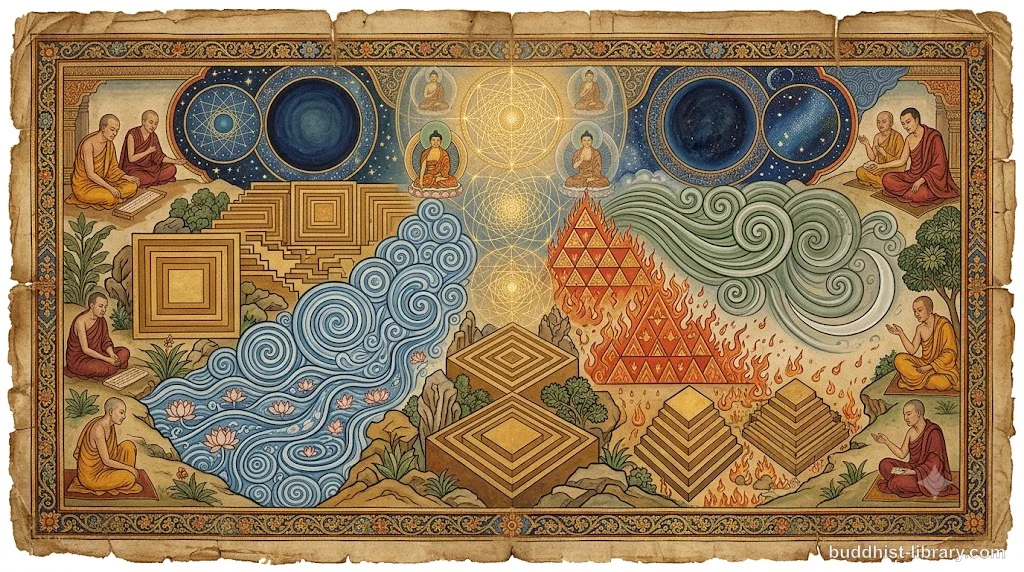
The Bahudhātuka Sutta (MN 115) is the Buddha’s most detailed teaching on elements, sense bases, and contact—the actual building blocks of experience. What seems like a unified self experiencing a unified world? The discourse breaks it down into multiple impersonal components, each arising and passing based on conditions. No solid experiencer. Just process.
What Is the Bahudhātuka Sutta?
The Bahudhātuka Sutta—“Discourse on the Many Elements”—is the 115th sutta in the Majjhima Nikāya. The Buddha taught it to Ānanda, who’d asked for help understanding the diverse elements (dhātus) that make up experience.
This isn’t the simple four-element framework you’ll find in introductory texts. The Buddha goes deep here, offering multiple ways to analyze experience: physical elements, sensory elements, cognitive elements, various types of contact. Each framework cuts the problem from a different angle.
Why so many angles? Because the discourse serves two purposes at once. Intellectually, it maps experience with precision. In practice, it hands meditators the exact tools they need to dismantle self-view piece by piece.
The Four Physical Elements (Mahābhūta)
The Buddha begins with the classical four elements that comprise material form:
Earth Element (Pathavī-dhātu)
The quality of solidity, hardness, and resistance. This includes bones, teeth, flesh—anything experienced as solid or resistant to pressure.
Water Element (Āpo-dhātu)
The quality of cohesion and fluidity. Blood, lymph, saliva, and anything that flows or binds things together manifests this element.
Fire Element (Tejo-dhātu)
The quality of temperature and energy. This includes body heat, digestion, aging—any process involving warmth or metabolism.
Air Element (Vāyo-dhātu)
The quality of movement and distension. Breath, winds in the body, and any motion or expansion shows this element.
Here’s what matters: None of these elements is “mine” or “myself.” They’re impersonal processes. Temporarily assembled. Constantly changing.
The body you identify with? Not a unified thing—just an unstable coalition of these four qualities.
The Six Sensory Elements
Beyond the physical, the Buddha describes six elements corresponding to the sense faculties:
- Eye element (cakkhu-dhātu)
- Ear element (sota-dhātu)
- Nose element (ghāna-dhātu)
- Tongue element (jivhā-dhātu)
- Body element (kāya-dhātu)
- Mind element (mano-dhātu)
These aren’t merely physical organs (except mind) but the capacities for seeing, hearing, smelling, tasting, touching, and thinking. Each element is a distinct process—sensitive, receptive, impermanent.
The Eighteen Elements (Dhātus)
The most detailed framework in the sutta expands to eighteen elements by considering three factors at each sense door:
At the eye:
- Eye element (the faculty)
- Visible form element (the object)
- Eye-consciousness element (the awareness)
At the ear:
- Ear element
- Sound element
- Ear-consciousness element
This pattern continues through all six senses, including mind. The result is eighteen distinct elements that, when they meet, produce what we call “seeing,” “hearing,” or “thinking.”
Why eighteen? Because experience doesn’t happen with just an eye or just a visible form. Contact requires the conjunction of three: faculty, object, and consciousness. None alone produces experience. All three are needed—and all three are impermanent, not-self.
Six Types of Contact (Phassa)
When the three elements at each sense door meet, contact (phassa) arises. The sutta distinguishes six types:
- Eye-contact
- Ear-contact
- Nose-contact
- Tongue-contact
- Body-contact
- Mind-contact
Contact is the pivotal moment. It’s where the external (object) and internal (faculty, consciousness) converge. Without contact, no feeling arises. Without feeling, no craving. Contact is a crucial link in the chain of dependent origination.
The Buddha emphasizes that contact itself is conditioned—it’s not a self making contact with the world, but impersonal elements colliding according to conditions.
Six Types of Feeling (Vedanā)
From contact comes feeling. The sutta catalogs six:
- Feeling born of eye-contact
- Feeling born of ear-contact
- Feeling born of nose-contact
- Feeling born of tongue-contact
- Feeling born of body-contact
- Feeling born of mind-contact
Each type of contact produces its own feeling. A visual pleasure is different from an auditory one. The feeling arising from thought differs from bodily sensation.
Understanding these distinctions helps meditators observe precisely. Rather than vague “I feel good,” you see: “Pleasant feeling has arisen from eye-contact with this color.” Precision prevents identification.
Six Types of Perception (Saññā)
Similarly, six types of perception correspond to the six sense doors:
- Perception of forms
- Perception of sounds
- Perception of odors
- Perception of tastes
- Perception of tactile sensations
- Perception of mental phenomena
Perception (saññā) recognizes and labels. It’s what turns a sensation into “red,” “loud,” “sweet,” or “painful.” These perceptions, like all elements, are conditioned, impermanent, and not-self.
Six Types of Intention (Cetanā)
The Buddha also describes six types of intention or volition:
- Intention regarding forms
- Intention regarding sounds
- Intention regarding odors
- Intention regarding tastes
- Intention regarding tactile sensations
- Intention regarding mental phenomena
Intention is the karmic factor—it’s what shapes actions and their results. By breaking it down into six types, the sutta shows how volition is not a unified self willing things, but a series of discrete intentional moments, each arising conditionally.
Why So Many Elements?
Fair question: why all this analysis? Isn’t Buddhism supposed to be about letting go, not cataloging?
The Buddha’s being therapeutic here. We suffer because we cling to a sense of self. But that self? It’s built from these impersonal elements. See them clearly—distinct, conditioned, not-self—and the construction collapses.
Each framework attacks the illusion from a different angle:
- Four elements: No solid body-self. Just qualities temporarily assembled.
- Six sensory elements: No perceiving self. Just capacities arising from conditions.
- Eighteen elements: No experiencer. Just faculties, objects, and consciousness colliding.
- Six types of contact/feeling/perception/intention: No unified mind. Just discrete processes at different sense doors.
See this deeply enough and clinging falls away. Not because you force it to. Because what seemed solid has dissolved into process.
Practical Application: Contemplating the Elements
This sutta isn’t philosophy. It’s a meditation manual.
Body contemplation: Sit. Feel your body. Instead of “my body,” recognize hardness (earth), fluidity (water), warmth (fire), motion (air). Each quality arises. Passes. Changes. None is yours. None is you.
Sense door contemplation: When seeing happens, note three factors: eye, form, eye-consciousness. Which one is “the one who sees”? None of them. Seeing is just conditional arising—empty of self.
Feeling contemplation: Feeling arises. Note its source. “This is feeling born of ear-contact.” Not “I feel.” Just feeling—present, conditioned by sound and ear and ear-consciousness. Watch it arise. Watch it pass. It belongs to nobody.
Intention contemplation: Before you act, catch the intention. “This is intention regarding forms.” See it as a conditioned mental event, not an autonomous self choosing. This doesn’t make you passive. It makes you clear about what’s actually happening.
Don’t memorize categories. Use them as tools. Break experience into its component elements and the sense of being a solid, continuous self breaks down with it.
The Sutta’s Place in the Path
The Bahudhātuka Sutta fits into the Buddha’s gradual training as a support for insight (vipassanā). After developing concentration (samādhi) and understanding basic teachings on impermanence and suffering, a practitioner can use this discourse’s detailed analysis to go deeper.
It’s closely related to:
- The Satipaṭṭhāna Sutta, which teaches contemplation of body (including elements) and mental qualities
- The Dhātuvibhaṅga Sutta (MN 140), another discourse on elements
- The Mahāhatthipadopama Sutta (MN 28), which also analyzes the elements and dependent origination
Together, these texts provide a comprehensive map for deconstructing self-view through analysis of experience.
Common Misunderstandings
“This is just intellectual analysis, not real practice.”
Wrong. Analysis and contemplation work together. You use the framework in meditation—directly observing elements as they arise. The understanding becomes experiential. It stops being conceptual when you’re sitting there watching “earth element” harden in your shin while “fire element” burns in your knee.
“I’m supposed to believe there are exactly eighteen elements?”
The number’s not the point. The Buddha teaches four elements in one place, six in another, eighteen here. He’s offering different maps for different terrain. What matters is seeing that experience is composite—multiple impersonal factors, not a unified self.
“Understanding elements is only for advanced practitioners.”
The full detail here does suit those with concentration and study experience. But even beginners benefit from simple element contemplation. Sit down. Feel the four elements in your body. That practice is accessible and it starts breaking down body-identification immediately.
Key Points
- The Bahudhātuka Sutta provides the Buddha’s most comprehensive analysis of the elements (dhātus) that constitute experience
- Multiple frameworks are presented: four physical elements, six sensory elements, eighteen elements (combining faculty, object, and consciousness)
- Six types each of contact, feeling, perception, and intention show how mental processes are also composite and conditioned
- None of these elements constitutes a self—they’re impersonal, conditioned, impermanent phenomena
- The detailed analysis serves contemplative practice by providing precise tools for deconstructing self-identification
- Practitioners use these frameworks in meditation to observe experience as a process rather than an entity
FAQ
How does element contemplation lead to insight?
See the body as just earth, water, fire, air—impersonal qualities temporarily assembled—and body-identification weakens. See experience as faculty, object, and consciousness colliding—none of them self—and the sense of being an experiencer dissolves.
Insight happens when you see directly that these elements are conditioned, impermanent, not-self.
Should I memorize all the elements before meditating on them?
No. Start simple. Four physical elements are enough. Sit. Feel hardness (earth), fluidity (water), warmth (fire), movement (air) in your body. As practice matures, work with the more detailed frameworks. Understanding deepens gradually.
Is this teaching unique to Theravada Buddhism?
The detailed analysis gets emphasized in Theravada (especially Abhidhamma). But the basic teaching on elements appears throughout early Buddhism and influenced Mahāyāna as well. Different schools emphasize different aspects. The core insight—phenomena are composite and empty of self—is shared across traditions.
Read more:
- The Mahāsatipaṭṭhāna Sutta: The Great Discourse on Mindfulness — This foundational sutta includes contemplation of the elements as part of its comprehensive mindfulness practice framework.
- What Is Nāmarūpa? Mind and Body in Buddhist Psychology — Explores how the Buddha analyzes experience into mental and physical components, complementing the element framework presented in the Bahudhātuka Sutta.
- The Five Aggregates (Khandhas): What We Mistake for ‘Self’ — Another key analytical framework showing how the sense of self is constructed from impersonal components.
📖 Source / license: Bahudhātuka Sutta, Majjhima Nikāya 115 (translated by Bhikkhu Bodhi, Bhikkhu Ñāṇamoli)
Frequently asked questions
What is the Bahudhātuka Sutta about?
The Bahudhātuka Sutta (MN 115) is the Buddha's detailed teaching on the many elements (dhātus), sense bases, and types of contact that constitute experience. It provides a systematic analysis of how reality is constructed through these various components.
How many elements does the Buddha describe in this sutta?
The Buddha describes multiple sets of elements: the four physical elements (earth, water, fire, air), six sensory elements (eye, ear, nose, tongue, body, mind), plus elements of space and consciousness. He also discusses eighteen dhātus combining sense organs, objects, and consciousness.
Why is the Bahudhātuka Sutta important for meditation practice?
This sutta provides a detailed map of experience that helps meditators deconstruct the sense of self. By seeing how experience arises from the interaction of impersonal elements rather than from a solid 'me', practitioners develop insight into non-self (anattā).