The Cunda Sutta: The Buddha's Last Meal and Final Acts of Compassion

A metalworker named Cunda offered the Buddha his final meal. What followed—violent dysentery, a painful journey on foot, and death within hours—could have crushed Cunda with guilt for the rest of his life. The Buddha knew this. So even as he was dying, he sent explicit instructions: tell Cunda his offering carried the same merit as the meal before my enlightenment. Absolve him completely. This is not a tragedy.
That message, preserved in the Mahāparinibbāna Sutta, tells us something about what an enlightened mind prioritizes in its last hours.
What Happened at Pāvā? The Story of Cunda’s Offering
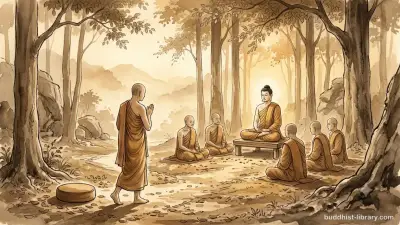
The Buddha was eighty. He was traveling through the Malla country with his attendant Ānanda and a group of monks, moving slowly toward what would be his final resting place. They stopped at Pāvā, a small town near Kusinārā (modern Kushinagar). A local metalworker lived there—Cunda.
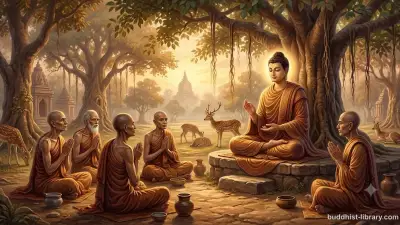
The texts identify Cunda as a kammāraputta, meaning “son of a smith” or metalworker—likely a blacksmith, goldsmith, or coppersmith. When Cunda learned the Buddha had arrived, he invited the Teacher and the Saṅgha to his home for a meal the following day.
The next morning, Cunda prepared an elaborate offering including various foods and one particular dish called sūkaramaddava. After the meal was served, the Buddha gave a specific instruction that shocked the assembly: he told Cunda to serve the sūkaramaddava only to him, and to bury the remainder where no human or animal would eat it.
The Buddha consumed the dish. Shortly afterward, he became violently ill with severe dysentery and “sharp pains came upon him, even unto death” (DN 16). Despite his suffering, the Buddha insisted on continuing the journey toward Kusinārā, the place where he would enter final nibbāna.
What Was Sūkaramaddava? The Scholarly Debate
The exact nature of sūkaramaddava has been debated for centuries. The Pāli compound breaks down as sūkara (pig) + maddava (soft, tender, delicate), but what this actually refers to remains uncertain:
Traditional interpretation: Tender pork, either a specific cut or a young pig. This is the most literal reading and appears in early Chinese translations.
Alternative interpretations:
- Mushrooms favored by pigs (a type of truffle)
- Bamboo shoots trampled by pigs
- A plant or tuber pigs enjoy eating
- Rice boiled in pig’s milk
Mahāyāna traditions tend toward the non-meat readings. Theravāda commentaries usually accept pork. The Buddha never forbade monks from eating meat that was offered (as long as the animal wasn’t killed for them specifically), which makes pork plausible.
But the ingredient itself matters less than what happened next.
The Buddha’s Illness and Journey to Kusinārā
After leaving Cunda’s home, the Buddha’s condition worsened rapidly. The Mahāparinibbāna Sutta describes his suffering in stark terms:
“Now when the Blessed One had eaten Cunda the metalworker’s food, a dire sickness fell upon him, with bleeding dysentery, and sharp pains came upon him, even unto death.”
Despite the severity of his illness, the Buddha did not blame Cunda, did not complain, and did not turn back. Instead, he mindfully endured the pain and continued walking toward Kusinārā. Along the way, he stopped multiple times to rest, at one point asking Ānanda to fold his robe so he could sit by the roadside.
In one of the most human moments in the early texts, the Buddha asked Ānanda to fetch water from a nearby stream because he was thirsty. When Ānanda initially hesitated (the water had been muddied by passing carts), the Buddha gently repeated the request, and Ānanda complied.
This journey—an aged, dying man walking in pain toward the place of his final rest—demonstrates the Buddha’s complete acceptance of the body’s dissolution.
The Buddha’s Compassion: Protecting Cunda from Blame
As the Buddha’s death approached, he became concerned not about his own suffering, but about Cunda’s emotional wellbeing. He knew that people might blame the metalworker for “killing the Buddha” with poisoned or spoiled food.
The Buddha explicitly instructed Ānanda to visit Cunda and deliver this message:
“It may be, Cunda, that someone will cause you remorse by saying: ‘It is no gain for you, Cunda, no benefit, that the Tathāgata took his last meal from you and then attained final nibbāna.’ Any such remorse, Cunda, you should dispel in this way: ‘It is a gain for me, a benefit, that the Tathāgata took his last meal from me and then attained final nibbāna. Face to face I have heard it from the Blessed One, face to face I have learned it: There are two offerings of food which are of equal fruit and profit, of greater fruit and profit than any other… What are the two? The offering of food which, when a Tathāgata has eaten, he attains supreme enlightenment; and the offering which, when a Tathāgata has eaten, he attains the nibbāna-element without residue. These two offerings of food are of equal fruit and profit.’”
Look at what this does:
First, it absolves Cunda completely. The meal did not kill the Buddha—his body was reaching its end regardless. Second, it places Cunda’s offering on the same level as Sujātā’s milk-rice, the meal the Buddha ate right before enlightenment. Two meals. Two turning points. Equal merit.
Third—and this is striking—the Buddha’s final concern was not his own pain but Cunda’s potential guilt. He was dying, and he used his remaining clarity to prevent someone else’s suffering.
And embedded in all of this is a teaching about kamma: outcomes don’t always trace back to individual actions in a neat moral line. The Buddha’s death was not punishment. It was an eighty-year-old body shutting down. That’s all.
Key Teachings from the Cunda Episode
1. Acceptance of Death Without Resistance
The Buddha did not seek healing, did not rage against his illness, and did not view death as a failure or tragedy. He had taught for forty-five years that all conditioned things are impermanent (sabbe saṅkhārā aniccā). Now he demonstrated that truth with his own body.
2. The Kamma of Offering vs. the Kamma of Outcomes
Cunda’s kamma was the wholesome intention and generous act of offering food. The Buddha’s illness was the natural result of an aging body, not punishment for anyone’s action. This distinction protects us from superstitious thinking where every misfortune is blamed on someone’s “bad karma.”
3. Compassion Extends Beyond the Grave
The Buddha’s final instructions about Cunda show that genuine compassion continues even when we cannot directly benefit. He knew he would not live to see Cunda’s relief—yet he arranged for it anyway.
4. True Generosity Is Its Own Reward
The merit of Cunda’s offering did not depend on the Buddha living a long life afterward. The act itself—offered with faith, respect, and generosity—was complete. The external outcome did not diminish its value.
Historical Context: Why This Story Matters
The Cunda episode appears in one of the earliest and most widely attested texts in the Buddhist canon. The Mahāparinibbāna Sutta exists in multiple versions across different schools (Theravāda, Dharmaguptaka, Sarvāstivāda), and all include this incident, suggesting it reflects genuine historical memory.
The story also reveals the Buddha’s humanity. He ate, he became ill, he suffered, he died. Early Buddhism did not present the Buddha as an immortal or supernatural being, but as a human who discovered the path to liberation and taught it to others. His death was not a defeat—it was the natural conclusion of a human life fully lived.
Cunda in Buddhist Memory: A Layperson’s Example
Cunda represents the faithful layperson whose generosity supports the Saṅgha. He was not a monk, not a scholar, not a royal patron—just a working artisan who offered what he could.
In some traditions, Cunda is honored as a model of dāna (generosity) and upāsaka (lay follower) practice. His offering, given with pure intention, earned him a place in the Buddha’s final days and in the memory of millions of Buddhists across centuries.
The Buddha’s explicit instruction to honor Cunda’s offering also set a precedent: acts of generosity toward the Saṅgha carry immense merit regardless of what happens afterward. The donor’s kamma is complete in the moment of giving.
Lessons for Modern Practice
For those facing guilt or regret: The Buddha’s treatment of Cunda offers profound relief. Sometimes outcomes beyond our control follow our well-intentioned actions. The Buddha teaches that wholesome intention and right action create wholesome kamma—external results are conditioned by countless factors, not solely by our deed.
For those practicing generosity: Cunda’s story reminds us that the value of giving lies in the act itself, not in controlling outcomes. We cannot demand that our generosity produce specific results. We give with an open hand and let go.
For those contemplating death: The Buddha’s calm acceptance of his final illness, his concern for others even while dying, and his clear-minded walk toward Kusinārā model a dignified, mindful relationship with mortality.
For those supporting others: Ānanda’s role—fetching water, folding robes, carrying messages—shows that attending to basic needs with care and respect is itself a profound practice.
The Final Words to Cunda
When Ānanda delivered the Buddha’s message, we can imagine Cunda’s relief. The guilt and social shame he might have carried for the rest of his life were lifted by the Buddha’s words. He had not killed the Teacher—he had participated in one of the two most significant meals in Buddhist history.
This is the deeper teaching of the Cunda Sutta: true compassion anticipates suffering before it arises and moves to prevent it. The Buddha, facing his own death, thought of Cunda’s potential anguish and acted to spare him. That is the mind of a fully awakened being—aware, responsive, and boundlessly kind.
Conclusion
This isn’t really a story about food or poison or even death.
It’s about what an enlightened mind does when it has hours left. The Buddha could have focused on his pain, on preparing himself, on saying final goodbyes. Instead, he thought ahead to Cunda’s guilt and moved to prevent it. He knew the metalworker would blame himself. So he sent a message absolving him and elevating his offering to the highest possible merit.
Cunda gave a meal. The Buddha ate it, got sick, and died. But the Buddha reframed it: this was not a killing. It was one of the two most significant offerings in all of Buddhist history. What looked like tragedy became teaching.
When we act with good intentions and the outcome goes badly anyway, the Cunda Sutta offers this: You did what was wholesome. The outcome is not the measure. Your kamma was complete in the moment of giving.
Read more:
- The Mahāparinibbāna Sutta: The Buddha’s Final Teaching and Passing — The complete account of the Buddha’s last days, final teachings, and entry into parinibbāna.
- What Is Dāna? The Practice and Power of Generosity in Buddhism — Understanding the role of generosity in Buddhist practice and how offerings like Cunda’s carry profound merit.
- The Life of the Buddha: From Prince Siddhārtha to Awakening — The complete arc of the Buddha’s life, from his birth to his enlightenment and forty-five years of teaching.
📖 Source / license: Mahāparinibbāna Sutta (DN 16), translated by Maurice Walshe (Wisdom Publications), and Bhikkhu Ānandajoti's edition on SuttaCentral
Frequently asked questions
What was the Buddha's last meal?
The Buddha's final meal was offered by Cunda the smith in Pāvā. The exact nature of the dish—sūkaramaddava—is debated, with interpretations ranging from pork to a type of mushroom or bamboo shoots. After this meal, the Buddha fell gravely ill.
Who was Cunda and why is he important?
Cunda was a metalworker (likely a blacksmith or goldsmith) from the town of Pāvā. He is significant because he offered the Buddha's final meal. Despite the meal preceding the Buddha's death, the Buddha explicitly absolved Cunda of any blame and declared his offering meritorious.
Why did the Buddha become ill after Cunda's meal?
The texts indicate the Buddha contracted severe dysentery after eating the meal Cunda offered. However, the Buddha made clear this was not Cunda's fault—the illness was simply the final physical decline of an aged body approaching parinibbāna (final passing).
What teachings did the Buddha give about Cunda's offering?
The Buddha taught that Cunda's offering had immense merit equal to the meal offered by Sujātā before his enlightenment. He instructed Ānanda to reassure Cunda that he bore no responsibility for the Buddha's death, demonstrating profound compassion and protecting Cunda from guilt and social blame.