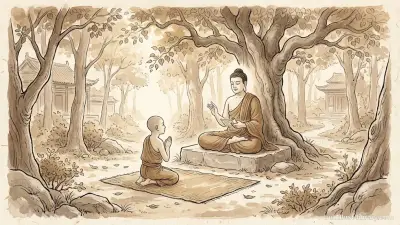
The Parable of the Mustard Seed: Kisa Gotami's Teaching on Universal Suffering
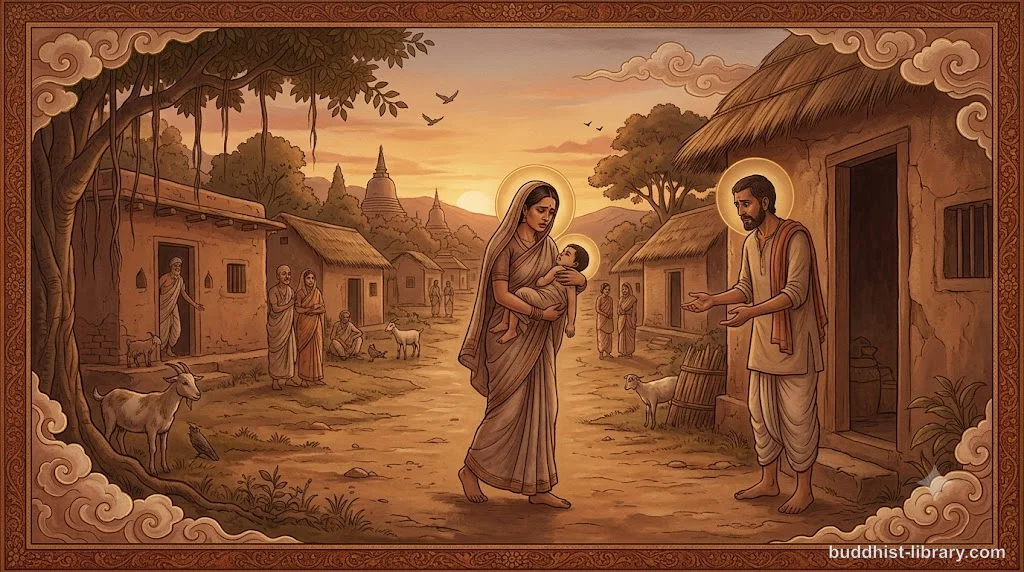
When Kisa Gotami lost her infant son, she refused to believe he was dead. Desperate, she carried his body through the streets, begging for medicine. The Buddha’s response — asking her to fetch a mustard seed from a home untouched by death — became one of Buddhism’s most profound teachings on grief, impermanence, and the universality of suffering.
This is more than a story about acceptance. The mustard seed parable demonstrates the Buddha’s extraordinary teaching skill (upāya-kauśalya) while illustrating the First Noble Truth in action: dukkha — suffering, unsatisfactoriness, the pain of loss — pervades all conditioned existence.
Who Was Kisa Gotami?
Kisa Gotami (literally “Lean Gotami”) was a young woman from a poor family in Sāvatthī during the Buddha’s lifetime. Her name reflected her frail appearance. After marriage, she gave birth to a son — a moment of profound joy that elevated her status in her husband’s household.
But that joy was short-lived. Her infant son died suddenly.
Overwhelmed by grief and unable to accept the loss, Kisa Gotami refused to perform the funeral rites. Instead, she carried the small body from house to house, pleading with neighbors: “Give me medicine for my child.” Most turned away, disturbed or saddened by her denial. Some spoke harshly; others pitied her madness.
Finally, a compassionate man directed her to the Buddha: “Go to the teacher. He may know of medicine.”
Why Did the Buddha Ask for a Mustard Seed?
When Kisa Gotami reached the Buddha, she laid her child before him and begged: “Lord, give me medicine to cure my son.”
The Buddha did not refuse her request. He did not lecture her on impermanence or rebuke her denial. Instead, he said gently: “You did well to come here. Go into the city and bring me a handful of mustard seed from any household where no one — child, spouse, parent, servant — has ever died.”
Mustard seed was common, used in every kitchen. The task seemed simple.
Hopeful, Kisa Gotami hurried into Sāvatthī, knocking on door after door. “Can you give me mustard seed? The Buddha needs it for medicine.”
“Of course,” people replied — but then came the Buddha’s condition: “from a house where no one has died.”
“Oh,” the first family said, “we lost our grandfather last year.”
At the next house: “Our daughter died in childbirth.”
Another: “My husband passed three months ago.”
And another: “We lost a servant to fever.”
Kisa Gotami moved from home to home, rich and poor, throughout the entire city. Every household offered mustard seed freely — but not one could meet the Buddha’s condition. Every home had known death.
By evening, Kisa Gotami stood still in the fading light, her son’s body in her arms. The truth settled over her with the dusk: death is not a cruelty visited upon her alone. It is the common law. No family, no household, no person escapes it.
She carried her child to the charnel ground, performed the rites, and returned to the Buddha — not with mustard seed, but with understanding.
What Did Kisa Gotami Learn?
The Buddha greeted her: “Did you bring the mustard seed?”
“I could not find it, Lord,” she replied. “In every house, someone has died. I see now: death is common to all. I am not the only one who grieves.”
The Buddha then spoke a verse, later recorded in the Dhammapada:
“The living are few; the dead are many.
Knowing this, the wise do not grieve,
for they understand the way of the world.”
She had discovered what no lecture could teach: the First Noble Truth. Dukkha pervades all conditioned existence. Her suffering was not unique or unfair — it was the inevitable fruit of impermanence (anicca). What arises passes away. What is born dies.
Understanding this did not leave her in despair. It freed her. Seeing suffering as universal, she let go of the isolating question “Why me?” and turned toward liberation.
What Is Skillful Means in This Teaching?
The Buddha’s method here is called upāya or upāya-kauśalya (skillful means) — the ability to teach in a way that meets the student exactly where they are.
Kisa Gotami, lost in denial and grief, could not have absorbed an abstract discourse on impermanence. Her mind was fixated on her son, on the impossibility of his death. A direct teaching would have bounced off her closed heart.
So the Buddha gave her an embodied lesson — a task that required her to move, to engage, to encounter the truth herself rather than receive it secondhand.
By nightfall, Kisa Gotami had not been told about universal suffering — she had verified it. Seen it in every doorway. Heard it in every family’s story. Felt it in the shared sorrow of an entire city. The teaching arose from her own experience. That kind of knowing transforms.
This is the Buddha’s pedagogical genius: he did not impose truth. He arranged conditions for realization.
What Happened to Kisa Gotami After?
Kisa Gotami did not stop at intellectual understanding. She asked the Buddha for ordination and joined the bhikkhunī saṅgha (the order of nuns). She practiced meditation diligently, contemplating impermanence, death, and the fading away of all formations.
According to the Therīgāthā (Verses of the Elder Nuns), Kisa Gotami attained arahatship — full enlightenment — and became one of the foremost disciples known for ascetic practice. Her verses express a profound freedom:
“I have seen the peril in sensual pleasures,
and I have seen renunciation as rest.
I delight in meditation — serene, composed, released.”
— Therīgāthā 10.1
From a grief-stricken mother unable to let go, Kisa Gotami became an enlightened elder whose wisdom inspired generations. Her story endures not as a tragedy, but as a path walked fully — from denial through understanding to liberation.
How Does This Parable Relate to the Four Noble Truths?
The mustard seed parable is a lived enactment of the Four Noble Truths:
-
Dukkha (Suffering): Kisa Gotami’s loss and desperate search embody the First Truth — suffering is real and inescapable in conditioned existence.
-
Samudaya (Origin of Suffering): Her clinging to her son, her refusal to accept his death, illustrated taṇhā (craving) and upādāna (clinging) — the causes of suffering.
-
Nirodha (Cessation of Suffering): When she understood the universality of death and released her clinging, she experienced the possibility of peace. Later, through practice, she realized full cessation — nibbāna.
-
Magga (The Path): Kisa Gotami’s journey from grief to enlightenment followed the Noble Eightfold Path — beginning with Right View (understanding impermanence) and culminating in liberation through meditation and wisdom.
The parable condenses the entire Dhamma into a single, unforgettable story.
What Can We Learn from This Story Today?
The mustard seed parable speaks across centuries because grief is timeless. We lose people we love. We resist the truth of death. We ask, “Why me? Why this? Why now?”
Kisa Gotami’s story holds several teachings for us:
Grief Is Not Wrong
The Buddha did not scold Kisa Gotami for her grief. He met her with compassion and guided her toward understanding. Grief is a natural response to loss; the suffering comes from clinging to the belief that things should be otherwise.
Isolation Deepens Suffering
When we believe our pain is unique, we feel alone in it. Kisa Gotami’s search revealed that everyone has known loss. This does not erase the pain, but it dissolves the isolating story of “only I suffer.”
In mindfulness practice, we might reflect: “This grief is not mine alone. It is the grief of countless beings. May all who grieve find peace.”
Understanding Must Be Lived, Not Just Learned
Kisa Gotami could have been told, “Death is universal.” But knowing intellectually is not the same as understanding deeply. The Buddha gave her a task that made the truth undeniable.
This points to the importance of practice — meditation, reflection, ethical action — as the ground where teachings become lived wisdom.
Skillful Means Adapts to the Student
Not everyone needs a mustard seed quest. The Buddha taught in many ways — through silence, questions, parables, detailed analysis, even humor. What worked for Kisa Gotami would not work for a philosopher seeking logical rigor.
For teachers and practitioners: wisdom is not one-size-fits-all. We must meet ourselves — and others — where we are.
Key Takeaways
- Kisa Gotami’s story illustrates the universality of death and suffering — no household is free from loss.
- The Buddha’s skillful means guided her to realize the First Noble Truth through direct experience, not abstract teaching.
- Grief and clinging are natural, but freedom comes from understanding impermanence and releasing the belief that suffering is uniquely ours.
- Kisa Gotami attained arahatship, showing that even the deepest despair can become the seed of awakening.
- The parable remains relevant as a teaching on grief, acceptance, and the shared nature of the human condition.
Frequently Asked Questions
Who was Kisa Gotami?
Kisa Gotami was a young mother who lost her infant son and, driven by grief, sought the Buddha’s help to revive him. Her story became one of Buddhism’s most powerful teachings on universal suffering and acceptance.
What is the lesson of the mustard seed parable?
The parable teaches that death and loss are universal — no household is free from death. By seeking a mustard seed from a home untouched by death, Kisa Gotami came to understand that suffering is not hers alone but shared by all.
Why did the Buddha ask for a mustard seed from a home with no death?
The Buddha used skillful means (upāya) to guide Kisa Gotami to her own realization. By searching for something impossible to find, she discovered the truth of universal suffering directly, rather than through abstract teaching.
What happened to Kisa Gotami after this teaching?
According to the Therigatha, Kisa Gotami became a devoted disciple, practiced diligently, and eventually attained arahatship — full enlightenment. Her verses are preserved among the enlightenment poems of the early Buddhist nuns.
How can this teaching help with modern grief?
The parable reminds us that grief is universal and shared. It invites us to release the isolating belief that “only I suffer” and to find compassion — both for ourselves and for all beings who know loss. It also points to the value of practice and understanding impermanence as a path to peace.
Is this story found in the Pali Canon?
The story appears in the Dhammapada Commentary and is referenced in the Therīgāthā (Verses of the Elder Nuns), where Kisa Gotami’s enlightenment verses are preserved. It is a well-attested teaching within the early Buddhist tradition.
Read more:
- Impermanence (Anicca): Why Everything Changes — Understand the First Mark of Existence that Kisa Gotami realized through her quest.
- What Is Dukkha? Understanding Suffering in Buddhism — Explore the First Noble Truth that underlies this powerful parable.
- Buddhist Approach to Grief and Loss: Working with Bereavement Mindfully — Practical guidance for working with grief in a Buddhist framework.
📖 Source / license: Therigatha 10.1 (Kisa Gotami Theri); Dhammapada Commentary; translated by K.R. Norman and C.A.F. Rhys Davids
Frequently asked questions
Who was Kisa Gotami?
Kisa Gotami was a young mother who lost her infant son and, driven by grief, sought the Buddha's help to revive him. Her story became one of Buddhism's most powerful teachings on universal suffering and acceptance.
What is the lesson of the mustard seed parable?
The parable teaches that death and loss are universal — no household is free from death. By seeking a mustard seed from a home untouched by death, Kisa Gotami came to understand that suffering is not hers alone but shared by all.
Why did the Buddha ask for a mustard seed from a home with no death?
The Buddha used skillful means (upāya) to guide Kisa Gotami to her own realization. By searching for something impossible to find, she discovered the truth of universal suffering directly, rather than through abstract teaching.
What happened to Kisa Gotami after this teaching?
According to the Therigatha, Kisa Gotami became a devoted disciple, practiced diligently, and eventually attained arahatship — full enlightenment. Her verses are preserved among the enlightenment poems of the early Buddhist nuns.