The Six Elements in Buddhism: Understanding Dhātu Meditation
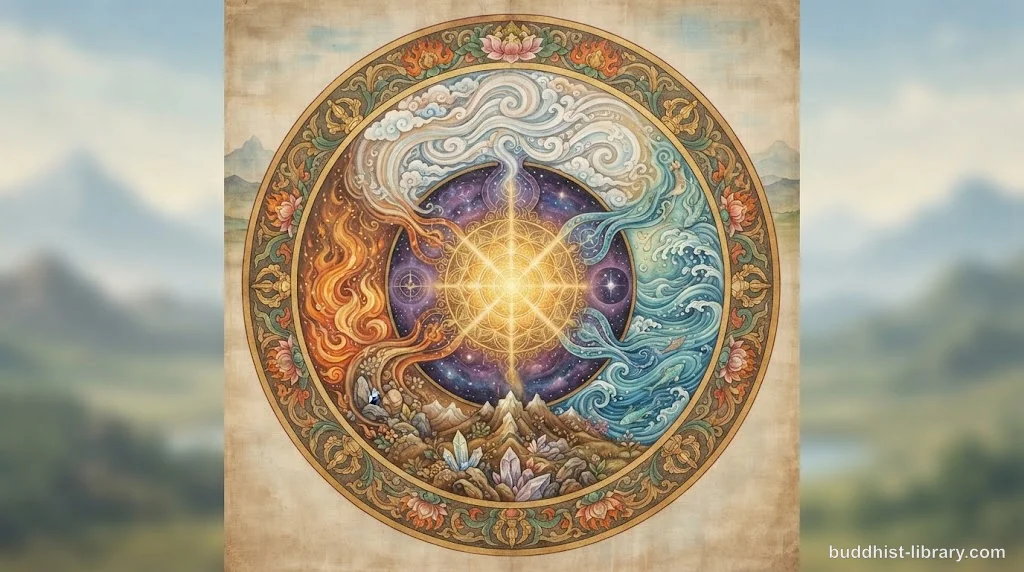
The six elements meditation deconstructs the illusion of self by revealing that your body and mind are not “you” but temporary assemblies of impersonal processes — earth (solidity), water (cohesion), fire (heat), air (motion), space (extension), and consciousness (awareness). This profound practice from the Buddha’s Dhātuvibhaṅga Sutta directly undermines the conceit “I am” and opens the door to liberation.
The first time you genuinely see that “your” body is just borrowed earth, water, fire, and air — no more yours than the ground you walk on — something shifts. The grip of self-view loosens. The six elements meditation (dhātu-vavatthāna) is one of the Buddha’s most precise tools for this shift, yet it remains less known than breath meditation or the four foundations of mindfulness. It deserves wider practice.
What Are the Six Elements in Buddhism?
In the Dhātuvibhaṅga Sutta (MN 140), the Buddha identifies six fundamental components that constitute all conditioned existence, including the human being:
- Earth element (paṭhavī-dhātu) — the quality of solidity, hardness, softness. In your body: bones, teeth, flesh, organs, hair.
- Water element (āpo-dhātu) — cohesion, fluidity, binding. In your body: blood, lymph, saliva, sweat, tears.
- Fire element (tejo-dhātu) — heat, temperature, energy that ripens and ages. In your body: body heat, fever, digestion.
- Air element (vāyo-dhātu) — motion, oscillation, pressure. In your body: breath, intestinal gas, movement in joints and limbs.
- Space element (ākāsa-dhātu) — extension, room, the spaces that allow the other elements to exist. In your body: cavities in ears, nose, mouth, stomach, intestines.
- Consciousness element (viññāṇa-dhātu) — awareness through the six sense doors (eye, ear, nose, tongue, body, mind). The knowing of sights, sounds, smells, tastes, tactile sensations, and mental objects.
These are not metaphysical substances but qualities of experience. They describe how phenomena present themselves to investigation, not hidden essences. The Buddha was not teaching chemistry or physics — he was teaching a contemplative map to dismantle the illusion of self.
Why Did the Buddha Teach Element Meditation?
In the Dhātuvibhaṅga Sutta, the Buddha told a young man named Pukkusāti that “one should see any kind of form whatever… as it actually is… ‘This is not mine, this I am not, this is not my self.’” Element meditation is the method to make that seeing real, not just intellectual.
We instinctively cling to the body and mind as “me” and “mine.” The six elements practice systematically reveals that:
- The earth in your body is the same earth element outside — it came from food, will return to soil.
- The water in your blood came from drink, will leave as sweat and urine.
- The heat in your body depends on metabolism, will cool when circulation stops.
- The air you breathe in and out is shared with every living being.
- The space in your body cavities is continuous with the space around you.
- Consciousness arises and ceases with conditions — sense contact, attention, mental formations — and is not a permanent owner.
Nothing here is exclusively “yours.” You are a temporary convergence of processes that never stopped being part of the world.
How to Practice the Six Elements Meditation
This is both an analytical contemplation and a direct-perception practice. The classical sequence, drawn from MN 140 and teacher commentaries:
Preparation
Sit in a stable meditation posture. Establish mindfulness of breathing until the mind is calm and collected. You need enough concentration (samādhi) to sustain investigation without drifting into distraction or dullness.
Contemplation of the Four Primary Elements
1. Earth element (solidity)
Sweep attention through the body: skull, teeth, spine, ribs, pelvis, arm and leg bones, tendons, flesh. Notice hardness, softness, roughness, smoothness. Then reflect:
“The internal earth element and the external earth element are both simply earth element. And that should be seen as it actually is… ‘This is not mine, this I am not, this is not my self.’ When one sees it thus… one becomes disenchanted with the earth element.”
You did not create the calcium in your bones. It came from outside — food grown in soil, eaten, absorbed. When you die, it returns to the earth. The earth element in “your” body and the earth outside are one continuum. The boundary of skin is conceptual, not ultimate.
2. Water element (cohesion)
Attend to blood, lymph, saliva, mucus, bile, synovial fluid, urine. Notice fluidity, trickle, moisture. Reflect:
“The water in this body came from outside — from rivers, rain, drinks. It circulates temporarily, then leaves as sweat, tears, urine. I do not own it. It is not ‘mine.’ It is just water doing what water does.”
The hydration you feel after drinking is the external water element temporarily cohering with the internal — then separating again. No ownership. No self in it.
3. Fire element (heat)
Notice warmth in the belly, chest, palms; areas of coolness; the heat of digestion. Reflect:
“This warmth comes from metabolism — the burning of food. The fire element in this body is the same heat that exists in the sun, in a candle flame, in fever. It arises with conditions, ceases with conditions. It is not ‘me.’”
When the body dies, the fire element cools. The heat was never a possession — it was a process sustained by fuel and oxygen.
4. Air element (motion)
Feel the in-breath and out-breath moving through nostrils, throat, chest. Notice the pressure of the diaphragm, the movement of gases in the intestines, the pulsing of blood. Reflect:
“The air I breathe in is external air. For a moment it is ‘inside,’ then it becomes external again. The movement in my body is the same wind element that moves the trees. I do not own the breath.”
The distinction between “my” breath and the atmosphere is functional, not absolute.
Contemplation of Space
Notice the spaces inside the body: the hollow of the throat, the cavities of the ears and nose, the empty stomach, the spaces between organs. Reflect:
“Space inside the body and space outside the body are the same element. The boundaries are provisional. Space allows the other elements to exist and move.”
Space (ākāsa) is often overlooked, but it is critical — without space, no form could arise or cease.
Contemplation of Consciousness
This is subtler. Notice awareness itself: the seeing of sights, hearing of sounds, tasting of flavors, feeling of tactile sensations, knowing of thoughts. Investigate:
- Consciousness arises dependent on conditions — sense organ + sense object + attention. When conditions cease, consciousness ceases.
- There is eye-consciousness (seeing), ear-consciousness (hearing), nose-consciousness (smelling), tongue-consciousness (tasting), body-consciousness (touching), mind-consciousness (thinking). Each is distinct, momentary, conditioned.
- Consciousness is not a self. It is an impersonal process. When the eye and a visible form are present, eye-consciousness arises. When they separate, it ceases.
Reflect:
“Consciousness is not ‘mine.’ It is a dependently arisen phenomenon. There is no one behind it who ‘has’ consciousness. There is just the knowing, which appears and disappears based on conditions.”
This is where the meditation becomes deeply liberating. You stop identifying with consciousness itself — the last hiding place of the self-conceit.
Integration: Seeing the Whole as Not-Self
After investigating each element, rest in the unified perception:
“This entire body-mind is a temporary assembly of six impersonal elements. None of it is ‘me,’ none of it is ‘mine,’ none of it is ‘my self.’ What I took to be a solid, independent person is a flowing process, borrowed from the world, sustained for a while, then returned. I am not in control of it. It is not satisfactory as a refuge. It is not self.”
This is not nihilism — you still function, eat, sleep, act. But the delusion that there is a permanent, independent owner of experience weakens and eventually collapses.
What Insight Does This Practice Yield?
The six elements meditation targets the conceit “I am” (asmi-māna), one of the deepest fetters binding beings to suffering and rebirth. Specifically, it reveals the three characteristics of existence:
Impermanence (Anicca)
Every element is in flux. The earth element in your body is constantly being replenished (food) and expelled (waste). Water enters and leaves. Heat rises and falls. Breath moves in and out. Space remains, but the forms within it shift. Consciousness arises and ceases thousands of times per hour. Nothing stays.
Suffering/Unsatisfactoriness (Dukkha)
Since the elements are impermanent and not under your control, clinging to them as “me” or “mine” inevitably leads to suffering. You cannot keep your body young (fire element declining), cannot prevent illness (earth and water elements destabilizing), cannot stop consciousness from ceasing in deep sleep or death. Grasping at any element as a reliable refuge is inherently frustrating.
Non-Self (Anattā)
This is the primary insight of the practice. If the elements that make up “you” are not yours — they existed before you, they will exist after you, you do not control them — then where is the self? The sense of “I” is revealed as a cognitive habit, not an ontological fact. It is a way the mind organizes experience, not a thing that exists independently.
How Does This Differ from Other Insight Practices?
The six elements meditation is one lens among several in the Buddha’s toolkit. It complements but differs from:
- Mindfulness of breathing — stabilizes attention, then investigates breath as impermanent/not-self. Six elements expands this to the whole body-mind.
- Mindfulness of the body (kāyagatāsati) — includes postures, parts of the body, elements, and corpse contemplations. The six elements is one frame within kāyagatāsati.
- Contemplation of feelings (vedanā) and mental formations (saṅkhāra) — these focus on the affective and cognitive layers. Six elements focuses on the material and consciousness layers.
- Dependent Origination — shows how suffering arises through the chain of conditions. Six elements shows that the “person” caught in that chain is itself a conditioned assembly.
The six elements practice is particularly useful for people who strongly identify with the body or who experience the sense of “I” as located in the body. By dissolving the body into impersonal processes, it cuts a major root of self-view.
Practical Tips for Six Elements Meditation
Start with the body, add consciousness later. The first four elements (earth, water, fire, air) are tangible and easier to investigate. Space and consciousness are subtler. Build skill with the first four before moving to the full six.
Do not rush. Spend 10–15 minutes on each element (or even a full session on one element). The point is not to complete the list but to see each element clearly as “not me, not mine.”
Use the traditional phrases. Repeating the Buddha’s words — “This is not mine, this I am not, this is not my self” — helps anchor the reflection and prevents the mind from slipping into vague thinking.
Balance analysis with direct perception. Start with thinking (“The water in my blood came from outside…”), but then let the thought fade and simply feel the fluidity, the wetness, the flow, without commentary. Insight arises in the gap between concept and perception.
Combine with other practices. Six elements meditation is not a standalone path. Pair it with moral discipline (sīla), concentration (samādhi), and the other insight practices. It is one tool in the gradual training.
Expect resistance. The mind has spent a lifetime constructing the sense of self. Deconstructing it can feel disorienting, even frightening.
This is normal.
Proceed gently. If strong fear arises, return to the breath or loving-kindness (mettā) to re-establish safety.
When to Use This Practice
The six elements meditation is especially powerful:
- When self-view feels solid and convincing. The reflection cuts through the illusion of a separate, permanent self.
- When attachment to the body is strong — whether through vanity, sensuality, or fear of aging/illness. Seeing the body as borrowed elements reduces clinging.
- In illness or approaching death. The practice helps release identification with the disintegrating body. Several teachers recommend it for end-of-life contemplation.
- After developing concentration. Attempting this practice without a stable, collected mind often results in dry intellectualizing or distraction.
Key Points
- The six elements (earth, water, fire, air, space, consciousness) are the building blocks of conditioned existence, not metaphysical atoms but qualities of experience.
- Element meditation deconstructs the illusion of self by revealing that “your” body and mind are temporary assemblies of impersonal processes — none of it truly “yours.”
- The practice comes from the Dhātuvibhaṅga Sutta (MN 140), where the Buddha taught it as a path to disenchantment with all conditioned phenomena.
- Insight from this practice includes seeing impermanence (elements constantly flowing), suffering (cannot control the elements), and non-self (no owner, just processes).
- It complements other practices like mindfulness of breathing, body contemplation, and vipassanā — offering a particularly effective antidote to identification with the physical body.
- Practical approach: start with earth, water, fire, air (tangible), then add space and consciousness (subtle); balance analytical reflection with direct perception; do not rush.
- This is not a beginner practice — it requires stable concentration and conceptual grounding in anattā (non-self) teaching to avoid nihilistic misunderstanding.
FAQ
What are the six elements in Buddhism?
The six elements (dhātu) are earth (solidity), water (cohesion), fire (heat), air (motion), space (extension), and consciousness (awareness). The Buddha taught that all phenomena, including what we call “self,” are temporary combinations of these impersonal elements.
How does six elements meditation lead to insight into non-self?
By systematically investigating each element in your body and mind, you directly see that nothing you experience “belongs” to you — every element is borrowed from the world, sustained temporarily, and returns to the world. This undermines the illusion of a permanent, independent self.
Is the six elements meditation suitable for beginners?
While conceptually accessible, this practice requires stable concentration and some grounding in Buddhist teachings on anattā (non-self). Beginners benefit from starting with mindfulness of breathing or body contemplation before attempting element analysis.
How is the six elements meditation different from vipassanā?
The six elements practice is a form of vipassanā (insight meditation). It uses analytical contemplation of the elements as the lens through which to see the three characteristics — impermanence, suffering, and non-self — particularly targeting the conceit “I am.”
Can I practice the six elements meditation on my own, or do I need a teacher?
While the instructions are clear in the suttas and accessible commentaries, a teacher is highly recommended — especially for working with the consciousness element and for navigating the disorientation that can arise when self-view weakens. At minimum, study traditional sources carefully before practicing alone.
What is the relationship between the six elements and the five aggregates?
The five aggregates (khandhas) and six elements are two complementary frameworks for analyzing experience. Aggregates divide experience into form, feeling, perception, mental formations, and consciousness. Elements divide it into material qualities (earth, water, fire, air, space) and awareness (consciousness). Both reveal non-self; elements emphasize the “borrowed” nature of what we take to be “ours.”
Conclusion: Borrowed and Returned
The six elements meditation is radical in its simplicity. You are not asked to believe anything or adopt a philosophy. You are simply invited to look closely at what makes up this body-mind and to see where the boundaries actually are.
What you will find, if you look with continuity and precision, is that the boundaries dissolve. The earth element in your bones is the same earth you walk on. The water in your blood is the same water in the river. The heat in your belly is the same fire in the sun. The breath in your lungs is the atmosphere. The space in your body is the space outside it. And consciousness — the knowing itself — arises and ceases moment by moment, ownerless, a natural process like wind or rain.
Nothing in this assemblage is “you.” And yet, here is life, functioning, aware, capable of understanding and release. The Buddha’s genius was not in denying the reality of experience but in showing where we misapprehend it — and in that showing, offering freedom.
As the Dhātuvibhaṅga Sutta concludes, when a practitioner sees the six elements as they truly are — impermanent, unsatisfactory, not-self — “he becomes dispassionate. Through dispassion, he is fully released. With full release, there is the knowledge, ‘Fully released.’ He discerns that ‘Birth is ended, the holy life fulfilled, the task done. There is nothing further for this world.’”
This is not the end of experience. It is the end of delusion about experience. And that makes all the difference.
Read more:
- The Five Aggregates (Khandhas): What We Mistake for ‘Self’ — another framework for deconstructing the illusion of self, focusing on form, feeling, perception, mental formations, and consciousness as conditioned processes.
- Anattā (Non-Self): What the Buddha Really Meant — the foundational teaching that underlies element meditation, exploring why the Buddha rejected both eternalism and nihilism in favor of seeing phenomena as they are.
- Dependent Origination (Paṭiccasamuppāda) — how suffering arises through the chain of conditions, complementing the six elements’ insight that even the “person” is a conditioned assembly with no independent core. ndependent core.
📖 Source / license: Dhātuvibhaṅga Sutta (MN 140), Access to Insight (Ṭhānissaro Bhikkhu translation), SuttaCentral, *The Island* by Ajahn Pasanno & Ajahn Amaro
Frequently asked questions
What are the six elements in Buddhism?
The six elements (dhātu) are earth (solidity), water (cohesion), fire (heat), air (motion), space (extension), and consciousness (awareness). The Buddha taught that all phenomena, including what we call 'self,' are temporary combinations of these impersonal elements.
How does six elements meditation lead to insight into non-self?
By systematically investigating each element in your body and mind, you directly see that nothing you experience 'belongs' to you — every element is borrowed from the world, sustained temporarily, and returns to the world. This undermines the illusion of a permanent, independent self.
Is the six elements meditation suitable for beginners?
While conceptually accessible, this practice requires stable concentration and some grounding in Buddhist teachings on anattā (non-self). Beginners benefit from starting with mindfulness of breathing or body contemplation before attempting element analysis.
How is the six elements meditation different from vipassanā?
The six elements practice is a form of vipassanā (insight meditation). It uses analytical contemplation of the elements as the lens through which to see the three characteristics — impermanence, suffering, and non-self — particularly targeting the conceit 'I am.'