The Vīṇopama: The Buddha's Simile of the Lute on Balanced Practice
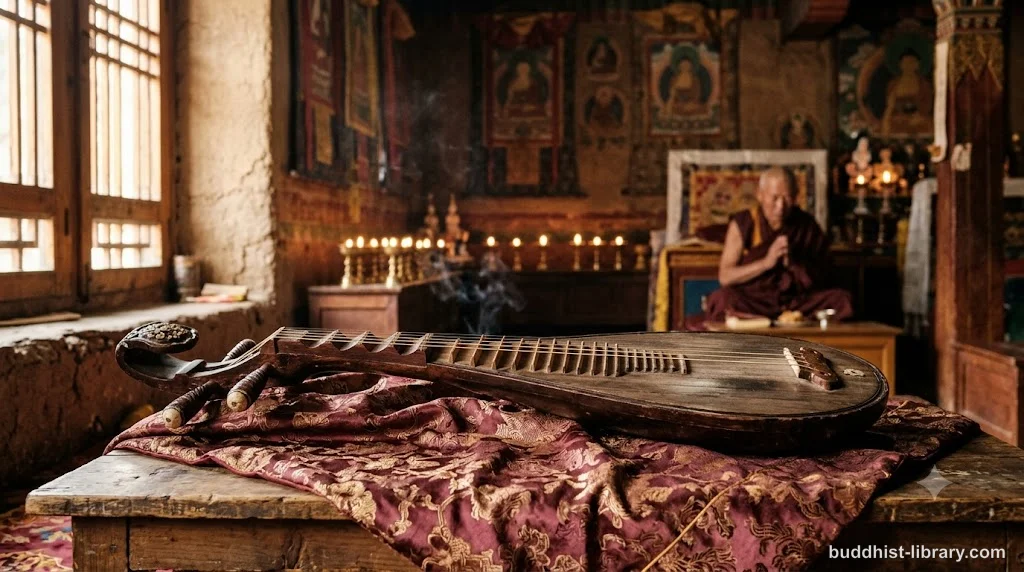
The Buddha teaches one of his most practical lessons on spiritual effort: like tuning a lute, practice requires balance. Too much tension breaks the string; too little produces no sound. The middle way of energy produces the music of awakening.
What Is the Vīṇopama Teaching?
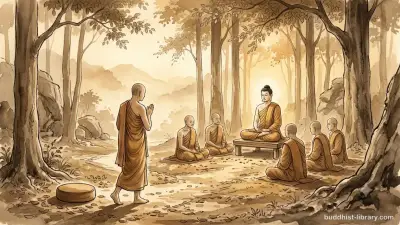
The Vīṇopama (sometimes called the Vīṇā Sutta or Simile of the Lute) records the Buddha’s teaching to Venerable Soṇa Koḷivisa, a monk who nearly destroyed his practice through sheer determination. Soṇa came from wealth. His feet had never known hardship. In his zeal to attain awakening, he practiced walking meditation until his feet bled.
Yet despite — or perhaps because of — this extreme effort, he made no progress. Exhausted and discouraged, Soṇa considered giving up monastic life entirely. Maybe he’d do better as a layperson practicing generosity.
The Buddha, perceiving Soṇa’s state of mind, came to him with a question that cuts to the heart of sustainable practice.
The Buddha’s Question About the Lute
The Buddha asked Soṇa: “Didn’t you formerly know how to play the lute?”
Soṇa, who had been a skilled musician before ordaining, replied yes.
“And when the strings of your lute were too taut,” the Buddha continued, “was your lute in tune and playable?”
“No, venerable sir.”
“And when the strings were too loose, was your lute in tune and playable?”
“No, venerable sir.”
“But when the strings were neither too taut nor too loose, but tuned to an even pitch — was your lute then in tune and playable?”
“Yes, venerable sir.”
The Buddha then delivered the teaching: “In the same way, Soṇa, when energy is too forceful it leads to restlessness, and when energy is too slack it leads to laziness. Therefore, Soṇa, determine on an evenness in your energy.”
Why This Teaching Matters
The Middle Way Applied to Effort
Most people know the Middle Way as a philosophical concept. The Vīṇopama shows what it actually looks like when you’re sitting on your cushion, struggling.
The problem is that nearly everyone falls into one extreme or the other:
Over-striving produces:
- Physical tension and pain
- Mental agitation and anxiety
- Restlessness (uddhacca)
- Burnout and exhaustion
- Aversion toward practice
- The false belief that suffering equals progress
Under-striving produces:
- Drowsiness and dullness (thīna-middha)
- Scattered attention
- Procrastination
- Stagnation in development
- The false belief that comfort equals wisdom
What the Buddha taught Soṇa cuts through both mistakes: real awakening comes from effort that’s alert but not tense, sustained but not strained.
Personal Calibration Required
The Buddha didn’t hand Soṇa a rule book. No “meditate three hours daily.” No “practice until you reach this specific state.” Instead, he asked Soṇa to remember what he already knew from music: you have to tune your own instrument.
Different lutes need different tension. So do different practitioners. Someone with a naturally driven temperament needs to learn to ease off. Someone inclined toward comfort needs to learn to lean in. What’s “too tight” for one person is “too loose” for another.
The instruction — determine on an evenness in your energy — means finding that middle path through trial and awareness, not through following someone else’s prescription.
Key Points: Tuning Your Practice
- The lute strings represent mental and physical energy in practice — spiritual effort (viriya) must be balanced to produce the “music” of insight and peace
- Too tight = restlessness and burnout — over-striving leads to agitation, physical strain, and eventual discouragement or disrobing
- Too loose = laziness and stagnation — under-exertion produces dullness, distraction, and no real development
- The middle way produces awakening — effort that is alert, consistent, and sustainable over the long term is what leads to realization
- You must tune your own instrument — the Buddha invites personal calibration, not blind adherence to external rules about how hard to practice
- Soṇa attained arahatship after this teaching — according to the Vinaya account, adjusting his effort led Soṇa to full enlightenment shortly afterward
How to Recognize Balanced Effort
Signs Your Effort Is Too Tight
- Constant physical tension (clenched jaw, tight shoulders, painful posture)
- Inability to relax or rest without guilt
- Restlessness and agitation even during breaks
- Obsessive self-monitoring (“Am I enlightened yet?”)
- Aversion arising toward practice itself
- Comparing yourself harshly to others
- Sleep disruption from over-arousal
- Thinking “If I just push harder, breakthrough will come”
Signs Your Effort Is Too Loose
- Habitual postponing of practice
- Drowsiness overtaking sessions regularly
- Mind wandering unchecked for long periods
- Justifying comfort as “self-compassion”
- No observable growth over months
- Practice feels optional, easily skipped
- Making plans but rarely following through
- Thinking “I’ll get serious about practice later”
Signs Your Effort Is Balanced
- Alert yet relaxed body and mind
- Consistent daily practice without force
- Challenges met with interest, not dread
- Progress steady, even if gradual
- Ability to adjust when conditions change
- Practice sustainable over years, not weeks
- Wisdom and compassion growing together
- The sense of being “in tune” with the path
Practical Applications Beyond Meditation
The Buddha used meditation as his example, but Soṇa’s lesson applies everywhere:
Study can be obsessive — reading text after text without digesting anything — or it can be lazy, all good intentions and no follow-through. Balanced study means engaging deeply enough to understand, lightly enough to let it settle.
Ethics practiced too tightly becomes scrupulosity, an anxious perfectionism that turns precepts into prison bars. Too loose, and ethics means nothing at all. Real ethical practice involves genuine care without self-torture.
Speech that’s too controlled chokes off honest communication. Too loose, and it’s just noise. Right speech emerges from paying attention, not from rigid rules about what you can and can’t say.
Work can consume you or bore you. The middle way supports both your practice and your survival without sacrificing one to the other.
Relationships need the same balance. Clinging suffocates; indifference kills. Love that respects both intimacy and freedom requires constant tuning.
What the Buddha gave Soṇa — and us — is a lifetime practice of adjustment. You tune the instrument every day until it produces something worth hearing.
What Happened to Venerable Soṇa?
According to the Vinaya, Soṇa took the teaching to heart. He adjusted his practice, finding the middle way between his previous extremes of brutal effort and despair.
Within a short time, he attained full arahatship.
The teaching that saved his practice became one of the most frequently quoted instructions in all of Buddhist literature. Why? Because it answers the question every serious practitioner eventually asks: How hard should I try?
Hard enough to stay awake. Gentle enough to last.
Read more:
- Right Effort (Sammā Vāyāma): The Four Right Exertions in Buddhism — how the Buddha defines wise effort as neither too lax nor too forced
- The Middle Way in Buddhism: Walking Between Extremes — the foundational teaching that the Vīṇopama illustrates in practice
- Working with Restlessness and Worry in Meditation: Buddhist Solutions — practical guidance when your effort is running too tight
📖 Source / license: Vinaya Piṭaka, Mahāvagga (Mv.I.245–246); also referenced in Aṅguttara Nikāya commentary. Translation based on Bhikkhu Bodhi and Thanissaro Bhikkhu.
Frequently asked questions
What is the main teaching of the Vīṇopama?
The Buddha teaches that spiritual effort must be balanced — neither too tense nor too slack — just as a lute must be tuned neither too tight nor too loose to produce beautiful music.
Who was this teaching given to?
The Buddha gave this teaching to Venerable Soṇa Koḷivisa (or Soṇa Kuṭikaṇṇa), a monk who was over-exerting himself in walking meditation until his feet bled.
How do I know if my effort is too tight or too loose?
Effort that is too tight produces restlessness, anxiety, and physical strain. Effort that is too loose leads to drowsiness, distraction, and stagnation. Balanced effort feels alert yet relaxed, sustainable over time.
Is this teaching only about meditation?
No. While the Buddha used meditation as the context, the principle applies to all aspects of practice — study, ethics, daily mindfulness, and livelihood. Sustainable practice requires the middle way in energy.