What Is Anumodanā? Rejoicing in Merit in Buddhist Practice
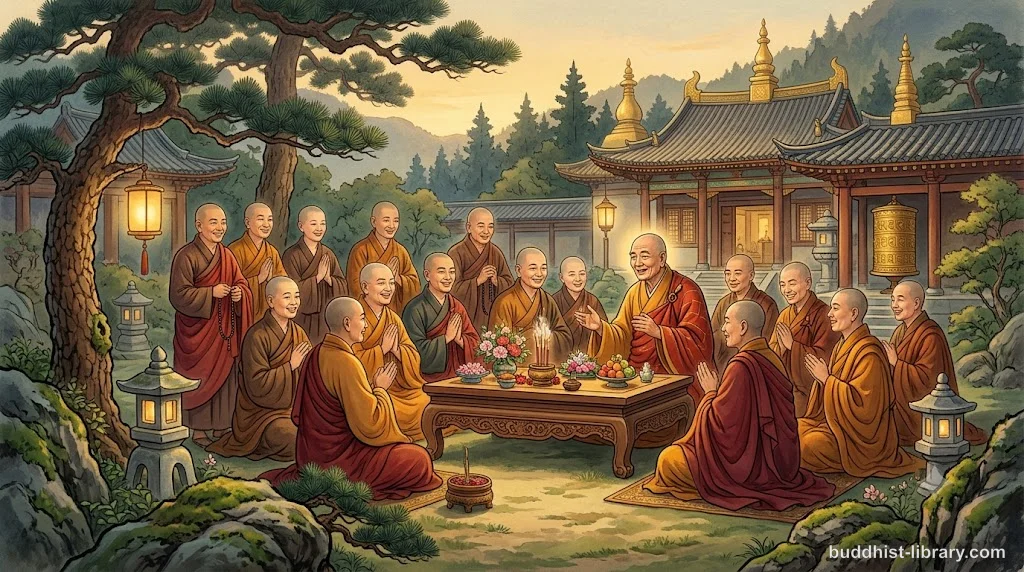
Anumodanā is the practice of rejoicing in wholesome actions—your own, others, or both. It is a deliberate mental response that transforms envy into appreciation, indifference into joy. The Buddha and the early tradition recognized something we often miss: how you relate to goodness—whether you celebrate it or resent it—shapes your mind as powerfully as the good deed itself.
The word itself tells the story. Anu- means “along with” or “following.” Modanā is joy, delight. Together: rejoicing along with, appreciative gladness. You are not creating the wholesome action. You are witnessing it and choosing to align your heart with it. That choice—according to the Buddhist teaching on intention (cetanā)—generates its own wholesome kamma.
Where Anumodanā Appears in the Tradition
Anumodanā is not the subject of a single famous sutta. It appears more in ritual contexts and in the systematization of the tradition found in the Abhidhamma and commentaries. The clearest mention is in the Dasa Puññakiriyavatthu—the Ten Bases of Meritorious Action—a list that appears in the Abhidhamma Piṭaka and is widely taught across Theravāda Buddhism.
The Ten Bases of Merit
The list identifies ten ways beings create wholesome kamma (puñña):
- Dāna – Generosity, giving
- Sīla – Virtue, ethical conduct
- Bhāvanā – Mental development, meditation
- Apacāyana – Showing respect, honoring
- Veyyāvacca – Service, helping others
- Pattidāna – Sharing or transferring merit
- Pattānumodanā – Rejoicing in merit transferred to oneself
- Dhammassavana – Listening to the Dhamma
- Dhammadesanā – Teaching the Dhamma
- Diṭṭhijjukamma – Straightening one’s views
Number seven—pattānumodanā—is the formal term for rejoicing in merit that has been dedicated or transferred to you. But the principle extends beyond that specific case. The broader practice of anumodanā includes rejoicing in any wholesome action: your own past generosity, a friend’s patience, a stranger’s kindness, a teacher’s wisdom.
Is Merit Transfer Debated?
Yes. The idea that one person can transfer merit to another is interpreted differently across Buddhist traditions. In Theravāda practice, pattidāna (merit dedication) is common—monastics chant blessings after a meal offering, and laypeople dedicate merit to deceased relatives. The mechanism is understood variously: some say the deceased rejoice and thereby gain their own merit (anumodanā); others treat it more symbolically as an expression of goodwill. In early Mahāyāna, the bodhisattva’s transfer of merit to all beings became central. But the core point for anumodanā is uncontroversial: your own act of rejoicing generates wholesome kamma, regardless of whether the original merit “transfers.”
Anumodanā vs. Muditā: What Is the Difference?
This is a common confusion. Both involve joy in response to goodness, but they operate at different levels.
-
Muditā is one of the four brahmavihāras—the boundless meditative qualities (loving-kindness, compassion, sympathetic joy, equanimity). It is a limitless, impartial joy in the happiness and success of all beings. You cultivate muditā by radiating “May all beings rejoice in their good fortune” without boundary or exclusion. It is a heart-quality, developed in formal meditation and carried into life.
-
Anumodanā is a specific practice: noticing a wholesome deed and choosing to feel glad about it. It is more concrete, more tied to particular actions. When a monk finishes the meal blessing and the laypeople respond “Sādhu, sādhu” (well done, well said), that is anumodanā. When you give a donation and later reflect “That was skillful, I am glad I did that,” that is anumodanā for your own deed.
Think of muditā as the underlying disposition—a mind trained not to begrudge success or goodness. Anumodanā is the repeated micro-practice that builds that disposition. Every time you notice something good and choose joy over envy or indifference, you are training muditā.
Why Anumodanā Matters: The Psychology of Comparison
The human default is comparison. You see someone else’s generosity and immediately measure it against your own. Theirs is greater? Envy. Yours is greater? Pride. Either way, the good deed becomes a referendum on your worth—which is exactly how the unwholesome roots (greed, aversion, delusion) hijack even the perception of virtue.
Anumodanā interrupts that pattern. It reframes the good deed as something to celebrate, not compete with. The immediate mental move is: “That was wholesome. I am glad it happened.” No measuring. No “but I could have done more.” No “they only did it for status.” Just appreciation.
This is not naive. You can still discern unskillful motivation when it is present. But the reflex shifts—look for what was wholesome first, then rejoice in it. Suspicion and resentment stop being the default.
The Antidote to Envy
Envy (issā) is listed among the mental defilements that bind beings to suffering. It is the pain you feel at another’s good fortune. Anumodanā is the direct antidote. When you train yourself to rejoice in what others accomplish, envy loses its foothold. There is no room for “why not me?” when your immediate response is “how wonderful that this good thing happened.”
This does not mean you stop striving. It means your striving is not poisoned by resentment. You can work toward your own generosity, your own patience, your own wisdom—and simultaneously celebrate when others embody those qualities. The mind becomes spacious enough to hold both.
How to Practice Anumodanā
1. Notice the Good
The first step is simple: pay attention. Goodness is everywhere, but the untrained mind filters it out. Someone lets you merge in traffic. A coworker stays late to help. You restrain yourself from harsh speech when angry. A neighbor donates to a food bank. A teacher offers guidance without expecting payment.
These are all wholesome actions. The practice is to notice them.
2. Name It Internally
When you see something wholesome, name it. “That was generous.” “That was kind.” “That was restraint.” This is not performative—you are training perception. The mind learns to recognize wholesome action as a category worth attending to.
3. Feel Appreciation
This is where anumodanā becomes more than analysis. You are not just noting “that was skillful.” You are letting yourself feel glad about it. This may be subtle at first—a brief warmth, a mental nod. Over time it deepens. You can cultivate it the way you cultivate mettā: by returning to the thought and allowing the feeling to stabilize.
4. Express It When Appropriate
In Buddhist cultures, anumodanā is often verbal. After a monk gives a blessing, the assembly responds “Sādhu!” (excellent, well done). After someone shares the Dhamma, listeners express gratitude. This is not flattery—it is collective reinforcement of the wholesome.
In everyday life, this can be as simple as “Thank you, that was kind,” or “I really appreciate what you did.” You are naming the goodness out loud, which makes it more real for both of you.
5. Rejoice in Your Own Wholesome Actions
This one is tricky for people trained to be humble or self-effacing. But anumodanā applies to your own deeds too. After you give, after you practice restraint, after you meditate or help someone, take a moment to acknowledge: “That was wholesome. I am glad I did that.”
This is not pride. Pride says “I am better than others because I did this.” Anumodanā says “Wholesome action occurred, and I am glad.” The focus is on the quality of the action, not on inflating the self. The Buddha taught that wholesome kamma leads to happiness—so why not let yourself feel that happiness consciously?
Anumodanā in Formal Practice
After Dāna (Generosity)
The most common ritual use of anumodanā is after an offering of food or requisites to monastics. The monk recites a blessing (often verses on the fruits of generosity), and the laypeople respond with “Sādhu, sādhu, sādhu.” This is anumodanā—rejoicing in the wholesome deed of giving.
You can do this for your own acts of generosity even outside a monastic context. After you donate, after you give your time or resources, pause and mentally rejoice. Let yourself feel glad that this wholesome action happened.
After Hearing Dhamma
In many traditions, a Dhamma talk ends with the teacher and listeners sharing merit. The teacher may say, “May the merit of this teaching be shared with all beings,” and the listeners respond “Sādhu” or recite an anumodanā verse. This reinforces the wholesome intention behind both the teaching and the listening.
Anumodanā for the Deceased
In Theravāda cultures, it is customary to dedicate merit to deceased relatives. The family performs a wholesome act (offering food to monks, chanting, meditation) and then mentally transfers the merit, saying “May this merit reach our departed loved ones.” The belief is that if the deceased are in a state where they can perceive this dedication, they will rejoice—and that rejoicing generates their own merit. Whether the mechanism is literal or symbolic, the practice cultivates generosity and connection across the boundary of death.
Obstacles to Anumodanā
Envy and Comparison
You see someone’s generosity and immediately think, “I should have done that,” or “I could never afford that.” The wholesome deed becomes a mirror for your perceived lack. This is the most common obstacle.
Antidote: Start with deeds that do not trigger your insecurities. Rejoice in a child’s sharing, in an animal’s gentleness, in historical acts of courage. Build the habit in safe territory. When envy arises, name it, notice how it feels in the body, and gently return to appreciation. Over time, the reflex shifts.
Cynicism
The mind says, “They only did that for status,” or “It is easy for them—they have money.” This is aversion disguised as discernment. You are dismissing the wholesome to protect yourself from feeling inadequate.
Antidote: Even if mixed motives are present, what was wholesome is still wholesome. A generous act done partly for recognition still feeds someone hungry. Rejoice in the result. You do not have to canonize the person; you are celebrating the quality of the action.
Indifference
Sometimes the obstacle is not envy or cynicism but simple numbness. Goodness happens and you do not care. This is delusion (moha)—the mind too dull or distracted to notice what matters.
Antidote: Slow down. Make anumodanā a deliberate practice. Set an intention: “Today I will notice three wholesome actions and mentally rejoice in them.” This trains perception. Over weeks, the mind becomes more sensitive to goodness.
Measuring Your Own Practice
You start practicing anumodanā and immediately begin tracking: “Have I rejoiced enough today? Was my rejoicing sincere? Am I doing this right?” Now the practice itself becomes another arena for self-judgment.
Antidote: Anumodanā is not a performance. It is a direction of attention. Some days the joy will be vivid; other days it will be faint. That is fine. The point is the repeated choice to turn toward goodness rather than away from it. Trust the process.
How Anumodanā Relates to Other Practices
Merit (Puñña)
Anumodanā is one of the ten bases of meritorious action. Every time you rejoice in wholesome kamma, you are creating your own wholesome kamma. The Buddha taught that intentions shape the mind’s future. By training the mind to align with goodness, you incline it toward more goodness.
Muditā (Sympathetic Joy)
As discussed, anumodanā is a concrete expression of the brahmavihāra of muditā. If muditā is the ocean, anumodanā is the wave—each instance of rejoicing deepens the broader quality of sympathetic joy.
Right View (Sammā Diṭṭhi)
Anumodanā depends on seeing clearly: recognizing what is wholesome, understanding that actions have consequences, knowing that your mind’s response to goodness matters. This is an application of Right View. When you rejoice in generosity, you are affirming that generosity leads to happiness. When you rejoice in patience, you are affirming that patience is a trainable skill. The practice makes your understanding of kamma experiential, not just intellectual.
Gratitude
Buddhist practice does not have a single Pali term that maps exactly onto modern “gratitude,” but anumodanā is the closest functional equivalent. It is the practice of noticing what is good and letting yourself feel glad about it. This is what gratitude is—a conscious choice to appreciate rather than take for granted.
Common Questions
Do I Have to Rejoice Out Loud?
No. Anumodanā is primarily a mental practice. The verbal expression (saying “Sādhu” or “Thank you”) is useful because it makes the practice explicit and shared, but the essence is the internal shift from indifference or envy to appreciation.
Can I Rejoice in Someone’s Success Even If I Am Struggling?
Yes, and this is where the practice gets hard and valuable. When you are unemployed and a friend gets promoted, anumodanā asks you to feel genuinely glad for them. This does not mean pretending your struggle does not hurt. It means the two can coexist: you can feel the difficulty of your situation and feel joy for your friend. This is not compartmentalization—it is the spaciousness that comes from not making everything about you.
Is Anumodanā Just Positive Thinking?
No. Positive thinking often involves denial—pretending things are fine when they are not. Anumodanā is the opposite: it is seeing clearly what is wholesome and responding appropriately. If someone acts with cruelty, you do not rejoice. If someone acts with kindness, you do. The practice is discernment plus heart.
What If I Cannot Feel the Joy?
Then notice that. “I see this was wholesome, but I feel nothing.” That is data. What is in the way? Envy? Resentment? Exhaustion? Depression? The practice does not require faking emotion. It requires honest attention. Over time, as the obstacles are worked with, the capacity for joy returns.
Anumodanā as a Way of Life
The formal contexts—saying “Sādhu” after a blessing, dedicating merit to the deceased—are where the practice is most visible. But anumodanā becomes transformative when it moves into the ordinary moments.
You notice your own restraint and mentally acknowledge it. You see a colleague’s patience and feel glad. You read about someone’s decades of service and let yourself be moved. You watch a child share and smile. Each of these is a small act of anumodanā, and each one trains the mind a little further toward appreciation and away from envy.
The cumulative effect is a mind that defaults to celebration rather than comparison. Not because you are naive, but because you have trained perception to notice goodness and trained the heart to align with it.
When the tradition says anumodanā generates merit, this is what it means. You are not racking up cosmic points. You are shaping the mind in the direction of freedom. A mind that can rejoice in others’ wholesome deeds is a mind less bound by jealousy, resentment, and self-centeredness.
Conclusion
Anumodanā is the practice of rejoicing in wholesome actions—your own, others, or both. It is a specific application of sympathetic joy (muditā), a recognized basis of merit (puñña), and a direct antidote to envy and comparison. It appears in ritual contexts (blessings, merit dedication) and in daily life (noticing kindness, appreciating generosity, celebrating patience).
The practice is simple: notice the good, name it, feel glad. The obstacles are equally simple: envy, cynicism, indifference, and self-judgment. The training is patient repetition. Over time, the mind learns to default to appreciation. That shift—from zero-sum comparison to genuine gladness—is what makes anumodanā a practice worth returning to, day after day.
When someone is generous, be glad. When someone is patient, be glad. When you yourself act skillfully, be glad. This is not ego. This is alignment with what is wholesome. And that alignment shapes everything that follows.
Read more:
- What Is Muditā? Sympathetic Joy in Buddhism — Explore the brahmavihāra of appreciative joy, the broader heart-quality of which anumodanā is a specific practice. Learn formal meditation instructions and how to cultivate genuine joy in others’ happiness.
- Dāna: The Practice and Power of Generosity in Buddhism — Understand the first of the ten bases of merit and the wholesome action most often followed by anumodanā. Discover why generosity is the foundation of the path and how giving reshapes the mind.
- What Is Puñña (Merit) in Buddhism? Understanding Wholesome Actions and Their Results — Learn the framework of merit that includes anumodanā as one of the ten bases of meritorious action, and how intention shapes the mind’s trajectory toward happiness or suffering.
📖 Source / license: Dasa Puññakiriyavatthu (Ten Bases of Meritorious Action, from Abhidhamma and Commentarial tradition); Access to Insight study guide on Merit; Thanissaro Bhikkhu, dhammatalks.org essays on merit and kamma
Frequently asked questions
Is anumodanā the same as muditā?
No, though they are closely related. Muditā (sympathetic joy) is one of the four brahmavihāras—a boundless meditative quality directed toward the happiness and success of all beings. Anumodanā is more specific—it means rejoicing in wholesome deeds, your own or others, and is often practiced after acts of generosity or other merit-making. Muditā is the broader heart quality; anumodanā is a specific application of it in the context of wholesome actions.
Can I gain merit just by rejoicing in someone else's good deed?
Yes, according to the Buddhist tradition. The commentaries teach that rejoicing in another person's wholesome action creates your own wholesome kamma, though the amount depends on the sincerity and depth of your joy. This is not passive—genuine rejoicing requires a conscious choice to appreciate goodness rather than compare or envy. The Buddha emphasized that intention (cetanā) is what makes an action kamma, so your heartfelt appreciation generates its own wholesome result.
How is anumodanā practiced in daily life?
Anumodanā is practiced whenever you notice something good—a friend's generosity, a stranger's kindness, your own restraint from harmful speech. Pause, acknowledge it internally ("That was skillful"), and feel genuine appreciation. In formal settings, it is the blessing or thanks offered after a meal offering to monks, or after hearing a Dhamma talk. In daily life, it is training the mind to notice and celebrate goodness wherever it appears, rather than defaulting to indifference or envy.
What if my rejoicing feels fake or forced?
This is common, especially if you are dealing with comparison or envy. Start small—rejoice in deeds that do not trigger your insecurities. Notice when a child shares a toy, or when someone picks up litter. As you train this response in easy cases, it becomes more natural in harder ones. If it still feels fake, that is data—investigate what is blocking the joy (fear of inadequacy, zero-sum thinking, unresolved resentment). Anumodanā exposes these patterns so you can work with them directly.