What Is Bodhi? Understanding Awakening and Enlightenment in Buddhism
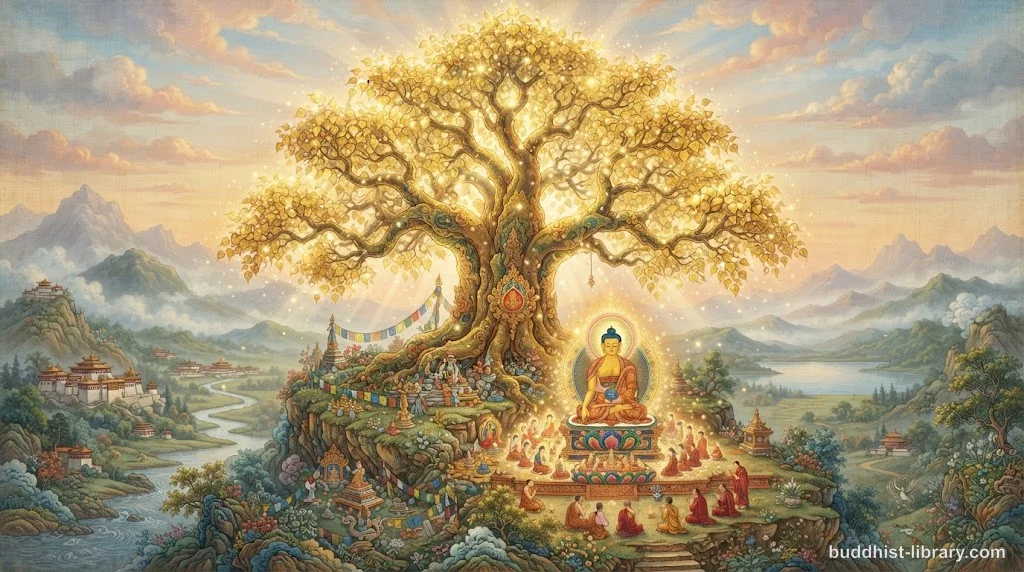
Bodhi is awakening—the direct, transformative realization of the truth that ends suffering. It is not a mystical state or philosophical belief, but the clear seeing of reality as it is, which destroys ignorance and craving at their root. The Buddha’s enlightenment under the Bodhi tree was the supreme example of bodhi: the complete, irreversible understanding that liberates the mind forever.
The term “bodhi” (Pali and Sanskrit: बोधि) literally means “awakening” or “enlightenment.” It comes from the root budh, “to awaken” or “to know”—the same root from which “Buddha” (the Awakened One) derives. Bodhi is not something you acquire or achieve in the ordinary sense; it is the removal of ignorance that reveals what has always been true.
What Does Bodhi Mean in the Buddhist Context?
Bodhi is the wisdom that penetrates the Four Noble Truths and realizes the nature of dependent origination (paṭiccasamuppāda). It is the knowledge that suffering arises from craving and ignorance, and that by eliminating these causes, suffering ceases.
In the Ariyapariyesana Sutta (MN 26), the Buddha describes his own awakening:
“I sought what is unborn, unaging, unailing, deathless, sorrowless, undefiled, the supreme security from bondage—Nibbāna—and I attained it.”
Bodhi is the event, the breakthrough moment when this realization occurs. Nirvana (nibbāna) is the result—the unconditioned freedom that follows. The two are intimately related but distinct: bodhi is the knowing; nirvana is the liberation that knowing brings.
The Core Insight of Bodhi
At the heart of bodhi is the direct perception of three characteristics of all conditioned phenomena:
- Anicca (impermanence) — all things arise and pass away
- Dukkha (suffering/unsatisfactoriness) — clinging to impermanent things causes suffering
- Anattā (non-self) — there is no permanent, unchanging self
When these truths are not just intellectually understood but directly seen through sustained meditation and insight, ignorance (avijjā) is destroyed. With ignorance gone, craving (taṇhā) ceases. With craving gone, suffering ends.
What Are the Three Types of Bodhi?
Early Buddhist texts describe three kinds of awakening, depending on how the realization is attained:
1. Sammā-Sambodhi (Perfect Self-Awakening)
This is the enlightenment of a sammā-sambuddha—a fully self-enlightened Buddha who discovers the path without a teacher and then teaches it to the world. This was the Buddha Gotama’s attainment.
The sammā-sambuddha not only realizes the truth but also possesses the skill and compassion to articulate the Dhamma in ways that guide others. This type of bodhi is exceedingly rare; according to tradition, only one sammā-sambuddha arises in a world-system at a time.
2. Pacceka-Bodhi (Solitary Awakening)
This is the enlightenment of a paccekabuddha—one who awakens on their own, without a teacher, but does not teach the path to others (either because they lack the skill to teach or because the world is not ready).
Paccekabuddhas realize the same truth as a sammā-sambuddha but do not establish a teaching tradition. They live quietly, often in forests, and pass away without leaving a lineage of disciples.
3. Sāvaka-Bodhi (Disciple’s Awakening)
This is the enlightenment of a sāvaka (disciple)—one who awakens by following the teaching of a Buddha. This includes all arahats who attain liberation through the Buddha’s guidance.
While the depth of realization is the same (both a sammā-sambuddha and a sāvaka-arahat destroy all defilements and attain nirvana), the sammā-sambuddha possesses unique qualities such as the ten powers (dasabalāni) and omniscience in certain domains.
Most practitioners on the Buddhist path aim for sāvaka-bodhi—awakening as a disciple—which is far more accessible and leads to the same ultimate freedom.
How Did the Buddha Attain Bodhi?
The story of the Buddha’s awakening is recounted in the Ariyapariyesana Sutta (MN 26) and elaborated in commentarial literature. After six years of extreme asceticism, Prince Siddhārtha realized that self-mortification was not the path to liberation. He accepted food, regained his strength, and sat beneath a fig tree (later called the Bodhi tree) in Bodh Gaya, resolving not to rise until he had attained full awakening.
The Night of Awakening
According to tradition, during the night of the full moon in the month of Vesākha, Siddhārtha passed through several stages:
First watch of the night: He recalled his past lives in detail, seeing the chain of births and deaths stretching back through countless lifetimes.
Second watch: He developed the “divine eye” (dibbacakkhu), perceiving how beings are reborn according to their karma—wholesome actions leading to fortunate rebirths, unwholesome actions to unfortunate ones.
Third watch: He penetrated the Four Noble Truths, realized dependent origination, and destroyed the āsavas (mental taints)—sensual desire, craving for existence, and ignorance. At that moment, he became a Buddha, the Fully Awakened One.
The Udāna (Ud 1.1–3) records the Buddha’s first utterances immediately after his awakening, expressions of joy and wonder at having found the “builder of the house” (craving) and dismantled it forever.
Is Bodhi the Same as Nirvana?
No, though they are closely related.
- Bodhi is the awakening, the wisdom-event that sees things as they are.
- Nirvana (Nibbāna) is the unconditioned state realized through that awakening—the complete cessation of craving, aversion, and delusion.
An analogy: bodhi is like turning on a light in a dark room; nirvana is the illuminated room itself. The light (wisdom) reveals what was always there, and the darkness (ignorance) is dispelled.
In the Saṃyutta Nikāya, the Buddha teaches that nirvana is “the destruction of greed, the destruction of hatred, the destruction of delusion” (SN 38.1). Bodhi is the realization that makes this destruction possible.
Can Bodhi Be Lost Once Attained?
No. According to the early texts, bodhi is irreversible. Once ignorance is completely destroyed and the Four Noble Truths are fully penetrated, there is no going back.
The Kīṭāgiri Sutta (MN 70) makes clear that a stream-enterer (sotāpanna)—the first level of awakening—is “incapable of passing away without having realized the fruit of arahantship.” Higher levels of awakening (once-returner, non-returner, arahat) are similarly irreversible.
This irreversibility is one of the defining features of genuine bodhi. It is not a temporary peak experience or altered state; it is a permanent transformation of understanding.
What Is the Bodhi Tree?
The Bodhi tree (Ficus religiosa, also called the pippala or sacred fig) is the tree under which the Buddha attained enlightenment in Bodh Gaya, India. It has become one of the most revered symbols in Buddhism.
The original tree is long gone, but descendant trees grown from cuttings have been planted at sacred sites around the world. The most famous is the Sri Maha Bodhi in Anuradhapura, Sri Lanka, which was planted in 288 BCE from a cutting of the original tree and is considered the oldest historically documented tree in the world.
Bodhi trees are often found at Buddhist temples and monasteries as a living reminder of the Buddha’s awakening and a symbol of the potential for enlightenment in all beings.
How Does One Cultivate Bodhi?
Bodhi is not produced by effort alone—it is the result of removing ignorance through the systematic cultivation of the path. The Buddha outlined this path in the Noble Eightfold Path:
- Right View — understanding the Four Noble Truths
- Right Intention — renunciation, goodwill, harmlessness
- Right Speech — truthful, kind, and beneficial words
- Right Action — ethical conduct in body
- Right Livelihood — ethical work
- Right Effort — cultivating wholesome states, abandoning unwholesome ones
- Right Mindfulness — continuous awareness of body, feelings, mind, and phenomena
- Right Concentration — deep meditative absorption (jhāna)
Through sustained practice of ethics (sīla), concentration (samādhi), and wisdom (paññā), the mind becomes purified, stable, and penetrative. Insight meditation (vipassanā) reveals the three characteristics of existence directly. When this insight matures, bodhi arises.
Key Practices Leading to Bodhi
- Meditation on impermanence, suffering, and non-self — seeing these truths in all phenomena
- Cultivation of the seven factors of enlightenment (bojjhaṅga) — mindfulness, investigation, energy, joy, tranquility, concentration, equanimity
- Development of the four foundations of mindfulness (satipaṭṭhāna) — body, feelings, mind, dhammas
- Ethical living — observing the precepts, practicing generosity and compassion
The path is gradual; the breakthrough is sudden. As the Cūḷavedalla Sutta (MN 44) explains, understanding develops step by step, but the moment ignorance is finally destroyed is immediate and irreversible.
What Does It Feel Like to Attain Bodhi?
The early texts describe bodhi as a state of profound peace, unshakable certainty, and complete freedom. The Aṅguttara Nikāya (AN 9.36) records:
“The liberated mind is unshakable; there is no more becoming for one who is freed.”
The Buddha described his own experience in the Bhayabherava Sutta (MN 4) as “the supreme security from bondage,” free from fear, agitation, and longing. There is no doubt, no need for confirmation from others, and no possibility of regression.
Ṭhānissaro Bhikkhu translates a passage from the Udāna:
“There is, monks, an unborn—unbecome—unmade—unfabricated. If there were not that unborn—unbecome—unmade—unfabricated, there would not be the case that escape from the born—become—made—fabricated would be discerned. But precisely because there is an unborn—unbecome—unmade—unfabricated, escape from the born—become—made—fabricated is discerned.”
This is the unconditioned reality glimpsed in bodhi.
Why Does Bodhi Matter?
Bodhi is the goal of the Buddhist path. Everything the Buddha taught—ethics, meditation, wisdom, the monastic community, the scriptures—exists to support and point toward this awakening.
Without bodhi, the cycle of suffering (saṃsāra) continues. With bodhi, suffering ends. The Buddha was unequivocal: “Both formerly and now, I teach only suffering and the end of suffering” (MN 22).
Bodhi is not an escape into bliss or a retreat from the world; it is the clear seeing of reality that frees the mind from delusion, greed, and hatred. A person who has attained bodhi lives in the world with wisdom, compassion, and equanimity, no longer driven by craving or aversion.
Key Points to Remember
- Bodhi is awakening—the direct realization of the truth that ends suffering, not a belief or concept.
- Three types exist—the Buddha’s complete self-awakening (sammā-sambodhi), solitary awakening (pacceka-bodhi), and disciple’s awakening (sāvaka-bodhi).
- Bodhi and nirvana are related but distinct—bodhi is the wisdom; nirvana is the freedom that wisdom reveals.
- Bodhi is irreversible—once ignorance is destroyed through complete penetration of the Four Noble Truths, there is no going back.
- The Buddha attained bodhi under the Bodhi tree in Bodh Gaya after perceiving his past lives, understanding karma, and realizing dependent origination.
- Bodhi is cultivated through the Eightfold Path—ethics, concentration, and wisdom practiced together remove ignorance and reveal the unconditioned.
- All beings have the potential for bodhi—the path is open to anyone willing to walk it with sincerity and diligence.
Frequently Asked Questions
What is the difference between bodhi and nirvana?
Bodhi is the awakening or wisdom that realizes the truth, while nirvana (nibbāna) is the cessation of suffering that results from that awakening. Bodhi is the knowing; nirvana is the freedom that knowing brings.
Can anyone attain bodhi?
Yes. While sammā-sambodhi (the Buddha’s complete self-awakening) is exceptionally rare, all beings have the potential to awaken through practice. Most practitioners aim for sāvaka-bodhi—awakening as a disciple of the Buddha—which leads to the same liberation.
What did the Buddha realize under the Bodhi tree?
The Buddha realized the Four Noble Truths, the nature of dependent origination, the end of craving and ignorance, and the complete cessation of suffering. He saw directly how suffering arises and how it can be ended—knowledge that cannot be unlearned.
Is bodhi a sudden or gradual experience?
Both gradual cultivation and sudden realization are involved. The path (meditation, ethics, wisdom) is gradual, but the moment of breakthrough—when ignorance is finally destroyed—is described as sudden and irreversible in the early texts.
How is bodhi different from stream-entry?
Stream-entry (sotāpanna) is the first taste of awakening, the first irreversible breakthrough that guarantees eventual full enlightenment within seven lifetimes. Full bodhi (arahantship) is the complete destruction of all defilements and the end of rebirth. Both are forms of bodhi, but differ in depth and completeness.
Conclusion
Bodhi is the heart of Buddhism—the awakening that ends suffering and reveals the unconditioned. It is not reserved for saints or monastics; it is the natural result of walking the path the Buddha taught: living ethically, training the mind, and cultivating wisdom.
The Buddha’s enlightenment under the Bodhi tree over 2,500 years ago was not the end of a story, but the beginning—a demonstration that awakening is possible, that suffering can be understood and ended, and that the truth is accessible to anyone willing to see clearly.
Whether one aspires to the rare attainment of a sammā-sambuddha or the more common path of a disciple, the destination is the same: the destruction of ignorance, the cessation of craving, and the unshakable peace of liberation.
Read more:
- What Is Nirvana (Nibbāna)? Meaning and Misconceptions — Understand the unconditioned state that bodhi reveals and how it differs from common misinterpretations of “nothingness” or annihilation.
- The Four Noble Truths: The Heart of the Buddha’s Teaching — Explore the core truths the Buddha realized at his awakening, the foundation of all Buddhist practice.
- What Is Stream Entry (Sotāpanna)? The First Stage of Buddhist Awakening — Learn about the first irreversible breakthrough on the path to full bodhi and what it means to “enter the stream.” eam.” ersible breakthrough on the path to full bodhi and what it means to “enter the stream.”
📖 Source / license: Majjhima Nikāya (MN 26, MN 4), Saṃyutta Nikāya (SN 56.11), Udāna 1.1–3; translations by Bhikkhu Bodhi and Bhikkhu Ñāṇamoli
Frequently asked questions
What is the difference between bodhi and nirvana?
Bodhi is the awakening or wisdom that realizes the truth, while nirvana (nibbāna) is the cessation of suffering that results from that awakening. Bodhi is the knowing; nirvana is the freedom that knowing brings.
Can anyone attain bodhi?
Yes. While sammā-sambodhi (the Buddha's complete self-awakening) is exceptionally rare, all beings have the potential to awaken through practice. Most practitioners aim for sāvaka-bodhi—awakening as a disciple of the Buddha—which leads to the same liberation.
What did the Buddha realize under the Bodhi tree?
The Buddha realized the Four Noble Truths, the nature of dependent origination, the end of craving and ignorance, and the complete cessation of suffering. He saw directly how suffering arises and how it can be ended—knowledge that cannot be unlearned.
Is bodhi a sudden or gradual experience?
Both gradual cultivation and sudden realization are involved. The path (meditation, ethics, wisdom) is gradual, but the moment of breakthrough—when ignorance is finally destroyed—is described as sudden and irreversible in the early texts.