What Is a Sammā-Sambuddha? Understanding the Perfectly Enlightened Buddha
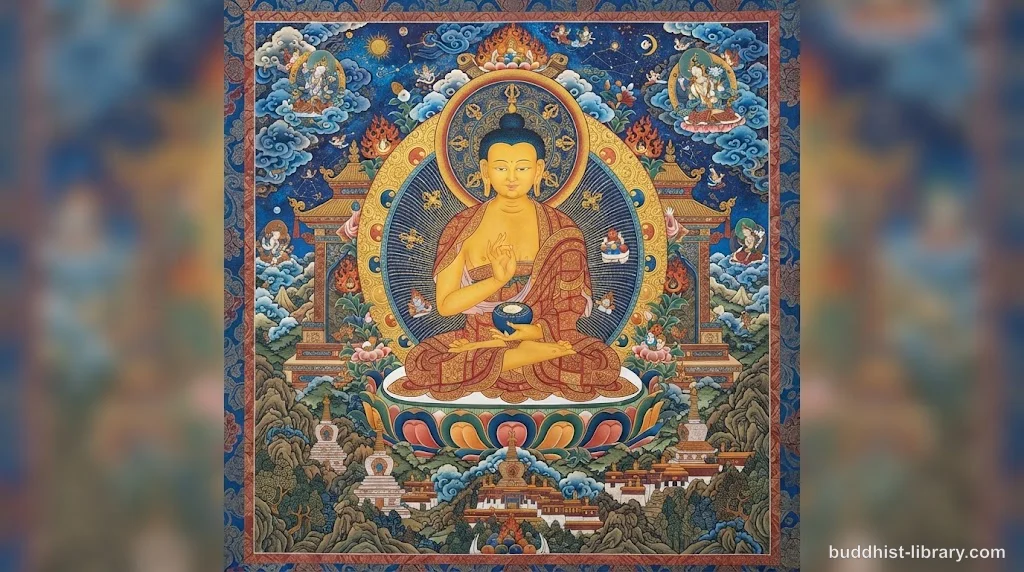
A Sammā-Sambuddha is a perfectly self-enlightened Buddha who, without a teacher, rediscovers the path to Nibbāna during a dark age when the Dhamma has been forgotten, then compassionately teaches it to the world. This isn’t just an honorary title. The term marks a functional distinction—the difference between founding a teaching and following one.
The Pāli sammā-sambuddha breaks down into sammā (rightly, perfectly) and sambuddha (self-awakened). Someone who has not only attained the highest wisdom but done so independently—and can establish an entirely new dispensation of the Dhamma.
What Does Sammā-Sambuddha Mean?
The word sammā-sambuddha appears throughout the early Buddhist texts to designate the Buddha Gotama and the rare class of enlightened beings he represents.
Sammā means “rightly” or “perfectly”—the same prefix used in the Noble Eightfold Path (Right View, Right Intention, etc.). Sambuddha derives from sam- (together, complete) and buddha (awakened). So sammā-sambuddha means “the perfectly and completely self-awakened one.”
In Buddhist cosmology, this marks a cosmic role: when all knowledge of liberation has vanished, the Sammā-Sambuddha independently discovers the Four Noble Truths, attains Nibbāna, and then teaches the path so others can follow.
Without such a Buddha, there would be no Dhamma in the world. The teaching doesn’t exist in books or institutions waiting to be found. It must be rediscovered, lived, and proclaimed anew.
How Is a Sammā-Sambuddha Different from an Arahat?
Both a Sammā-Sambuddha and an Arahat reach the same goal—the complete ending of suffering and the uprooting of greed, hatred, and delusion. Same destination.
The difference? How they get there, and what they do when they arrive.
The Arahat’s Path
An Arahat attains enlightenment by practicing the Buddha’s already-established teaching. The path has been laid out, the method explained, the community (Saṅgha) formed. The Arahat follows these instructions and reaches the goal.
As the Buddha said in the Samyutta Nikaya (22.58): “Whether Tathāgatas arise or not, that element still persists—the lawfulness of phenomena, their fixed nature… A Tathāgata awakens to this and breaks through to it. Having broken through, he explains it, teaches it, proclaims it.”
The Arahat receives this teaching. The Sammā-Sambuddha discovers it from scratch.
The Sammā-Sambuddha’s Unique Role
The Sammā-Sambuddha arises in a “dark age”—when all traces of the previous Buddha’s teaching have disappeared. No scriptures. No monasteries. No living tradition. The path to liberation is unknown.
Through millions of lifetimes cultivating the Ten Perfections as a Bodhisatta, the future Buddha develops the capacity to pierce through ignorance without guidance. In his final life, beneath the Bodhi tree, he rediscovers dependent origination, the Four Noble Truths, and the complete path to Nibbāna.
Entirely alone.
Then comes the crucial step that defines a Sammā-Sambuddha: he teaches. He turns the Wheel of Dhamma, establishes the Fourfold Assembly (monks, nuns, laymen, laywomen), and ensures the teaching will survive his death.
An Arahat may teach skillfully—many did. But an Arahat didn’t create the dispensation. The Sammā-Sambuddha does.
What Are the Unique Qualities of a Sammā-Sambuddha?
The early texts describe several characteristics that mark a Sammā-Sambuddha:
Complete Omniscience in the Dhamma
The Sammā-Sambuddha knows all that is necessary for liberation and can teach it with perfect skill. This is not omniscience in every mundane detail, but complete mastery of the path, its obstacles, and the methods to overcome them.
The Ten Powers (Dasa Balāni)
Unique to a Sammā-Sambuddha, these powers include knowledge of what is possible and impossible, the results of actions, the faculties of beings, their inclinations, past lives, and the destruction of the taints (āsava). The Arahat may develop some of these, but the Buddha’s powers are described as supreme and unshakable.
The Four Confidences (Vesārajja)
The Buddha has unwavering confidence that he has:
- Fully understood all things worth understanding
- Destroyed all taints
- Taught the path that truly leads to liberation
- Identified the real obstacles to the path
Great Compassion (Mahākaruṇā)
All enlightened beings have compassion. But the Sammā-Sambuddha’s compassion is boundless and tireless. For 45 years, the Buddha Gotama walked the dusty roads of northern India teaching everyone—from kings to outcasts. He never stopped until his body gave out.
Establishment of the Sāsana
The Sammā-Sambuddha does not merely teach; he founds a sāsana—a complete dispensation with training rules, monastic structure, textual tradition, and practice methods that can survive for thousands of years.
Can There Be Multiple Sammā-Sambuddhas at the Same Time?
According to Theravāda tradition, no. Only one Sammā-Sambuddha appears in a world-system (cakkavāla) at a time.
The Buddhavaṃsa (Chronicle of the Buddhas) explains that a new Buddha arises only when the previous Buddha’s teaching (sāsana) has completely disappeared—not just the texts, but the living practice, the understanding, and even the memory of the path.
The texts describe five stages of decline after a Buddha’s death:
- Loss of realization (no more Arahats)
- Loss of practice (meditation methods forgotten)
- Loss of learning (scriptures no longer studied)
- Loss of symbols (robes and relics disappear)
- Complete disappearance of all traces
Only when this cycle completes can conditions ripen for the next Sammā-Sambuddha to arise.
Does this mean Buddhas are rare in the universe? Not necessarily. Mahāyāna cosmology speaks of countless Buddhas in countless world-systems. But within any single world-system, the appearance of a Sammā-Sambuddha is extraordinarily rare.
Who Were the Previous Sammā-Sambuddhas?
The Pāli Canon names several Buddhas who appeared before Gotama. The Buddhavaṃsa lists 24 previous Buddhas, and the Mahāpadāna Sutta (Digha Nikaya 14) provides detailed accounts of the most recent seven:
- Vipassī (91 aeons ago)
- Sikhī (31 aeons ago)
- Vessabhū (31 aeons ago)
- Kakusandha (this aeon)
- Koṇāgamana (this aeon)
- Kassapa (this aeon)
- Gotama (our current Buddha)
Each of these Buddhas rediscovered the Dhamma, taught it, and established a dispensation that eventually disappeared. The pattern is remarkably consistent: all Sammā-Sambuddhas realize the same Four Noble Truths, teach the same Noble Eightfold Path, establish similar communities.
What varies? External details. Lifespans, the size of the Saṅgha, the length of the sāsana. But the core teaching remains identical across aeons. As the Buddha said, “Just as the great ocean has one taste, the taste of salt, so this Dhamma has one taste—the taste of liberation.”
Will There Be Another Sammā-Sambuddha?
Yes. The texts predict the next Sammā-Sambuddha will be Metteyya (Maitreya in Sanskrit), the “Buddha of Loving-Kindness.”
According to tradition, Metteyya is currently a Bodhisatta dwelling in the Tusita heaven, perfecting the Ten Perfections. When Gotama Buddha’s teaching has completely vanished and conditions are right, Metteyya will descend, take birth in a human family, renounce, practice, attain enlightenment, and proclaim the Dhamma once again.
The Cakkavatti-Sīhanāda Sutta describes Metteyya’s era: long lifespans, prosperity, ethical living. Conditions that will allow vast numbers to benefit from his teaching.
But don’t hold your breath. Theravāda tradition teaches that the current Buddha’s sāsana will last 5,000 years. We’re roughly 2,600 years in.
Why Does the Title Matter?
The term sammā-sambuddha isn’t ceremonial. It encodes a worldview about how truth is transmitted.
The Buddha didn’t claim to have been told the Dhamma by a god or to have inherited it from an ancient lineage. He discovered it through his own effort, verified it through direct experience, and taught it out of compassion. This makes the Dhamma empirical, testable, free from appeals to authority.
When we call Gotama a sammā-sambuddha, we acknowledge:
- The teaching is rediscovered, not revealed
- It can be verified through practice
- It depends on beings like us walking the path
- It will disappear if not preserved and practiced
- Another will come, but only when we’ve lost it
A reminder: the Dhamma is fragile, precious, and entirely dependent on human effort.
Key Points
- Sammā-Sambuddha means “perfectly self-enlightened Buddha”—one who rediscovers the path to Nibbāna without a teacher and teaches it to the world
- Unlike an Arahat who follows the Buddha’s teaching, a Sammā-Sambuddha discovers the teaching when it has been completely forgotten
- Only one Sammā-Sambuddha appears in a world-system at a time; the next one can arise only after the previous sāsana has vanished
- Gotama Buddha is the seventh in a lineage of Sammā-Sambuddhas stretching back 91 aeons
- The next Sammā-Sambuddha will be Metteyya, predicted to appear thousands of years in the future
- The title emphasizes that the Dhamma is rediscovered through effort, not revealed by authority
Frequently Asked Questions
What makes a Sammā-Sambuddha different from an Arahat?
A Sammā-Sambuddha discovers the path to enlightenment without a teacher during a time when the Dhamma is lost, then establishes the teaching for others. An Arahat achieves enlightenment by following the Buddha’s already-established teaching.
Can there be multiple Sammā-Sambuddhas at the same time?
No. According to Theravāda tradition, only one Sammā-Sambuddha appears in a world-system at a time. The teaching must completely disappear before conditions ripen for another Buddha to arise.
Is Gautama Buddha the only Sammā-Sambuddha?
No. Buddhist texts name previous Buddhas who appeared in past ages—such as Kassapa, Koṇāgamana, and Vipassī—and predict the future Buddha Metteyya. Gautama is the Sammā-Sambuddha of our current era.
How long does it take to become a Sammā-Sambuddha?
According to tradition, a Bodhisatta must perfect the Ten Perfections (pāramī) over countless lifetimes—often described as lasting millions or even incalculable aeons—before conditions are right for final enlightenment.
Does Mahāyāna Buddhism have a different view of Sammā-Sambuddha?
Yes. While Theravāda emphasizes the rarity and singularity of Sammā-Sambuddhas, Mahāyāna cosmology speaks of countless Buddhas appearing simultaneously in infinite world-systems, and the Bodhisattva path is opened to all beings.
Conclusion
The Sammā-Sambuddha isn’t merely an enlightened being. He’s the founding pillar of an age of Dhamma. Without such a Buddha, the path stays hidden. With his arising, the doors to the Deathless swing open.
Gotama called himself a Tathāgata—“one who has gone thus”—marking the path for those who would follow. But before he walked it, that path didn’t exist in this world. That’s the meaning of sammā-sambuddha: the one who sees what has never been seen, teaches what has never been taught, lights the way for countless beings.
Near the end of his life, he said: “All conditioned things are subject to decay. Strive on with diligence.”
The Dhamma he rediscovered will one day vanish. Another Sammā-Sambuddha will arise.
Until then? Our task—as his students—is to keep the lamp burning.
Read more:
- What Is an Arahat? Understanding Full Enlightenment in Early Buddhism — Explore the final stage of awakening that both Arahats and Sammā-Sambuddhas share, and understand the path every follower of the Buddha walks.
- The Ten Perfections (Pāramī): Qualities to Cultivate on the Path — Learn about the virtues a Bodhisatta perfects over countless lifetimes before becoming a Sammā-Sambuddha.
- The Life of the Buddha: From Prince Siddhārtha to Awakening — Follow the journey of Gotama, the Sammā-Sambuddha of our age, from his birth as a prince to his enlightenment under the Bodhi tree.
📖 Source / license: Samyutta Nikaya 22.58, Anguttara Nikaya 4.36, Buddhavaṃsa
Frequently asked questions
What makes a Sammā-Sambuddha different from an Arahat?
A Sammā-Sambuddha discovers the path to enlightenment without a teacher during a time when the Dhamma is lost, then establishes the teaching for others. An Arahat achieves enlightenment by following the Buddha's already-established teaching.
Can there be multiple Sammā-Sambuddhas at the same time?
No. According to Theravada tradition, only one Sammā-Sambuddha appears in a world-system at a time. The teaching must completely disappear before conditions ripen for another Buddha to arise.
Is Gautama Buddha the only Sammā-Sambuddha?
No. Buddhist texts name previous Buddhas who appeared in past ages—such as Kassapa, Koṇāgamana, and Vipassī—and predict the future Buddha Metteyya. Gautama is the Sammā-Sambuddha of our current era.