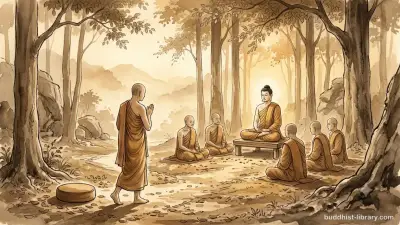
The Bāhiya Sutta: In the Seen, Only the Seen

The Bāhiya Sutta records the Buddha’s briefest and most direct teaching on liberation: “In the seen, there is only the seen; in the heard, only the heard; in the sensed, only the sensed; in the cognized, only the cognized.” This instruction led the wandering ascetic Bāhiya to immediate arahatship — complete enlightenment achieved in moments.
What Is the Bāhiya Sutta?
The Bāhiya Sutta (Udāna 1.10) appears in the Udāna, a collection of the Buddha’s inspired utterances in the Pali Canon. It tells the story of Bāhiya Dārucīriya, a wandering ascetic on the seacoast who thought he’d already reached the summit of spiritual attainment.
He was wrong.
A deity who had been his relative in a past life intervened, revealing that far greater masters existed — the Buddha among them, teaching in Sāvatthī. Bāhiya dropped everything and walked through the night to find him. The urgency was absolute.
He found the Buddha on alms round the next morning and begged for instruction. The Buddha refused — improper time, improper place. But Bāhiya pressed with words that cut through protocol: “It is hard to know for sure what dangers there may be for the Blessed One’s life, or what dangers there may be for mine.”
The Buddha stopped. He saw that Bāhiya was ready — spiritually ripe, burning with saṃvega (spiritual urgency). Right there on the street, he taught.
What Did the Buddha Actually Tell Bāhiya?
The Buddha’s instruction consists of four lines — the most compressed liberation teaching in the Pali Canon:
“Then, Bāhiya, you should train yourself thus: In reference to the seen, there will be only the seen. In reference to the heard, only the heard. In reference to the sensed, only the sensed. In reference to the cognized, only the cognized. That is how you should train yourself.
When for you there will be only the seen in reference to the seen, only the heard in reference to the heard, only the sensed in reference to the sensed, only the cognized in reference to the cognized, then, Bāhiya, there is no you in connection with that. When there is no you in connection with that, there is no you there. When there is no you there, you are neither here nor yonder nor between the two. This, just this, is the end of stress.”
The Buddha then departed to continue his alms round. Bāhiya went off to contemplate the teaching and was almost immediately afterward killed by a cow with a young calf. The Buddha later confirmed that Bāhiya had attained full arahatship before his death.
What Does “In the Seen, Only the Seen” Mean?
This phrase points to direct, unelaborated experience — perception without the addition of self-reference, story, judgment, or conceptual overlay.
When you see a tree, there is normally:
- The visual appearance (shape, color, movement)
- Recognition (“that’s a tree”)
- Evaluation (“beautiful,” “ordinary,” “blocking my view”)
- Self-reference (“I am seeing this,” “this is my experience”)
- Story (“reminds me of the tree I climbed as a child”)
The Buddha’s instruction cuts through everything except the first layer: in the seen, there is only the seen. No seer. No self experiencing it. No conceptual elaboration. Just the bare sensory event, arising and passing.
The same applies to the other sense doors:
- Heard: sounds without “I am hearing” or “this is noise annoying me”
- Sensed: tactile sensations, smells, tastes without ownership or interpretation
- Cognized: mental events (thoughts, emotions, memories) witnessed as mere phenomena, not as “my thoughts” or “my feelings”
How Does This Lead to Liberation?
The teaching works through a precise chain of insight:
- Direct experience without elaboration — “In the seen, only the seen”
- No self in relation to that — When experience is not claimed as “mine” or attributed to “me,” the sense of a permanent self dissolves
- No location for self — Without self-identification, there is no “you” positioned here (subject), there (object), or in between
- End of suffering — With no self to protect, grasp, or defend, suffering ceases
The Buddha is pointing to anattā (non-self) from the perspective of direct experience. Rather than analyzing the aggregates conceptually, Bāhiya is instructed to see through the illusion as it happens in each moment of perception.
This is not suppression of thought or forced concentration. It is recognizing that the sense of “I am experiencing this” is itself just another mental event — not the owner of experience, but part of the experience itself.
Why Did the Teaching Work for Bāhiya?
If the teaching is this simple, why doesn’t everyone who hears it become enlightened on the spot?
Because Bāhiya had put in the years. He’d been practicing as an ascetic, developing concentration, ethical discipline, and insight. He had the skills — he’d just misidentified where he stood. The Buddha’s words weren’t new information; they were a pointing-out of what was already there but hidden by one last subtle misperception.
The fruit was ripe. It just needed to fall.
This mirrors how Right View (Sammā Diṭṭhi) works — not as something added, but as the stripping away of wrong view that lets reality show itself as it is.
Can Modern Practitioners Use This Teaching?
Yes, but with clear understanding of context.
The Bāhiya Sutta is not a mantra to repeat or a formula to apply mechanically. It is a pointing-out instruction — a direct pointer for someone who has already developed the foundation through meditation practice, ethical conduct, and study.
For practitioners engaged in insight meditation (vipassanā), the Bāhiya teaching clarifies the goal: to see each moment of experience arising and passing without the superimposition of self. This is precisely what mindfulness practice trains — the capacity to observe without identifying, to witness without claiming.
Practically, the instruction can be applied during meditation:
- When a sound arises, notice if there is just the sound, or if “I am hearing” is added
- When a thought appears, see if there is just the thought, or if “this is my thought” layers on top
- When visual perception occurs, observe if there is just the image, or if “I am the one seeing” intervenes
Over time, this reveals that the sense of being a separate self experiencing the world is constructed moment by moment — and can be deconstructed the same way.
How Does the Bāhiya Sutta Relate to Other Teachings?
The Bāhiya Sutta complements several core Buddhist teachings:
The Four Foundations of Mindfulness (Satipaṭṭhāna): The Satipaṭṭhāna Sutta provides a systematic method for developing the same direct awareness the Bāhiya teaching points to — observing body, feelings, mind, and mental qualities without identification.
Dependent Origination: The Bāhiya teaching shows the breaking point in the chain — when sensory contact does not lead to craving (because there is no “I” to crave), the entire structure of suffering collapses.
The Three Marks of Existence: By seeing experience as just experience — impermanent, unsatisfying, and not-self — the Bāhiya instruction makes the three characteristics direct and immediate rather than conceptual.
Emptiness (Suññatā): In Mahayana contexts, the Bāhiya teaching is sometimes read as an early expression of emptiness — the recognition that phenomena arise without inherent essence or independent existence, including the self.
Warnings and Misconceptions
This teaching gets misread in predictable ways:
“So I just suppress all thoughts?”
No. Thoughts arise — that’s cognition happening. The instruction isn’t to block them but to stop claiming ownership. Let thoughts be cognized without the layer of “these are my thoughts” or the identity-building that follows.
“This is just mindfulness — living in the now.”
Not quite. The teaching goes deeper than popular mindfulness. It’s not about paying better attention to the present. It’s about seeing through the fiction of a permanent self doing the paying attention.
“Anyone can get enlightened from reading this.”
Bāhiya’s instant awakening rested on years of intensive practice. For most of us, this teaching is the destination, not a shortcut that bypasses the journey. Aspire to it; don’t expect it to work like a magic spell.
“The Buddha is denying that things exist.”
He’s not. Trees exist. Sounds are real. What dissolves is the superimposed belief “I am the one seeing the tree.” The teaching dismantles the self-reference, not the world.
Key Points
- The Bāhiya Sutta is the Buddha’s most concise teaching on liberation, delivered spontaneously to a prepared practitioner
- “In the seen, only the seen” means direct experience without adding self-reference, story, or mental elaboration
- The teaching leads to liberation by revealing that the sense of self is a construction superimposed on bare experience
- Bāhiya achieved immediate arahatship because he was already ripe through prior practice
- Modern practitioners can use this as a pointing-out instruction within established meditation, not as a stand-alone technique
- The teaching complements systematic methods like the Satipaṭṭhāna and reveals the experiential dimension of anattā
Frequently Asked Questions
What is the Bāhiya Sutta?
The Bāhiya Sutta (Udāna 1.10) is a canonical discourse where the Buddha delivers his most concise teaching on liberation to Bāhiya Dārucīriya, a wandering ascetic who achieved arahatship immediately upon hearing it.
What does “in the seen, only the seen” mean?
It means experiencing phenomena directly without adding mental constructions. When you see something, there is just the seeing — no seer, no story, no self-reference layered on top of bare sensory experience.
How can such a brief teaching lead to enlightenment?
The teaching works for someone already deeply prepared through prior practice. Bāhiya had cultivated profound concentration and insight as an ascetic — the Buddha’s instruction was the final key that unlocked what was already ripe to open.
Can modern practitioners use this teaching?
Yes, but as a pointing-out instruction within established meditation practice, not as a stand-alone formula. It reveals what insight meditation aims for — direct experience free from conceptual overlay.
Is this teaching the same as “living in the now”?
No. While it involves direct present-moment awareness, the Bāhiya teaching specifically addresses the dismantling of self-identification. It’s not just paying attention to now — it’s recognizing there is no permanent “I” doing the paying attention.
Why did Bāhiya die right after attaining enlightenment?
According to the sutta, Bāhiya was killed by a cow protecting her calf shortly after receiving the teaching. The Buddha confirmed Bāhiya had already attained full liberation before death. The timing underscores the urgency (saṃvega) that drove Bāhiya to seek teaching immediately.
Conclusion
The Bāhiya Sutta is four lines that changed a life in minutes. Brief, yes — but not simple.
What it points to cuts to the bone: the self we protect, worry about, and build our lives around is assembled moment by moment, layered onto experience like commentary onto a film. And it can be seen through just as quickly.
For practitioners today, this teaching works two ways. It shows where the path can lead when preparation meets the right instruction. And it reminds us that awakening isn’t about collecting peak experiences — it’s about recognizing there’s no solid “you” collecting them in the first place.
Read more:
- Anattā (Non-Self): What the Buddha Really Meant — The Bāhiya teaching is a direct expression of non-self realized in immediate experience rather than analyzed conceptually.
- The Satipaṭṭhāna Sutta: Foundations of Mindfulness Explained — The systematic method for developing the same direct awareness the Bāhiya Sutta points to in four lines.
- What Is Mindfulness (Sati) in Buddhism? — Understanding sati as the capacity to observe without claiming is essential for applying the Bāhiya instruction in practice.
📖 Source / license: Udāna 1.10 — translated by Ṭhānissaro Bhikkhu (Access to Insight)
Frequently asked questions
What is the Bāhiya Sutta?
The Bāhiya Sutta (Udāna 1.10) is a canonical discourse where the Buddha delivers his most concise teaching on liberation to Bāhiya Dārucīriya, a wandering ascetic who achieved arahatship immediately upon hearing it.
What does 'in the seen, only the seen' mean?
It means experiencing phenomena directly without adding mental constructions. When you see something, there is just the seeing — no seer, no story, no self-reference layered on top of bare sensory experience.
How can such a brief teaching lead to enlightenment?
The teaching works for someone already deeply prepared through prior practice. Bāhiya had cultivated profound concentration and insight as an ascetic — the Buddha's instruction was the final key that unlocked what was already ripe to open.
Can modern practitioners use this teaching?
Yes, but as a pointing-out instruction within established meditation practice, not as a stand-alone formula. It reveals what insight meditation aims for — direct experience free from conceptual overlay.