The Cūḷavedalla Sutta: Questions and Answers on Buddhist Doctrine
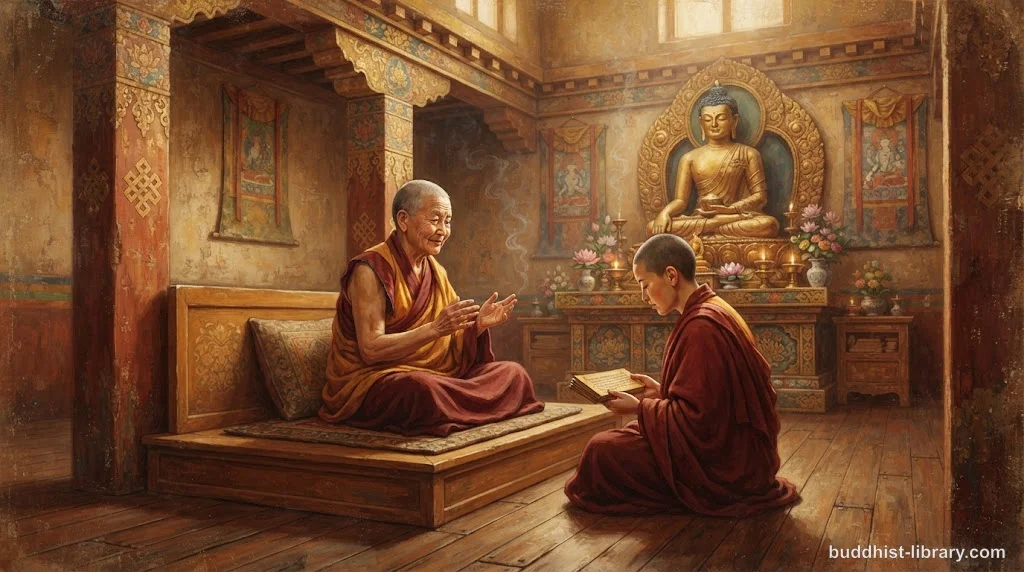
The Cūḷavedalla Sutta records a profound dialogue where the bhikkhunī Dhammadinnā answers fundamental questions about Buddhist doctrine, covering the five aggregates, personality view, concentration, and the path to liberation—demonstrating teaching skill so precise that the Buddha himself declared he could not have answered differently.
What makes this discourse stand out? It’s one of the few suttas where a bhikkhunī takes center stage as teacher, offering systematic explanations of core Buddhist concepts through straightforward question and answer.
What Makes the Cūḷavedalla Sutta Unique?
The Cūḷavedalla Sutta (MN 44) unfolds as a dialogue between Venerable Visākha, a lay disciple, and the bhikkhunī Dhammadinnā—his former wife who had ordained and reached advanced stages of realization. A learned nun teaching a male questioner wasn’t the standard pattern in the canon, which makes this exchange worth attention.
Dhammadinnā’s teaching method shows real skill. She doesn’t recite doctrinal formulas—she explains concepts in ways that reveal how they connect and what they mean in practice. When Visākha later takes his questions to the Buddha, expecting further elaboration, the Buddha tells him: Dhammadinnā’s answers were exactly what he himself would have said. That’s confirmation of complete understanding.
The sutta covers territory that’s scattered across many other discourses—aggregates, sense bases, elements, dependent origination, the path—pulling them together in one coherent conversation. For students who want a compact overview of Buddhist doctrine without hunting through dozens of texts, that’s genuinely useful.
How Does the Sutta Explain Personality View?
One of the sutta’s central topics is personality view (sakkāya-diṭṭhi)—the mistaken belief in a permanent, independent self. Dhammadinnā explains that this view arises specifically in relation to the five aggregates: form, feeling, perception, mental formations, and consciousness.
She breaks down how personality view manifests in sixteen ways: regarding each of the five aggregates as “This is mine,” “This I am,” or “This is my self,” plus seeing them as “belonging to self” somehow. Multiply it out and you get all the ways the delusion of self can latch onto the components of experience.
What’s the origin of personality view? Dhammadinnā traces it to craving accompanied by delight and lust—the craving that seeks renewal of being, the drive that keeps the cycle of suffering turning. Personality view ends when that craving completely fades away.
The path leading to this cessation is the Noble Eightfold Path—the systematic training in ethics, concentration, and wisdom that dismantles the delusion of self through direct insight into the aggregates’ true nature.
What Does the Sutta Teach About Concentration?
Dhammadinnā addresses concentration (samādhi) by explaining its defining characteristics and what accompanies it. She identifies one-pointedness of mind (cittass’ ekaggatā) as the essence of concentration—the quality of mind that becomes steadily focused on a single object.
The factors accompanying concentration are the remaining components of the Noble Eightfold Path: right view, right intention, right speech, right action, right livelihood, right effort, and right mindfulness. This explanation clarifies that concentration doesn’t develop in isolation but as part of an integrated path.
The sutta makes a distinction worth understanding: concentration with supports (sa-upādāna) versus concentration without supports (anupādāna). The first kind still involves the five aggregates of clinging, still bound to formations that can serve as objects of attachment. The second kind transcends that clinging entirely—it’s the mental unification of an arahat whose mind has stopped grasping.
Dhammadinnā also explains the development of concentration through systematic practice, emphasizing that genuine samādhi requires the right foundation of ethical conduct and the support of other path factors working together.
How Does It Present the Noble Eightfold Path?
The sutta offers multiple perspectives on the Noble Eightfold Path. First, Dhammadinnā identifies it as the way leading to the cessation of suffering—answering the question of what practical path leads to liberation.
She then addresses whether the Noble Eightfold Path is conditioned or unconditioned. Her answer: it’s conditioned. The path is a constructed thing, something to be developed, not an absolute reality existing independent of causes. This clarification helps prevent misunderstanding the path as an eternal entity rather than a pragmatic training to be undertaken.
When Visākha asks if the three categories of the path—virtue, concentration, and wisdom—are included in the eight factors or vice versa, Dhammadinnā explains that the eight factors are included in the three trainings. Right speech, right action, and right livelihood fall under virtue. Right effort, right mindfulness, and right concentration constitute the training in concentration. Right view and right intention make up the training in wisdom.
This analysis shows how the path’s components work together as an integrated system rather than isolated practices.
What Are the Key Points?
-
Authoritative female voice: The sutta features the bhikkhunī Dhammadinnā as teacher, with the Buddha confirming that her explanations matched his own understanding—rare recognition in the canon.
-
Personality view explained systematically: Sakkāya-diṭṭhi is shown to arise from identifying with the five aggregates in any way as “self” or “mine,” with its cessation coming through the Noble Eightfold Path.
-
Concentration with and without supports: The sutta distinguishes concentration still bound to clinging from the concentration of full liberation, clarifying different levels of attainment.
-
Integration of path factors: The eight factors of the path are shown to work together, grouped into the three trainings of ethics, concentration, and wisdom.
-
Question-and-answer format: The dialogue structure makes complex doctrine accessible through Visākha’s natural progression of questions and Dhammadinnā’s clear, systematic responses.
How Does This Sutta Relate to Other Teachings?
The Cūḷavedalla Sutta serves as a doctrinal summary that connects many teachings appearing elsewhere in the canon. Its explanation of the five aggregates relates directly to the Anattalakkhaṇa Sutta, where the Buddha first taught the characteristic of non-self using these same categories.
The discussion of concentration complements the detailed meditation instructions found in the Ānāpānasati Sutta and other practice-oriented discourses. While those texts explain how to develop concentration, this sutta clarifies what concentration is and how it fits into the broader structure of the path.
The treatment of right view here connects with more extensive explanations in texts like the Sammādiṭṭhi Sutta (MN 9), which explores right view from ten aspects. The Cūḷavedalla Sutta provides a concise version that covers the essential points—understanding the Four Noble Truths and the nature of wholesome and unwholesome actions.
Dhammadinnā’s teaching on personality view directly addresses what the Satipaṭṭhāna Sutta aims to overcome through mindfulness practice—the habitual identification with the aggregates as “I” and “mine.”
What Can We Learn from Dhammadinnā’s Teaching Method?
Dhammadinnā demonstrates several qualities worth noting for anyone interested in teaching or learning the Dhamma. She answers each question completely without adding unnecessary elaboration. When Visākha asks about personality view, she doesn’t launch into every tangentially related topic but gives the precise answer that addresses his question.
She also reveals the interconnections between concepts. Her explanation of concentration naturally leads to discussion of the path factors that accompany it, showing how Buddhist teachings form a coherent whole rather than a collection of isolated ideas.
Her approach balances doctrinal precision with accessibility. The technical terms are used correctly, but they’re explained in ways that make their meaning clear. She doesn’t assume Visākha already understands every term, yet she doesn’t condescend or oversimplify.
The Buddha’s endorsement of her teaching—saying he would have answered exactly as she did—suggests that clarity, precision, and systematic explanation are marks of genuine understanding. Teachers who truly comprehend the Dhamma can explain it in ways that reveal its structure without distorting its meaning.
FAQ
What is the Cūḷavedalla Sutta about?
The Cūḷavedalla Sutta (MN 44) is a dialogue where the bhikkhunī Dhammadinnā answers Venerable Visākha’s questions about fundamental Buddhist teachings, including the five aggregates, personality view, the Noble Eightfold Path, and concentration.
Who was Dhammadinnā in the Cūḷavedalla Sutta?
Dhammadinnā was a bhikkhunī (fully ordained nun) whom the Buddha declared foremost among nuns who teach the Dhamma. In this sutta, she demonstrates profound understanding by answering Visākha’s complex questions, earning the Buddha’s praise that her answers matched what he himself would have said.
What does the Cūḷavedalla Sutta teach about personality view?
The sutta explains that personality view (sakkāya-diṭṭhi) arises from regarding the five aggregates—form, feeling, perception, mental formations, and consciousness—as “self” or “belonging to self.” This view is overcome through understanding the aggregates’ true nature as impermanent, unsatisfactory, and not-self.
How does the Cūḷavedalla Sutta define right view?
The sutta presents right view as understanding suffering, its origin, its cessation, and the path leading to its cessation—the Four Noble Truths. It also explains right view as understanding wholesome and unwholesome actions, their roots, and their consequences.
What is the difference between concentration with and without supports?
Concentration with supports (sa-upādāna) involves the five aggregates of clinging and is still bound to formations that can serve as objects of attachment. Concentration without supports (anupādāna) transcends this clinging and represents the mental unification of an arahat whose mind no longer grasps at any phenomena.
Conclusion
The Cūḷavedalla Sutta offers something rare in early Buddhist texts: systematic doctrinal explanation delivered by a female teacher whose understanding the Buddha himself validates as complete and correct. Dhammadinnā’s teaching proves that awakening and the ability to teach the Dhamma have nothing to do with gender. Realization comes to those who practice sincerely.
For students of Buddhism, this sutta works as an accessible entry point to concepts that can seem abstract in isolation. The dialogue format—natural questions met with clear answers—makes complex doctrine approachable without dumbing it down.
The teaching on personality view hits directly at what practitioners working with not-self need to understand: how we build a sense of self around the aggregates, and how that construction can come apart. That’s not peripheral philosophy. It’s the heart of Buddhist liberation.
Read more:
- The Five Aggregates (Khandhas): What We Mistake for ‘Self’ — Learn more about the five components of experience that the Cūḷavedalla Sutta explains as the basis for personality view.
- The Noble Eightfold Path: A Complete Guide to Buddhist Practice — Explore the systematic path that Dhammadinnā presents as the way to overcome personality view and reach liberation.
- Right View (Sammā Diṭṭhi): The Foundation of the Buddhist Path — Dive deeper into one of the central topics of the Cūḷavedalla Sutta: the nature and development of right understanding.
📖 Source / license: Majjhima Nikāya 44, translated by Bhikkhu Ñāṇamoli and Bhikkhu Bodhi (The Middle Length Discourses of the Buddha)
Frequently asked questions
What is the Cūḷavedalla Sutta about?
The Cūḷavedalla Sutta (MN 44) is a dialogue where the bhikkhunī Dhammadinnā answers Venerable Visākha's questions about fundamental Buddhist teachings, including the five aggregates, personality view, the Noble Eightfold Path, and concentration.
Who was Dhammadinnā in the Cūḷavedalla Sutta?
Dhammadinnā was a bhikkhunī (fully ordained nun) whom the Buddha declared foremost among nuns who teach the Dhamma. In this sutta, she demonstrates profound understanding by answering Visākha's complex questions, earning the Buddha's praise that her answers matched what he himself would have said.
What does the Cūḷavedalla Sutta teach about personality view?
The sutta explains that personality view (sakkāya-diṭṭhi) arises from regarding the five aggregates—form, feeling, perception, mental formations, and consciousness—as 'self' or 'belonging to self.' This view is overcome through understanding the aggregates' true nature as impermanent, unsatisfactory, and not-self.
How does the Cūḷavedalla Sutta define right view?
The sutta presents right view as understanding suffering, its origin, its cessation, and the path leading to its cessation—the Four Noble Truths. It also explains right view as understanding wholesome and unwholesome actions, their roots, and their consequences.