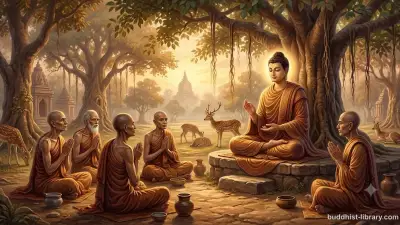
The Loṇaphala Sutta: The Salt Crystal Teaching on Karma and Results

The Loṇaphala Sutta teaches that karma does not ripen in fixed, mechanical measure — the same unwholesome deed produces different results depending on one’s spiritual development. A person with cultivated body, virtue, mind, and wisdom experiences karma’s effects diluted, like a salt crystal in the Ganges; an undeveloped person experiences them concentrated, like the same crystal in a cup of water.
The Buddha offered this teaching to counter a rigid, deterministic view of karma common in his time — particularly the Jain doctrine that every deed bears an exact, unavoidable result. The Loṇaphala Sutta (also known as the Salt Crystal Sutta) appears in the Aṅguttara Nikāya and presents one of the Buddha’s most liberating insights: spiritual practice changes not whether karma ripens, but how we experience it.
What Is the Loṇaphala Sutta?
The Loṇaphala Sutta (Pali: Loṇaphala Sutta, sometimes Loṇakapalla Sutta) is the 99th discourse in the Book of Threes of the Aṅguttara Nikāya. The title means “Salt Crystal” discourse, named after the central simile the Buddha uses.
The discourse addresses a specific wrong view: that when someone does an unskillful deed — even a trifling one — they are destined for hell, with no room for development or mitigation. The Buddha calls this view “a statement that is utterly ruinous” because it strips away the power of practice.
Instead, the Buddha presents two contrasting types of individuals:
-
The undeveloped person — limited in body (sensory restraint), virtue, mind (concentration), and discernment (wisdom). For this person, even a small unwholesome deed “takes them to hell.”
-
The developed person — one who has cultivated these four qualities through training. For this person, the same small unwholesome deed is experienced in the present life and does not drag them to hell.
The sutta is revolutionary because it shifts karma from fate to training ground.
The Salt Crystal Simile: Dilution, Not Elimination
The Buddha illustrates with a vivid image:
“Suppose a man were to drop a salt crystal into a small cup of water. What do you think — would the water in the cup become salty and undrinkable?”
“Yes, venerable sir. Why is that? Because there is only a little water in the cup, so the salt crystal makes it salty and undrinkable.”
“Now suppose a man were to drop a salt crystal into the river Ganges. What do you think — would the water in the Ganges become salty and undrinkable?”
“No, venerable sir. Why is that? Because there is a great mass of water in the Ganges, so it would not become salty or undrinkable because of the salt crystal.”
The salt crystal is the unwholesome deed — the same deed in both cases. The difference lies in the volume of water: the spiritual development of the person.
This is not about escaping karma. The salt is still there. The deed still bears fruit. But a person with the depth of a great river can absorb the result without being overwhelmed. The undeveloped person — with the inner capacity of a cup — is made bitter by the same deed.
The point is anti-deterministic: karma is not a mechanical, fixed-proportion punishment system. How results ripen depends on who you have become through practice.
The Four Qualities That Create Inner Spaciousness
What makes a person “developed” enough to dilute karma’s impact? The Buddha specifies four trainings:
1. Developed in Body (Kāya-bhāvanā)
This refers to restraint of the senses — not indulging in overwhelming sensory experiences that destabilize the mind. A developed person sees a form, hears a sound, tastes a flavor without grasping or pushing away. This creates stability.
2. Developed in Virtue (Sīla-bhāvanā)
Moral discipline — the Five Precepts for laypeople or the fuller training for monastics. Virtue creates the foundation of non-remorse, which supports concentration and insight. Without it, the mind is caught in guilt and fear.
3. Developed in Mind (Citta-bhāvanā)
This is concentration — the ability to steady attention through meditation practice. The concentrated mind is not easily shaken. It has spaciousness. The simile of the Ganges is partly about this: a mind that can hold steady is a mind that can weather difficult results.
4. Developed in Discernment (Paññā-bhāvanā)
Wisdom — seeing clearly into impermanence, suffering, and non-self. Discernment understands that karmic results are conditioned phenomena, not personal attacks. This understanding itself dilutes the sting. You see: “This is the fruit of that deed. It arises, it will pass.”
These four are not separate compartments; they support each other. Virtue steadies the mind. Concentration reveals what wisdom can see. Wisdom deepens the commitment to virtue. Together, they create the inner river that can absorb karma’s salt.
How Does This Differ from Jain and Deterministic Views?
The Buddha’s contemporaries — particularly the Jains — taught a strict karmic determinism. In that view, every unwholesome deed produces a fixed quantum of suffering, which must be endured or burned off through ascetic practices. There is no dilution, no transformation through wisdom — only mechanical retribution.
The Buddha rejected this. In the Loṇaphala Sutta, he explicitly says that the idea “anyone who does such-and-such a deed is destined for hell” is wrong view. Why? Because it leaves no room for the path. If karma were mechanically fixed, there would be no point in practicing virtue, concentration, or wisdom — the result is already sealed.
The Buddha’s insight: karma is conditioned, and so is the person who receives its results. Change the person, and the experience of the result changes.
This is not relativism or moral license — the deed is still unskillful, the salt is still salt. But the teaching opens the door: you are not locked into a fate. You can grow the river.
Key Misconceptions About This Teaching
”I can do whatever I want as long as I meditate a lot.”
No. The sutta does not say developed people are immune to karma or free to act carelessly. The undeveloped person goes to hell for a trifling deed because they lack the qualities that prevent large-scale harm. The developed person doesn’t commit large-scale harm in the first place — virtue and discernment prevent it.
The teaching is about bearing the results of past deeds, not permission for future ones.
”Spiritual practice erases bad karma.”
Not quite. The sutta says the deed is experienced differently, not erased. The result still ripens — but in a spacious, developed mind it does not produce devastation. This is crucial: results are borne, not avoided.
The Mahāyāna concept of purifying karma (through confession, bodhisattva practice, etc.) goes further than this early sutta, but even there the mechanism involves transformation, not deletion.
”This makes karma arbitrary or unfair.”
The teaching is the opposite of arbitrary — it shows that karma responds intelligently to conditions, including the condition of the person. A rigid mechanical system that punishes a cup-sized person and a river-sized person identically for the same trifling deed would be unjust. The sutta reveals that karmic law includes proportionality and context.
Practical Implications: How to Grow the River
If the Loṇaphala Sutta’s promise is real — that spiritual development changes how we experience karma — then the practical question is: how do we cultivate that depth?
The sutta points to the four trainings, which map directly onto the gradual training (anupubbasikkhā):
-
Develop the body (sensory restraint): Practice moderation. Notice when sense contact overwhelms you — and step back. This is not asceticism, but wise restraint. See the Right Action teaching.
-
Develop virtue: Keep the precepts. Live in a way that creates no harm and leaves no remorse. Guilt and regret destabilize the mind; virtue stabilizes it. See Sīla.
-
Develop the mind (concentration): Practice samatha or mindfulness meditation. A scattered mind has no spaciousness. A concentrated mind becomes the river.
-
Develop discernment (wisdom): Investigate experience. See impermanence, suffering, and non-self. Wisdom is what ultimately liberates — not by making karma disappear, but by understanding its conditioned, impersonal nature. See What Is Paññā?
These are not quick fixes. The Ganges is vast because countless tributaries have fed it over time. So too with the mind: gradual, sustained practice creates depth.
Related Teachings: Karma, Results, and Spiritual Maturity
The Loṇaphala Sutta complements other key discourses on karma:
-
The Cūḷakammavibhaṅga Sutta — explains what kinds of deeds produce what kinds of results (short life vs. long life, beauty vs. ugliness, etc.). The Loṇaphala Sutta adds: and how those results are experienced depends on who you’ve become.
-
The Karma and Rebirth teaching — lays out the general principle. The Salt Crystal Sutta refines it: karma is not mechanical fate, but conditioned by the person’s development.
-
The Tittha Sutta (AN 3.61) — the Buddha criticizes deterministic views (fatalism, theistic determinism, nihilism) and affirms that effort matters. The Loṇaphala Sutta is an application of that anti-fatalism to karmic results.
Why is this teaching liberating? Because it says flatly: you are not stuck. The past has weight. But present practice changes how that weight is borne.
Conclusion: The Path as Inner Spaciousness
The Loṇaphala Sutta is a teaching of hope grounded in realism. Yes, unwholesome deeds bear unwholesome results — that is the law of karma. But no, you are not doomed by every misstep to a fixed, mechanical punishment. The law includes your development in its reckoning.
The undeveloped person experiences trifling deeds as devastating because their inner life is small, constricted, reactive. The developed person — through virtue, concentration, and wisdom — has grown an inner river vast enough to dilute the same result.
This does not mean karma is erased or cheated. It means the path works. Practice matters. The Buddha is saying: build the river. Develop the body, virtue, mind, and discernment. Then, when karma’s results ripen — as they will — you will be able to bear them without being broken.
Read more:
- Karma and Rebirth in Buddhism: How They Actually Work — foundational understanding of how intentional actions shape future experience.
- The Cūḷakammavibhaṅga Sutta: Understanding the Buddha’s Teaching on the Workings of Karma — detailed explanation of specific deeds and their corresponding results.
- The Gradual Training in Buddhism: The Buddha’s Step-by-Step Path — the systematic cultivation of virtue, concentration, and wisdom that creates inner spaciousness. , and wisdom that creates inner spaciousness.
📖 Source / license: Anguttara Nikaya 3.99, translated by Thanissaro Bhikkhu (Access to Insight)
Frequently asked questions
Does the Salt Crystal Sutta mean karma can be erased or escaped?
No. The sutta teaches that karma's results are experienced differently depending on spiritual development — diluted like salt in a river versus concentrated in a cup — but not eliminated. The deed still bears fruit; the capacity to bear it changes.
What makes someone a 'developed person' according to this teaching?
The Buddha defines a developed person as one who has cultivated body (through sensory restraint), virtue (moral discipline), mind (concentration through meditation), and discernment (wisdom). These four trainings create the inner spaciousness that dilutes karmic results.
Is this teaching the same across all Buddhist schools?
The core metaphor appears in the Pali Canon (Theravada) and is generally accepted, though Mahayana adds bodhisattva practices and some schools emphasize different aspects of karmic transformation. The anti-deterministic stance (karma is not mechanical fate) is widely shared.