The Majjhima Nikāya: The Buddha's Middle Length Discourses Explained
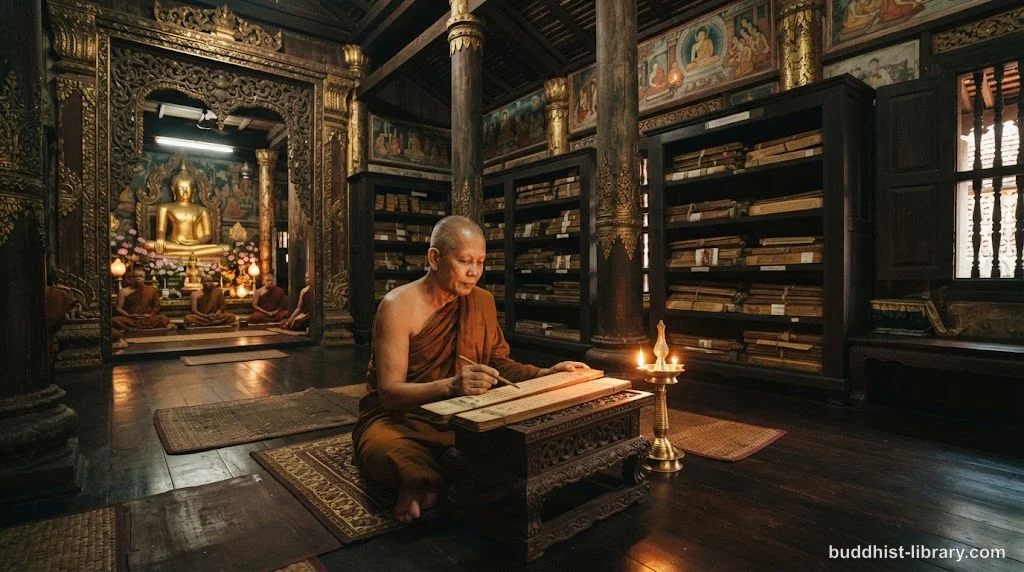
The Majjhima Nikāya is the second major collection of the Sutta Piṭaka in the Pali Canon, containing 152 middle-length discourses that cover the Buddha’s core teachings. These suttas hit a sweet spot: long enough to work through an idea properly, short enough that you can actually remember what you read.
It’s one of the most important sources we have for understanding early Buddhism. Brief utterances leave you wanting more context. Extended narratives can lose you in the details. These middle-length discourses give you complete teachings—philosophical clarity married to practical guidance. Many of Buddhism’s most studied suttas come from this collection.
What Is the Majjhima Nikāya?
The Majjhima Nikāya (MN) is the “Collection of Middle-Length Discourses,” the second basket of the Sutta Piṭaka in the Pali Canon. It sits between the Dīgha Nikāya (Long Discourses) and the shorter collections, offering teachings that are neither too brief nor too extended.
The collection contains 152 suttas divided into three groups of roughly fifty each:
- Mūlapaṇṇāsa (Root Fifty, MN 1–50)
- Majjhimapaṇṇāsa (Middle Fifty, MN 51–100)
- Uparipaṇṇāsa (Final Fifty, MN 101–152)
Each division contains suttas on various themes—meditation, ethics, doctrine, and stories about the Buddha’s interactions with disciples, brahmins, wanderers, and laypeople.
Why Are These Suttas Called “Middle Length”?
The term “middle” refers to the length of the discourses, not their importance. These suttas typically run from a few pages to about twenty pages in modern translations—substantial enough to develop a teaching fully, but shorter than the marathon discourses in the Dīgha Nikāya.
This middle length made them practical in the oral tradition. A monk could recite one in a single sitting. Students could discuss it thoroughly and retain it without drowning in detail. Length determines format, not value.
What Topics Does the Majjhima Nikāya Cover?
The Majjhima Nikāya is remarkably comprehensive. Major themes include:
Meditation and mental development: Detailed instructions on mindfulness practice, concentration, and insight meditation. The Satipaṭṭhāna Sutta (MN 10) is the foundational text on the four establishments of mindfulness.
The path to awakening: Systematic presentations of the Noble Eightfold Path and the gradual training. The Sammādiṭṭhi Sutta (MN 9) comprehensively explains Right View.
Understanding reality: Teachings on non-self (anattā), impermanence, dependent origination, and the five aggregates. The Anattalakkhaṇa Sutta (MN 35) and the Mahātaṇhāsaṅkhaya Sutta (MN 38) explore these doctrines.
Ethics and livelihood: Guidance on moral conduct, speech, and Right Livelihood for both monastics and laypeople.
Encountering views: Dialogues where the Buddha addresses wrong views, metaphysical speculation, and eternalist or nihilist positions. The Brahmajāla Sutta equivalent in this collection is the Cūḷavedalla Sutta (MN 44).
Narratives and parables: Stories that illustrate teachings through vivid imagery, like the simile of the saw in the Kakacūpama Sutta (MN 21) or the poisoned arrow parable in the Cūḷamāluṅkya Sutta (MN 63).
Key Suttas in the Majjhima Nikāya
Some suttas from this collection have become foundational to Buddhist practice worldwide:
- MN 2 — Sabbāsava Sutta: Seven methods for removing mental taints
- MN 9 — Sammādiṭṭhi Sutta: A comprehensive explanation of Right View
- MN 10 — Satipaṭṭhāna Sutta: The foundations of mindfulness (also at DN 22)
- MN 21 — Kakacūpama Sutta: The simile of the saw on patience and forbearance
- MN 22 — Alagaddūpama Sutta: The snake simile on right understanding of the Dhamma
- MN 38 — Mahātaṇhāsaṅkhaya Sutta: On consciousness and dependent origination
- MN 44 — Cūḷavedalla Sutta: A dialogue explaining fundamental Buddhist concepts
- MN 62 — Mahārāhulovāda Sutta: The Buddha’s instruction to his son Rāhula on mindfulness
- MN 63 — Cūḷamāluṅkya Sutta: The parable of the poisoned arrow
- MN 118 — Ānāpānasati Sutta: Mindfulness of breathing explained in sixteen steps
- MN 131 — Bhaddekaratta Sutta: Living in the present moment
These suttas are frequently studied, translated, and taught in Buddhist communities worldwide.
How Is the Majjhima Nikāya Organized?
Unlike the Saṃyutta Nikāya (thematically grouped) or the Aṅguttara Nikāya (numerically arranged), the Majjhima Nikāya has no strict organizing principle. Suttas appear in a somewhat loose arrangement, though patterns emerge within each paṇṇāsa.
Scholars debate the logic. Maybe suttas on similar topics were clustered together. Maybe the sequence reflects the order they were added to the collection over centuries of oral transmission. We don’t know for certain.
But honestly? It doesn’t matter much. Each sutta stands on its own as a complete teaching. You can read them in any order.
Why Is the Majjhima Nikāya Important?
The Majjhima Nikāya occupies a central place in Buddhist literature. Here’s why:
Each discourse is complete. You get context, explanation, often a concluding narrative. Not fragments—the whole picture.
The middle length hits a usability sweet spot. More approachable than the marathon Dīgha Nikāya suttas. More detailed than the terse utterances in other collections.
Many of the clearest expositions of Buddhist doctrine come from this collection. When you want to understand what the Buddha actually taught about a topic, this is where you look first.
These suttas balance theory with practice relentlessly. They explain concepts, then show you how to apply them in meditation, daily life, relationships. No floating abstractions.
And scholars generally regard this collection as containing some of the oldest, most reliable records we have of the Buddha’s teachings—preserved with remarkable fidelity through centuries of oral transmission.
How to Study the Majjhima Nikāya
Reading 152 suttas can feel overwhelming. Here are practical approaches:
Start with the classics: Begin with widely studied suttas like MN 10 (Satipaṭṭhāna), MN 9 (Sammādiṭṭhi), MN 2 (Sabbāsava), and MN 22 (Alagaddūpama). These provide a solid foundation.
Follow a theme: Choose a topic that interests you—meditation, ethics, understanding reality—and read suttas that address it. Many anthologies and websites organize suttas by theme.
Read with commentary: Traditional commentaries by scholars like Buddhaghosa and modern teachers like Bhikkhu Bodhi provide essential context. The Wisdom Publications translation of the Majjhima Nikāya includes Bhikkhu Bodhi’s extensive notes.
Study with others: Join a sutta study group or online forum. Discussing these teachings with others deepens understanding and reveals perspectives you might miss alone.
Apply what you read: The suttas are not academic texts—they’re instructions for practice. After reading a sutta, reflect on how it applies to your life and meditation.
Be patient: You don’t need to read all 152 suttas immediately. Even studying a few deeply will transform your understanding and practice.
What Makes a Sutta “Middle Length”?
The distinction between “short,” “middle,” and “long” isn’t rigid. Some suttas in the Majjhima Nikāya are quite brief, while others approach the length of discourses in the Dīgha Nikāya.
Generally, a middle-length sutta:
- Can be recited in one sitting (roughly 30 minutes to an hour)
- Develops a single theme or a few related themes
- Includes narrative context, teaching, and often a conclusion
- Balances brevity with sufficient detail to be clear
The key is that these suttas are complete teachings—not fragments or extended chronicles.
How Does the Majjhima Nikāya Relate to Other Nikāyas?
The five major Nikāyas (collections) of the Sutta Piṭaka overlap and complement each other:
- Dīgha Nikāya: Long discourses, often with extensive narratives
- Majjhima Nikāya: Middle-length discourses with balanced exposition
- Saṃyutta Nikāya: Thematically grouped shorter discourses
- Aṅguttara Nikāya: Numerically organized teachings (ones, twos, threes, etc.)
- Khuddaka Nikāya: Miscellaneous shorter texts including the Dhammapada, Udāna, and Jātaka tales
Some teachings appear in multiple Nikāyas. For example, the Satipaṭṭhāna Sutta appears in both the Majjhima Nikāya (MN 10) and the Dīgha Nikāya (DN 22). The shorter version is in the Majjhima; the extended version with more detail is in the Dīgha.
This repetition isn’t redundancy—it reflects the oral tradition’s way of preserving teachings through multiple recensions and contexts.
Translations of the Majjhima Nikāya
The most widely used English translation is “The Middle Length Discourses of the Buddha” translated by Bhikkhu Ñāṇamoli and edited by Bhikkhu Bodhi (Wisdom Publications, 1995). This translation includes extensive notes and is considered the standard scholarly edition.
Other valuable resources include:
- Access to Insight and dhammatalks.org: Free online translations of individual suttas by various translators
- SuttaCentral: Multiple translations with Pali text and cross-references
- Thanissaro Bhikkhu’s translations: Available free online with contemporary English phrasing
Each translator brings a slightly different perspective, so reading multiple versions can deepen your understanding.
Who Should Read the Majjhima Nikāya?
Anyone interested in the Buddha’s original teachings should spend time with the Majjhima Nikāya. These suttas are for:
Beginners: Clear, complete teachings that introduce Buddhism’s core concepts and practices
Experienced practitioners: Detailed guidance on advanced meditation, subtle doctrinal points, and the stages of awakening
Scholars: Primary sources for understanding early Buddhism, the Buddha’s teaching style, and the development of Buddhist doctrine
Teachers: Authoritative texts for explaining the Dhamma to others
You don’t need to be a monk, scholar, or advanced meditator. The Buddha taught laypeople as well as renunciants, and these suttas reflect that inclusivity.
Key Concepts to Understand
A few recurring concepts appear throughout the Majjhima Nikāya:
- The gradual training (anupubbasikkhā): The step-by-step path from ethics to concentration to wisdom
- Right View (sammādiṭṭhi): Correct understanding of the Four Noble Truths and the nature of reality
- Mindfulness (sati): Present-moment awareness as the foundation of insight
- Concentration (samādhi): The development of mental stability through meditation
- Wisdom (paññā): Direct insight into impermanence, suffering, and non-self
- The unconditioned (asaṅkhata): Nibbāna, the end of suffering
Understanding these concepts helps you follow the arguments and instructions in the suttas.
Common Misunderstandings
“These are just philosophical texts.” Wrong. The Majjhima Nikāya includes philosophical analysis, sure—but every teaching points toward liberation from suffering. The Buddha had zero interest in abstract speculation. If it doesn’t help you wake up, he didn’t teach it.
“You need to read them in order.” No. The suttas aren’t chapters in a book with a plot. Start anywhere. Follow your interests. Skip around freely.
“These teachings are only for monks.” Also wrong. Many suttas explicitly address laypeople. The Buddha taught householders about ethics, relationships, generosity, meditation practices for those with jobs and families.
“The translations are too hard to read.” Some suttas use technical terms and ancient Indian cultural references. But most are surprisingly readable. Start with the simpler ones. Use translations with good notes. The language becomes familiar fast.
Practical Application
The Majjhima Nikāya isn’t meant to stay on the shelf. Here’s how to bring these teachings into practice:
In meditation: Use suttas like MN 10 (Satipaṭṭhāna) and MN 118 (Ānāpānasati) as meditation manuals. Follow their instructions directly in your practice.
In daily life: Apply teachings on speech, livelihood, and relationships. The Buddha’s guidance on ethical conduct is practical and clear.
When doubts arise: Turn to suttas that address wrong views and metaphysical questions. The Buddha’s approach to answering (or not answering) questions offers a model for working with uncertainty.
For inspiration: Read narratives about the Buddha and his disciples. Their stories—of struggle, insight, and awakening—can energize your own practice.
Why “Middle” Matters
The middle length is more than a practical consideration. It reflects how the Buddha taught.
He didn’t give one-sentence soundbites. He didn’t deliver marathon lectures. He taught thoroughly without overwhelming you, in detail without being tedious.
This middle way in teaching mirrors the Middle Way in practice: avoiding extremes of self-indulgence and self-mortification, eternalism and nihilism, speculation and dismissal.
The Majjhima Nikāya embodies that balance. Grounded, complete, accessible.
Read more:
- The Pali Canon (Tipiṭaka): Structure and Contents of Early Buddhist Scriptures — Understand how the Majjhima Nikāya fits within the broader structure of the Tipiṭaka and the organization of the Buddha’s teachings.
- The Satipaṭṭhāna Sutta: Foundations of Mindfulness Explained — Explore one of the most important suttas from the Majjhima Nikāya, MN 10, which provides the complete framework for mindfulness meditation.
- The Alagaddūpama Sutta: The Snake Simile and Right Understanding — Dive into MN 22, where the Buddha uses vivid imagery to explain how to approach the Dhamma with the right attitude and avoid misunderstanding his teachings.
📖 Source / license: Majjhima Nikāya (Pali Canon). English translations by Bhikkhu Ñāṇamoli and Bhikkhu Bodhi. Access to Insight (dhammatalks.org) and SuttaCentral.
Frequently asked questions
How many suttas are in the Majjhima Nikāya?
The Majjhima Nikāya contains 152 suttas (discourses) divided into three divisions called paṇṇāsa: the Mūlapaṇṇāsa (Root Fifty), the Majjhimapaṇṇāsa (Middle Fifty), and the Uparipaṇṇāsa (Final Fifty).
What does Majjhima Nikāya mean?
Majjhima Nikāya means 'Collection of Middle-Length Discourses' in Pali. These suttas are longer than the brief sayings in the Saṃyutta Nikāya but shorter than the extended teachings in the Dīgha Nikāya.
Which suttas should beginners start with in the Majjhima Nikāya?
Beginners should start with foundational suttas like the Satipaṭṭhāna Sutta (MN 10) on mindfulness, the Sabbāsava Sutta (MN 2) on removing mental taints, the Alagaddūpama Sutta (MN 22) on right understanding, and the Cūḷavedalla Sutta (MN 44) which explains key Buddhist concepts through questions and answers.
How does the Majjhima Nikāya differ from other collections in the Pali Canon?
Unlike the thematically organized Saṃyutta Nikāya or the numerically arranged Aṅguttara Nikāya, the Majjhima Nikāya presents comprehensive teachings that combine doctrine, practice, and narrative. Each sutta typically develops a complete theme with context, explanation, and practical application.