The Rathavinīta Sutta: The Relay Chariots Simile on the Buddhist Path
The Rathavinīta Sutta teaches that Buddhist awakening unfolds through seven progressive stages of purification, each one building on the last like relay chariots carrying a traveler to their destination. The sutta shows that enlightenment is not a single leap but a structured journey where moral discipline leads to mental clarity, which reveals right understanding, culminating in the complete knowledge and vision of liberation.
The Rathavinīta Sutta, found in the Majjhima Nikāya (MN 24), is one of the Buddha’s most elegant teachings on the nature of spiritual progress. Through a conversation between two of his senior disciples — Venerable Sāriputta and Venerable Puṇṇa Mantāṇiputta — the sutta addresses a crucial question: What is the ultimate purpose of living the holy life under the Buddha?
The answer unfolds not as a single destination but as a relay of seven stages, each one a necessary vehicle to the next.
What Is the Rathavinīta Sutta About?
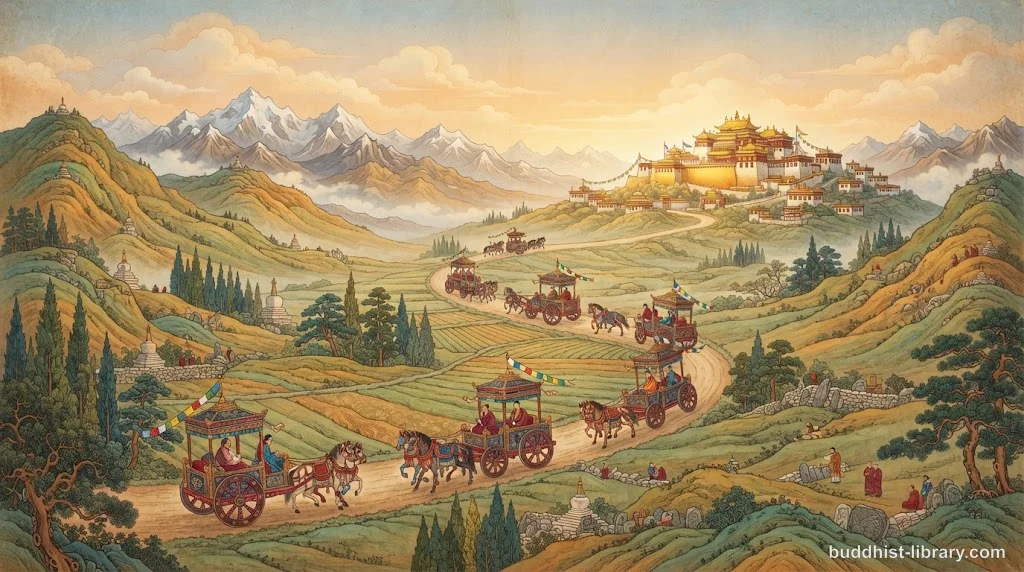
The Rathavinīta Sutta (the “Relay Chariots Discourse”) presents the Buddhist path as a series of seven successive purifications. The central metaphor comes from the sutta itself: imagine a king who must travel from one city to another distant city. He does not use a single chariot for the entire journey. Instead, relay chariots are stationed at intervals — he rides the first chariot to the first station, switches to a second chariot to reach the second station, and continues this way through seven stages until he reaches the royal palace.
When asked which chariot brought him to the palace, the king would have to say: all of them. No single chariot completed the journey; each one was necessary for its stage.
In the same way, the Buddha teaches, the holy life does not rest on a single practice or attainment. It progresses through seven stages of purification (satta visuddhiyo), each one dependent on the one before it, each one a vehicle toward the final goal — nibbāna, the complete cessation of suffering.
This framework appears in the Visuddhimagga (Path of Purification) by Buddhaghosa, but its canonical source is this sutta.
Why Did the Buddha Teach the Seven Purifications?
The context of the sutta is significant. Venerable Puṇṇa asks Venerable Sāriputta a pointed question: “Friend, is the holy life lived under the Blessed One for the sake of purification of virtue?”
Sāriputta answers: “No.”
Puṇṇa continues through each stage — purification of mind, purification of view, and so on. Each time, Sāriputta says no — the holy life is not lived for the sake of that particular purification alone.
Finally, Puṇṇa asks: “Then for what purpose is the holy life lived?”
Sāriputta explains: the holy life is lived for the sake of final knowledge and vision (ñāṇadassana), which means the complete, direct realization of nibbāna. But that final knowledge is not reached in isolation. It depends on the prior purifications — each one a stage, each one a chariot in the relay.
The teaching counters two misunderstandings:
- Reductionism — the idea that one practice (e.g., moral conduct or meditation alone) is sufficient for liberation.
- Goal displacement — mistaking an intermediate stage (like concentration or insight into impermanence) for the final goal.
The sutta says: every stage matters, but no stage is the end. You need all seven chariots to reach the palace.
What Are the Seven Stages of Purification?
The Rathavinīta Sutta identifies seven progressive purifications, each one building on the previous:
1. Purification of Virtue (Sīla-visuddhi)
This is the foundation. Purification of virtue means living in accordance with the Five Precepts for laypeople or the monastic code (Vinaya) for monks and nuns. It involves refraining from harmful actions of body and speech — killing, stealing, sexual misconduct, lying, and intoxication.
Why it matters: Without ethical conduct, the mind remains agitated by guilt, fear, and the consequences of unwholesome actions. Virtue creates the conditions for mental stability.
In the chariot simile: This is the first relay chariot. It does not take you all the way to nibbāna, but without it, you cannot even begin the journey.
2. Purification of Mind (Citta-visuddhi)
Grounded in virtue, the practitioner develops concentration (samādhi) through meditation. Purification of mind refers specifically to the attainment of the jhānas — deep meditative absorptions where the hindrances (sensual desire, ill will, sloth, restlessness, doubt) are temporarily suppressed and the mind becomes unified, clear, and powerful.
The jhānas are detailed in the Ānāpānasati Sutta and other meditation teachings.
Why it matters: A scattered, distracted mind cannot penetrate the nature of reality. The jhānas provide the mental clarity and stability needed for insight.
In the chariot simile: The second relay chariot. Concentration is not the destination — it is a vehicle to deeper understanding.
3. Purification of View (Diṭṭhi-visuddhi)
With a concentrated mind, the practitioner begins to investigate experience directly and sees the three characteristics — impermanence (anicca), suffering (dukkha), and non-self (anattā) — not as concepts but as lived realities.
Purification of view means distinguishing ultimate reality (the aggregates, sense bases, elements) from conventional concepts (person, self, I, mine). The practitioner sees that what we call “self” is actually five aggregates arising and passing away in dependence on conditions.
Why it matters: Wrong view — especially the belief in a permanent, independent self — is the root of craving and clinging. Right view dismantles that illusion.
In the chariot simile: The third relay chariot. This is where insight (vipassanā) begins.
4. Purification by Overcoming Doubt (Kaṅkhā-vitaraṇa-visuddhi)
Seeing impermanence, suffering, and non-self directly, the practitioner now investigates causality — how things arise and cease. This is the direct realization of dependent origination (paṭiccasamuppāda).
By tracing the chain of conditions (ignorance → formations → consciousness → … → suffering), the practitioner overcomes doubt about:
- The nature of past, present, and future existence.
- Whether the Buddha’s teaching is true.
- Whether liberation is actually possible.
Why it matters: Doubt is one of the five lower fetters that bind beings to the cycle of rebirth. Overcoming doubt establishes unshakable confidence in the path.
In the chariot simile: The fourth relay chariot. You now know the territory — the map of conditionality is clear.
5. Purification by Knowledge of What Is Path and Not-Path (Maggāmagga-ñāṇadassana-visuddhi)
At this stage, the practitioner gains the ability to discern what leads to liberation and what does not. This is not abstract theory — it is direct, experiential knowledge of which mental qualities support awakening (the seven factors of enlightenment, the Noble Eightfold Path) and which ones lead to delusion and suffering (the three poisons, wrong views).
The practitioner also sees through “counterfeit” spiritual experiences — mistaking pleasant meditative states, psychic powers, or temporary insights for final liberation.
Why it matters: This purification protects against spiritual bypassing and dead ends. It ensures the practitioner stays on the road to nibbāna and does not get lost in side paths.
In the chariot simile: The fifth relay chariot. You know which turns to take and which to avoid.
6. Purification by Knowledge of the Way (Paṭipadā-ñāṇadassana-visuddhi)
This is the stage of direct insight practice where the practitioner systematically observes the arising and passing of phenomena — sensations, feelings, perceptions, mental formations — with continuous mindfulness and equanimity. This is advanced vipassanā, often called the “knowledge of arising and passing away” and the subsequent insight knowledges.
The mind sees more and more clearly that all conditioned things are unsatisfactory, that clinging to any of them only perpetuates suffering, and that letting go is the way forward.
Why it matters: This purification erodes the deeper layers of attachment and aversion. The practitioner is no longer just understanding impermanence conceptually — they are living it moment by moment.
In the chariot simile: The sixth relay chariot. You are in the final approach to the palace.
7. Purification by Knowledge and Vision (Ñāṇadassana-visuddhi)
This is the culmination — the direct realization of nibbāna, the unconditioned, the cessation of all suffering. At this stage, the practitioner experiences path and fruition (magga-phala) — the moment of awakening where the fetters binding them to suffering are cut.
There are four levels of awakening:
- Stream-entry (sotāpanna) — the first irreversible breakthrough, eliminating the first three fetters (identity view, doubt, attachment to rites and rituals).
- Once-returner (sakadāgāmī) — weakening of sensual desire and ill will.
- Non-returner (anāgāmī) — complete elimination of sensual desire and ill will.
- Arahat — full liberation, elimination of all ten fetters.
At each level, purification by knowledge and vision deepens until, at arahatship, it is complete.
Why it matters: This is what the entire relay of chariots was leading to — the direct, unshakable knowledge that suffering has ended, its cause has been abandoned, and the path has been fully walked.
In the chariot simile: Arrival at the royal palace. The journey is complete.
How Do the Seven Purifications Work Together?
The brilliance of the relay chariot simile is that it shows conditionality without reductionism. Each purification is:
- Dependent on the prior one (you cannot purify view without first purifying mind).
- Incomplete on its own (purification of virtue alone does not lead to nibbāna).
- Necessary for the next stage (purification of mind creates the conditions for purification of view).
In practical terms:
- You begin with ethics (sīla) — restraining harmful actions, cultivating wholesome conduct.
- Ethics create mental stability, which you develop through meditation (samādhi).
- A concentrated mind can then see clearly (paññā) — investigating impermanence, dependent origination, and non-self.
- That clarity removes doubt, discerns the path, deepens insight, and finally cuts through to the unconditioned.
The path is gradual and progressive — like climbing a staircase where each step supports the next — but it is also organic, not mechanical. The stages can overlap; virtues reinforces concentration, concentration sharpens wisdom, and wisdom deepens virtue.
How Does This Relate to Modern Practice?
For contemporary practitioners, the Rathavinīta Sutta cuts through common misunderstandings.
You Cannot Skip Stages
The path is sequential. You cannot meditate your way to insight if your life is chaotic and unethical. You cannot develop liberating wisdom if your mind is scattered. Start where the Buddha started — with virtue.
Every Stage Matters, But No Stage Is the End
Concentration feels good. Insight into impermanence can be profound. But mistaking a stage for the destination stops your progress cold. The sutta says: keep going.
Purification Means Removing What Obscures
The word visuddhi does not mean becoming morally “pure.” It means removing obscurations — clearing away the defilements, wrong views, and attachments that block direct seeing. It is active work.
Liberation Is the Goal, Not Attainments
The question-and-answer structure makes this explicit. The goal is not jhāna, not psychic powers, not insight. It is nibbāna — the end of suffering. Everything else is a vehicle.
Conclusion: The Journey and the Destination
The Rathavinīta Sutta teaches that enlightenment is both structured and profound. Structured, because it follows a clear sequence — each purification building on what came before. Profound, because nibbāna transcends every stage that leads to it.
No single chariot completes the relay. Each one is necessary.
The same holds for virtue, concentration, and wisdom. They are not the goal. They are the vehicles.
And the Buddha’s teaching? It is not about choosing between ethics, meditation, or insight. It is about walking the whole path — stage by stage — until liberation is no longer a concept but a lived reality.
Read more:
- The Gradual Training in Buddhism: The Buddha’s Step-by-Step Path — explores the progressive structure of Buddhist practice from ethical conduct through meditation to wisdom.
- The Three Trainings in Buddhism: Sīla, Samādhi, and Paññā — explains how the three core dimensions of practice (morality, concentration, wisdom) work together on the path to liberation.
- The Seven Factors of Enlightenment: Cultivating the Bojjhaṅgas — details the mental qualities that mature through the stages of purification and lead directly to awakening.
📖 Source / license: Majjhima Nikāya 24 (Access to Insight, Ñāṇamoli & Bodhi translation)
Frequently asked questions
What are the seven stages of purification in the Rathavinīta Sutta?
The seven stages are: purification of virtue (sīla), purification of mind (citta), purification of view (diṭṭhi), purification by overcoming doubt, purification by knowledge of what is path and not-path, purification by knowledge of the way, and purification by knowledge and vision — each one leading to the next like relay chariots.
Why does the Buddha use the chariot simile in this sutta?
The chariot simile illustrates that the spiritual path is progressive and cumulative — just as relay chariots take a traveler stage by stage to their destination, each level of purification serves as a vehicle to the next, with the ultimate destination being nibbāna.
Do you need to master all seven purifications to reach awakening?
Yes. The sutta teaches that each stage depends on the previous one — you cannot skip stages. Purification of virtue supports purification of mind, which enables purification of view, and so on. However, the stages can overlap and reinforce each other in practice.
How does the Rathavinīta Sutta relate to other gradual training suttas?
The Rathavinīta Sutta complements teachings like the gradual training discourse by mapping out specific purification stages. While the gradual training emphasizes sequential practices (ethics, sense restraint, mindfulness), this sutta focuses on the internal transformations — the successive clarifications of mind and view — that occur along the path.