What Is Saṅkhata and Asaṅkhata? Understanding Conditioned and Unconditioned Reality in Buddhism
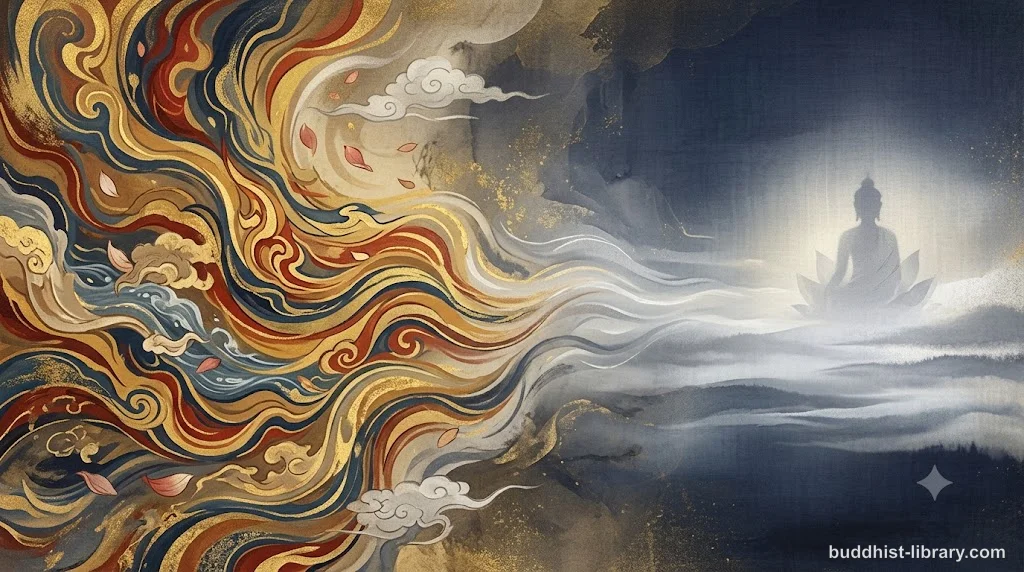
Saṅkhata (conditioned) refers to everything that arises dependent on causes — thoughts, feelings, bodies, worlds. Asaṅkhata (unconditioned) is Nibbāna alone: the reality that does not arise, does not change, and does not pass away. This distinction between the fabricated and the unfabricated is central to understanding what the Buddhist path aims toward.
The Buddha’s teaching rests on a simple observation: everything we experience in the ordinary world is saṅkhata. Put together. Dependent. Impermanent.
Every sensation, thought, relationship, and form arises from conditions and will pass when those conditions change. Liberation comes through realizing the asaṅkhata — the deathless, the unborn, the unconditioned.
What Does Saṅkhata Mean?
Saṅkhata comes from the Pali root saṅ- (together) and kata (made, done). It literally means “put together” or “constructed.” In Buddhist philosophy, saṅkhata refers to all conditioned phenomena — everything that:
- Arises dependent on causes and conditions
- Changes over time
- Eventually ceases
This includes the five aggregates (form, feeling, perception, mental formations, consciousness), the six sense bases, all mental states, all physical forms, and even subtle meditative states like the jhānas. If it arises, it is saṅkhata.
The Saṃyutta Nikāya (SN 43) lists synonyms for the conditioned: the born, the become, the made, the fabricated, the liable to aging and death. Conditioned phenomena carry the three marks of existence: they are impermanent (anicca), unsatisfactory (dukkha), and non-self (anattā).
What Does Asaṅkhata Mean?
Asaṅkhata is the negation of saṅkhata: a- (not) + saṅkhata (conditioned). It means unconditioned, unfabricated, not put together. In Theravāda Buddhism, the term asaṅkhata refers to Nibbāna alone.
The Udāna (Ud 8.3) famously describes the unconditioned:
“There is, monks, an unborn, unbecome, unmade, unconditioned. If there were not that unborn, unbecome, unmade, unconditioned, there would be no escape from the born, become, made, and conditioned. But precisely because there is an unborn, unbecome, unmade, unconditioned, therefore an escape from the born, become, made, and conditioned is discerned.”
Nibbāna does not arise, does not change, and does not pass away. It is not fabricated by causes. It is not located in time or space, because time and space themselves are conditioned.
How Are Saṅkhata and Asaṅkhata Different?
The contrast is absolute:
| Saṅkhata | Asaṅkhata |
|---|---|
| Arises from causes | Does not arise |
| Changes and ages | Does not change |
| Ceases and passes away | Does not cease |
| Impermanent, unreliable | Permanent, stable |
| Subject to dukkha | Free from dukkha |
| Bound by dependent origination | Not bound by conditions |
Saṅkhata phenomena are governed by the law of dependent origination (paṭiccasamuppāda). They exist only as long as their supporting conditions persist. When conditions shift, they dissolve.
Asaṅkhata does not depend on anything. It is not supported by conditions, so it cannot be destroyed by changing conditions. It is discovered, not created. It is realized, not fabricated.
What Are Examples of Saṅkhata?
Everything in ordinary experience is saṅkhata:
- Physical forms: bodies, trees, mountains, stars
- Mental states: anger, joy, concentration, confusion
- Relationships: friendships, conflicts, social roles
- Perceptions and concepts: self-image, identity, beliefs
- Meditative attainments: jhānas, formless absorptions, psychic powers
Even refined spiritual states are still conditioned. A meditator who reaches the fourth jhāna has not reached the unconditioned — that absorption still arises, persists, and eventually passes.
The aggregates (khandhas) are saṅkhata. The six sense bases are saṅkhata. Consciousness itself is saṅkhata. Anything you can point to and say “this” is conditioned.
Is Anything Other Than Nibbāna Unconditioned?
In Theravāda Buddhism, only Nibbāna is asaṅkhata. The Abhidhamma lists one unconditioned reality: Nibbāna.
Other Buddhist schools debated whether space (ākāsa) or certain types of cessation might also be unconditioned. Some Mahāyāna traditions speak of the “unconditioned nature of mind” or emptiness (śūnyatā) as ultimate reality. But in the Pali Canon, the term asaṅkhata consistently points to Nibbāna alone.
Even consciousness (viññāṇa), though sometimes described in poetic language as luminous or radiant, is still conditioned. It arises dependent on sense contact, it changes with objects, and it ceases. It is part of the five aggregates, and the Buddha repeatedly called the aggregates conditioned.
Why Does This Distinction Matter for Practice?
This distinction clarifies where the path actually points.
Many practitioners spend years trying to perfect conditioned phenomena — seeking perfect concentration, perfect relationships, perfect states of mind. Refined, yes. But still conditioned. Still subject to change and dissolution.
Perfecting saṅkhata does not lead to liberation.
The path aims at the asaṅkhata. The Noble Eightfold Path, the development of virtue, concentration, and wisdom, the cultivation of insight — these are conditioned means pointing toward an unconditioned end. The raft is saṅkhata. The far shore is asaṅkhata.
Seeing all phenomena as conditioned loosens clinging. When you recognize that every experience — pleasant or painful, subtle or gross — is fabricated and will dissolve, you stop demanding permanence from the impermanent. This is the beginning of dispassion (virāga).
Directing attention toward the unconditioned orients the mind toward freedom. Through letting go. Through cessation. Through the fading of craving.
How Do You Realize the Unconditioned?
You do not create Nibbāna. You remove the conditions that obscure it.
The canonical method is insight into the conditioned nature of phenomena. By observing arising and passing (udayabbaya), the meditator sees directly that everything experienced is saṅkhata. This seeing undermines the illusion of permanence and self.
When craving (taṇhā) and clinging (upādāna) cease, the conditioned processes that sustain suffering cease. What remains is the unconditioned: Nibbāna.
The Dhammapada (verse 277) states:
“All conditioned things are impermanent” — when one sees this with wisdom, one turns away from suffering. This is the path to purity.
Turning away from the conditioned means turning toward the unconditioned. Lasting peace is not found in rearranging saṅkhata, but in realizing asaṅkhata.
What Is the Relationship Between Saṅkhata and Emptiness?
In the Pali Canon, the conditioned nature of phenomena links directly to their emptiness (suññatā).
Because all saṅkhata things arise dependent on conditions, they are empty of independent existence. No inherent self. No stable essence. A feeling arises due to contact; when contact ceases, the feeling ceases. No stable core.
The Buddha taught that by seeing the conditioned as conditioned, and by seeing that conditioned things are empty of self, the mind releases its grip. The unconditioned emerges through letting go of the fabrications that obscure it.
Some Mahāyāna traditions describe emptiness itself as unconditioned — the ultimate nature underlying all phenomena. Early Buddhism stops short of that philosophical move. But the insight is similar: the deepest freedom comes through letting go, not through perfecting what is inherently unstable.
Key Takeaways
- Saṅkhata (conditioned): All phenomena that arise from causes, change, and cease — including thoughts, bodies, feelings, perceptions, and even refined meditative states.
- Asaṅkhata (unconditioned): In Theravāda Buddhism, Nibbāna alone — that which does not arise, does not change, and does not pass away.
- Why it matters: Recognizing everything in experience as conditioned reduces clinging. Understanding the unconditioned as the goal orients practice toward liberation rather than perfecting impermanent phenomena.
- How to realize it: Through insight into impermanence, through letting go of craving, and through the cessation of conditioned processes that sustain suffering.
The distinction between saṅkhata and asaṅkhata is not abstract metaphysics. It is a practical teaching that points meditators beyond the cycle of fabrication and toward the deathless.
Read more:
- What Is Dependent Origination (Paṭiccasamuppāda)? — The law governing all conditioned phenomena and how they arise interdependently.
- Nirodha: Understanding Cessation — The Third Noble Truth — Cessation as the door to the unconditioned and the end of suffering.
- What Is Nirvana (Nibbāna)? Meaning and Misconceptions — A deeper exploration of the unconditioned reality that is the goal of the Buddhist path.
📖 Source / license: Saṃyutta Nikāya 43 (Asaṅkhata-saṃyutta), Udāna 8.3 (Nibbāna Sutta), Abhidhamma classification
Frequently asked questions
What does saṅkhata mean in Buddhism?
Saṅkhata means 'conditioned' or 'constructed.' It refers to all phenomena that arise through causes and conditions, are impermanent, and subject to change and cessation.
What is asaṅkhata in Buddhist philosophy?
Asaṅkhata means 'unconditioned' — that which does not arise, does not pass away, and is not fabricated by causes. In Theravāda Buddhism, the only asaṅkhata is Nibbāna.
How does understanding saṅkhata and asaṅkhata help practice?
Recognizing all experience as saṅkhata (conditioned and impermanent) reduces clinging. Understanding asaṅkhata (the unconditioned) as the goal orients practice toward liberation rather than rearranging conditioned phenomena.
Is space or consciousness unconditioned in early Buddhism?
In early Buddhism, only Nibbāna is truly asaṅkhata. Space and consciousness are still conditioned phenomena, though some later schools debated this classification.