The Soṇa Sutta: Tuning Your Effort Like a Lute String

Meditation effort should feel like a well-tuned lute string: taut enough to resonate, loose enough not to snap. The Buddha gave this instruction to Venerable Soṇa, whose feet literally bled from over-zealous walking meditation — yet who was making no real progress. Sometimes the problem isn’t insufficient dedication. It’s misapplied intensity.
What Is the Soṇa Sutta?
The Soṇa Sutta (also called the Soṇa Koḷivisa teaching) is a discourse found in the Mahāvagga section of the Vinaya Piṭaka. While technically part of the monastic code rather than the Sutta Piṭaka, it contains one of the Buddha’s most memorable teachings on Right Effort.
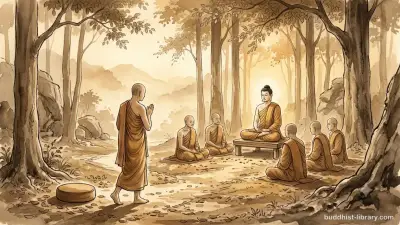
Venerable Soṇa was a dedicated monk who practiced walking meditation so intensively that his feet bled. Despite this extreme effort, he wasn’t making the progress he expected. Discouraged, he considered giving up the monastic life and returning to lay life where he could at least support the Saṅgha with his wealth.
The Buddha, knowing Soṇa’s thoughts, appeared to him and asked a pivotal question.
The Lute String Analogy
The Buddha asked Soṇa: “When you were a householder, were you skilled at playing the lute?”
Soṇa replied that he was.
The Buddha then asked: “When the strings of your lute were too tight, was your lute in tune and playable?”
“No, venerable sir.”
“And when the strings of your lute were too slack, was your lute in tune and playable?”
“No, venerable sir.”
“But when the strings of your lute were neither too tight nor too slack, but tuned to be right on pitch, was your lute in tune and playable?”
“Yes, venerable sir.”
The Buddha concluded: “In the same way, Soṇa, over-aroused energy leads to restlessness, and overly slack energy leads to laziness. Thus you should determine the right pitch for your energy, penetrate the pitch of the [five spiritual] faculties, and there pick up your theme.”
Why This Teaching Matters
The Middle Way in Practice
This sutta is a direct application of the Middle Way — not as abstract philosophy, but as concrete meditation instruction. The Buddha isn’t advocating for mediocrity or half-hearted practice. He’s pointing to a sustainable intensity that can be maintained over the long haul.
A lute string tuned to the right pitch produces beautiful music. Similarly, effort calibrated correctly produces concentration, insight, and progress on the path.
Recognizing the Two Extremes
Too tight (over-aroused energy):
- Physical tension and exhaustion
- Mental agitation and restlessness
- Striving that becomes its own obstacle
- Burnout and discouragement
- The mind becomes “hard” and brittle
Too slack (overly slack energy):
- Drowsiness and dullness
- Mind-wandering and distraction
- Lack of momentum or progress
- Complacency masquerading as “letting go”
- The mind becomes foggy and unresponsive
Finding the Right Pitch
The sweet spot isn’t obvious. You’re engaged but not grinding your teeth about it. Relaxed but awake. Alert without that white-knuckle grip that actually prevents clear seeing.
Notice the Buddha didn’t tell Soṇa to “try harder.” He told him to tune. That shift matters.
How to Apply This Teaching
1. Develop Body Awareness
Physical tension is often the first sign that effort has become excessive. Notice:
- Furrowed brow or clenched jaw
- Tight shoulders or chest
- Shallow breathing
- Fatigue that feels strained rather than the clean tiredness of good work
If you notice these signs, consciously relax. Let the breath settle. Soften the body while maintaining clear awareness.
2. Watch the Quality of Mind
A mind striving too hard becomes narrow, rigid, tense. Thoughts loop obsessively about “doing it right” or “getting somewhere.” Progress becomes a mental project.
A mind too lax drifts, daydreams, forgets the meditation object repeatedly. There’s a sense of “going through the motions” without real engagement.
Balanced effort feels bright, spacious, and curious. There’s interest without pressure.
3. Adjust Dynamically
Effort isn’t a one-time setting. Some days you wake up energized and need to guard against over-doing. Other days you’re sluggish and need to rouse energy.
Like tuning a lute, you check the pitch regularly and make small adjustments. This is part of what the Buddha meant by “pick up your theme” — you return to the meditation object with the energy level appropriate for this moment.
4. Let Go of the Outcome Grip
Soṇa wasn’t just over-exerting physically. He’d bought into the idea that awakening comes from grinding hard enough. Force the result.
The Buddha’s correction shifted everything. According to the Vinaya account, Soṇa adjusted his effort and soon after attained arahantship. Not from backing off entirely — from finding the right tension.
The Five Spiritual Faculties
The Buddha’s instruction to “penetrate the pitch of the [five spiritual] faculties” points to a broader framework. The five faculties — faith (saddhā), energy (vīriya), mindfulness (sati), concentration (samādhi), and wisdom (paññā) — must be balanced with each other.
Too much faith without wisdom becomes blind belief. Too much energy without concentration scatters. Too much concentration without investigation becomes dull absorption.
The lute analogy applies to the whole practice: everything in tune, working together, producing the “music” of liberation.
Common Misunderstandings
”Balanced effort means being casual”
No. A well-tuned lute string is under real tension — just not breaking tension. Balanced effort is still effort: committed, deliberate, sustained. It’s simply not self-sabotaging.
The Buddha wasn’t telling Soṇa to care less about awakening. He was telling him to practice intelligently instead of desperately.
”I should always feel comfortable”
Also wrong. Discomfort happens. Physical discomfort from sitting. Mental discomfort when you face what you’d rather avoid.
The question isn’t “Am I comfortable?” It’s “Is this sustainable?” You can sit with discomfort without layering striving on top of it.
”This only applies to monastics”
The teaching was given to a monk, yes. But parents juggling practice and family need this. Workers with 20 minutes before dawn need it. Retreat practitioners sitting 12 hours a day absolutely need it.
Find your sustainable pitch wherever you are.
Beyond the Cushion
This teaching escapes the meditation hall. How much effort at work? In relationships? In trying to be good?
The middle way gets misread as “do less” or “care less.” Wrong target. It’s about sustainable engagement — the level that lets you keep going, keep learning, stay responsive instead of brittle.
Play a lute with balanced strings and you get music. Live with balanced effort and wisdom has room to grow.
Key Points
- Venerable Soṇa practiced so hard his feet bled, yet made little progress
- The Buddha used Soṇa’s skill with the lute to teach balanced effort
- Strings too tight snap; strings too slack produce no sound
- Right effort in meditation is sustainable, alert, and engaged without strain
- Physical tension and mental restlessness signal over-aroused energy
- Dullness and drift signal energy that’s too slack
- Tuning effort is an ongoing practice, not a one-time adjustment
- This teaching applies to all five spiritual faculties and to life itself
Frequently Asked Questions
What is the Soṇa Sutta about?
The Soṇa Sutta records the Buddha’s teaching to Venerable Soṇa on how to balance effort in meditation practice using the analogy of tuning a lute string — neither too tight nor too slack.
Where is the Soṇa Sutta found?
This teaching is found in the Mahāvagga (5.1.15-16) of the Vinaya Piṭaka, the monastic code section of the Pali Canon.
What does the lute analogy teach about meditation?
The lute analogy teaches that meditation effort should be balanced: strings too tight snap, strings too slack produce no sound. Similarly, excessive striving causes burnout while insufficient effort leads to slackness.
How do I know if my effort is balanced?
Balanced effort feels sustainable and produces results over time. Signs of excess include tension, agitation, or burnout. Signs of deficiency include dullness, distraction, or lack of progress.
Did Soṇa attain enlightenment after this teaching?
Yes. The Vinaya records that after adjusting his effort according to the Buddha’s instruction, Soṇa soon attained arahantship.
Does this teaching only apply to meditation?
While given as meditation instruction, the principle of balanced effort applies broadly — to ethical practice, livelihood, study, and all aspects of the path.
Conclusion
Spiritual practice isn’t a test of willpower. Soṇa had plenty of will — his bleeding feet proved that. What he lacked was calibration.
The Buddha could have doubled down, praised the dedication, urged him to push through. He didn’t. He gave him a tuning lesson instead.
Check your pitch. Adjust when needed. The instrument is you.
Read more:
- Right Effort (Sammā Vāyāma): The Four Right Exertions in Buddhist Practice — Explore the formal teaching on effort as the sixth factor of the Noble Eightfold Path, including how to generate, maintain, and balance wholesome mind-states.
- The Five Spiritual Faculties (Indriya): Faith, Energy, Mindfulness, Concentration, Wisdom — Understand the five faculties that must be balanced together, and how energy (vīriya) works in concert with the other four.
- The Middle Way in Buddhism: Walking Between Extremes — Discover the broader principle of the Middle Way that underlies the Soṇa Sutta’s teaching on balanced effort.
📖 Source / license: Mahāvagga 5.1.15-16, Vinaya Piṭaka; Ṭhānissaro Bhikkhu translation
Frequently asked questions
What is the Soṇa Sutta about?
The Soṇa Sutta records the Buddha's teaching to Venerable Soṇa on how to balance effort in meditation practice using the analogy of tuning a lute string — neither too tight nor too slack.
Where is the Soṇa Sutta found?
This teaching is found in the Mahāvagga (5.1.15-16) of the Vinaya Piṭaka, the monastic code section of the Pali Canon.
What does the lute analogy teach about meditation?
The lute analogy teaches that meditation effort should be balanced: strings too tight snap, strings too slack produce no sound. Similarly, excessive striving causes burnout while insufficient effort leads to slackness.
How do I know if my effort is balanced?
Balanced effort feels sustainable and produces results over time. Signs of excess include tension, agitation, or burnout. Signs of deficiency include dullness, distraction, or lack of progress.