The Theragāthā and Therīgāthā: Enlightenment Verses of the First Buddhist Disciples
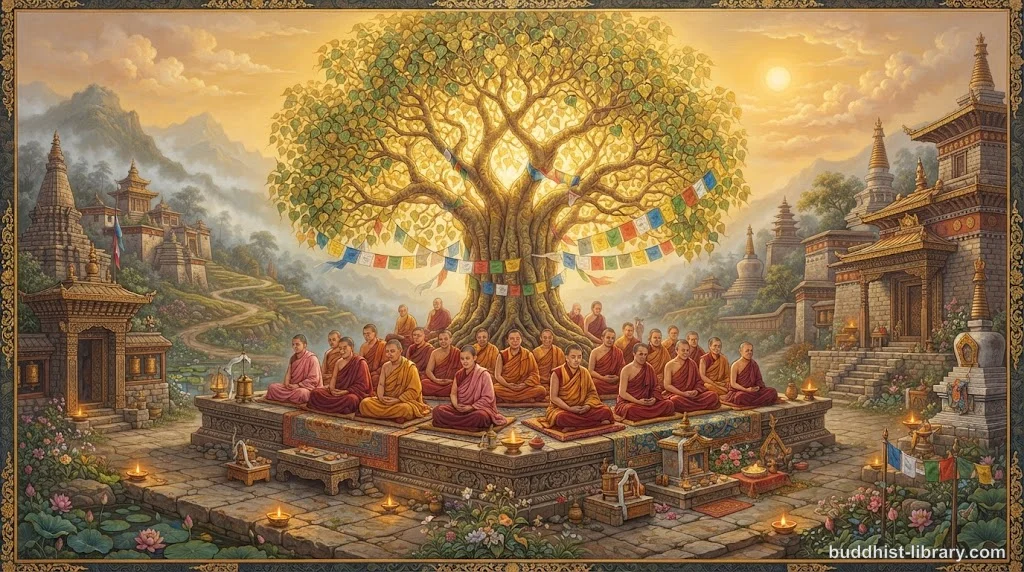
The Theragāthā and Therīgāthā are ancient collections of enlightenment poetry—the actual words of the Buddha’s first awakened disciples, both monks and nuns, describing their struggles, insights, and the profound joy of liberation. These verses preserve voices from 2,500 years ago, offering intimate glimpses into the minds of those who walked the path to its end.
These collections sit within the Khuddaka Nikāya (“Minor Collection”) of the Pali Canon. Nothing minor about them. Raw, honest, sometimes shocking—elderly disciples shouting their freedom, former courtesans describing their escape from exploitation, forest monks drunk on solitude, nuns recounting battles with doubt and despair that they won.
What Are the Theragāthā and Therīgāthā?
The Theragāthā (“Verses of the Elder Monks”) contains 264 poems attributed to individual bhikkhus (monks) who attained enlightenment during the Buddha’s lifetime or shortly after. The Therīgāthā (“Verses of the Elder Nuns”) preserves 73 poems from bhikkhunīs (nuns) who reached the same goal.
These aren’t instruction manuals.
They’re victory songs.
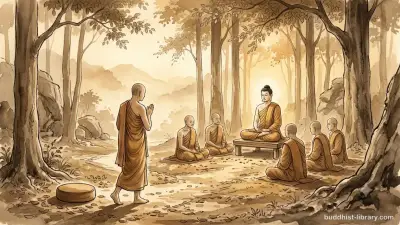
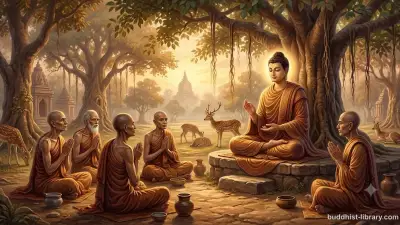
When Venerable Aññā Koṇḍañña became the first person besides the Buddha to see the Dhamma, he didn’t write a treatise—he spoke verses. When the nun Mahāpajāpatī Gotamī, the Buddha’s foster mother, realized full awakening along with 500 other nuns, they expressed it in poetry. The verses collected here represent that tradition: enlightened beings giving voice to what they’d seen and overcome.
The collections vary in length. Some entries are a single verse—four lines capturing one moment of realization. Others run to dozens of stanzas, telling a complete spiritual autobiography from worldly entanglement to final freedom.
Historical Context: Who Spoke These Verses?
The speakers came from every background imaginable in ancient India.
Among the monks: Rulers who renounced kingdoms. Brahmins who abandoned caste privilege. Manual laborers. A barber. A hunter. Former ascetics who practiced for decades before meeting the Buddha. Young men who ordained as teenagers and reached arahatship before age twenty.
Among the nuns: Queens and courtesans. Wealthy noblewomen and destitute widows. Women who ordained after losing children. Former beauties who watched their looks fade. Mothers, daughters, sisters—sometimes from the same family, sometimes finding each other in the Sangha after years apart.
The Therīgāthā holds special significance. It’s one of the oldest bodies of women’s spiritual literature in any language. Where else in the ancient world do we hear women’s voices speaking directly about their path to liberation—not through male interpreters, not as passive recipients, but as autonomous practitioners who fought their own battles and won?
Khemā had been a queen. Famous for her beauty. Her verses describe confronting aging, illness, and the collapse of everything she’d built identity around—then breaking through to freedom.
Paṭācārā lost her entire family in a single day. Wandered mad with grief. The Buddha’s teaching cut through her anguish, and she became one of his foremost female disciples. Her verses teach other nuns, passing on what she learned through unspeakable loss.
What Do These Verses Contain?
Personal Spiritual Narratives
Many verses tell complete stories. The monk Sunīta was an outcast, a street sweeper so low in social hierarchy that others wouldn’t let his shadow touch them. His verses describe how the Buddha personally ordained him, how he practiced with fierce determination, and how he attained arahatship—then met his former “superiors” on the road and watched them bow to him, not for his caste but for his liberation.
The nun Subhā was harassed by a man who praised her eyes. Her response? She plucked one out and handed it to him, then described how the Buddha restored her sight after she attained enlightenment—a shocking story about the lengths some went to preserve their practice.
Descriptions of Awakening
Some verses capture the moment of breakthrough with startling clarity. Vaṅgīsa, the Buddha’s foremost poet-disciple, describes insight arising:
“Just as rain breaks through
a poorly thatched roof,
so passion breaks through
an undeveloped mind.Just as rain doesn’t break through
a well-thatched roof,
so passion doesn’t break through
a well-developed mind.”
Others describe the after-effects: the release from all anxiety, the end of craving, the unshakeable peace that comes when every fetter drops away.
Reflections on Renunciation
Monks and nuns describe what they left behind and why it was worth leaving. Revatā speaks of abandoning gold and lands. Kisā Gotamī, who lost her infant son and sought the Buddha in grief, describes finding something more lasting than any family bond.
Some verses are blunt about the downsides of household life. Therīgāthā verses from married women describe domestic existence as a trap, childbearing as suffering, beauty as a lure into bondage. Modern readers sometimes find this harsh—but these aren’t condemnations of others’ choices. They’re honest accounts of what these particular women experienced and what freedom meant to them.
Celebrations of Solitude
Forest-dwelling monks fill their verses with nature imagery: mountains, caves, rivers, wildlife. They’re drunk on wilderness and silence, ecstatic about what arises when every distraction falls away.
Ekavihāriya celebrates living alone:
“Wandering alone,
unindolent,
like a wind-freed lion,
not depending on another,
not building a nest—
such is the sage’s way.”
This isn’t misanthropy. It’s about finding conditions where the mind settles completely.
Warnings and Encouragement
Older disciples address younger ones, offering warnings drawn from experience. Don’t waste time. Don’t get caught in pleasant distractions. Don’t delay practice until some imaginary “better” moment arrives. Death comes for everyone—use the time you have.
The nun Muttā, her name meaning “freed,” declares:
“I’m free, completely free,
from three crooked things:
mortar, pestle, and my crooked husband!
I’m freed from birth and death,
and all that dragged me back.”
That’s not bitterness. That’s victory.
Key Themes Across Both Collections
Liberation Is the Only Real Goal
Whatever else differs between speakers, this stays constant: They found something worth every sacrifice.
Wealth, status, family, comfort—all worthwhile to some degree. But nothing compared to the end of dukkha.
The Struggle Is Real
These verses don’t pretend the path is easy.
Doubt, depression, physical hardship, social rejection, internal battles with lust and anger—it’s all here. Soṇa Koḷivisa wore the skin off his feet walking meditation until his footprints filled with blood. He attained arahatship that very night.
Enlightenment in these accounts isn’t handed out.
Joy Beyond Measure
The emotional tone of many verses? Pure exuberance.
Disciples describe a happiness that worldly pleasures can’t touch—not because it’s “higher” in some abstract sense, but because it doesn’t depend on conditions that inevitably change. This isn’t dry detachment. It’s alive, energetic, sometimes playful.
The Buddha’s Role
Nearly every verse acknowledges the Buddha with profound gratitude. Without his teaching, they say, none of this would have been possible. He’s praised not as a deity but as the teacher who showed the way—and then got out of their way so they could walk it themselves.
How to Read These Verses
For Inspiration
Practice feeling dry or impossible? Read a verse from someone who faced worse conditions and broke through anyway.
Soṇa was a wealthy merchant’s son with delicate feet. He practiced until they bled. If he could do it, maybe you can take one more step.
For Perspective
These disciples didn’t have cushions, meditation apps, or retreat centers. They practiced in forests with wild animals, through monsoons and droughts, often with minimal food. Your challenges are real—but you have resources they couldn’t imagine.
For Company
The path can feel isolating, especially if you’re practicing in a culture that doesn’t value it. These verses are company across 2,500 years—proof that others have walked this way, that it leads somewhere real, that you’re not crazy for trying.
As Objects of Contemplation
Choose a verse that speaks to you and memorize it. Return to it during sitting practice or when you need a reminder. Let it become part of your inner landscape.
Notable Verses Worth Knowing
Upaka’s Question (Theragāthā 1.49): After enlightenment, the Buddha met the ascetic Upaka, who asked about his teacher. The Buddha replied in verse—the first person to hear him declare his awakening.
Raṭṭhapāla’s Declarations (Theragāthā 16.1): A prince who renounced everything, he describes the world as a stream sweeping all beings toward death, with Dhamma as the only island.
Ambapālī’s Verses (Therīgāthā 13.1): A famous courtesan who became a nun, she describes her beauty’s decay in graphic detail, then celebrates the freedom found when that beauty—and attachment to it—was completely gone.
Puṇṇā’s Teaching (Therīgāthā 5.1): After losing children and husband, this nun addresses Māra (delusion personified) with utter confidence: “I’ve cut the fetter, shattered the peak, pulled up the post—why do you stand there, evil one, obstructing me?”
The Therīgāthā: Why It Matters
In a world where women were often excluded from spiritual authority, the Therīgāthā stands as evidence that the Buddha’s path was genuinely open. These weren’t symbolic tokens. They were fully enlightened arahants—the Buddha himself confirmed their attainment.
Their verses describe experiences men’s accounts often miss: the specific suffering of being valued only for beauty or fertility, the complex grief of losing children, the domestic constraints that made renunciation both harder and more necessary.
Modern feminist scholars study the Therīgāthā not as ancient curiosity but as living proof that women’s liberation—in every sense—has been possible all along.
Practical Application
Start small: Pick one or two verses that resonate. Don’t try to read the whole collection at once—these are dense, packed with meaning.
Look for translations you connect with: Thanissaro Bhikkhu’s translations preserve the poetry. Bhikkhu Bodhi’s include detailed notes on context. Try different versions until you find the voice that speaks to you.
Read alongside practice: These verses make more sense the further you go in your own meditation. A description of jhāna or insight that seems abstract now may suddenly click after a breakthrough in practice.
Remember they’re human: These weren’t gods or mythical figures. They were people—flawed, struggling, sometimes screwing up—who kept going until they made it. That should encourage you, not intimidate you.
Common Misconceptions
“These are just legends”: Wrong. While poetic language is used, scholars generally accept these as genuine early documents preserving real disciples’ words. The Pali Canon was memorized and transmitted with extraordinary accuracy—errors would have been caught and corrected by multiple recitation lineages.
“Enlightenment was easier back then”: The verses themselves disprove this. Years of struggle. Repeated failures. Physical hardship. The difference wasn’t ease—it was determination and the Buddha’s living presence.
“These verses teach the path”: Not directly. They’re testimonials, not instructions. For step-by-step teaching, read the suttas where the Buddha lays out method. Read the Theragāthā and Therīgāthā to remember why the path is worth walking.
A Living Tradition
Today, monks and nuns in the Theravada tradition still memorize and chant these verses. They’re sung at ceremonies, referenced in Dhamma talks, used as inspiration during retreats.
When you read them, you’re not studying dead history. You’re hearing voices from the first generation of liberated beings—and joining a lineage that hasn’t broken in 2,500 years.
They walked the path. They made it. Their verses say: So can you.
Read more:
- The Dhammapada: An Introduction to the Buddha’s Verses — Another poetic collection from the Pali Canon, offering the Buddha’s own teachings in memorable verse form.
- What Is the Pali Canon (Tipiṭaka)? Structure and Contents of Early Buddhist Scriptures — Understand where the Theragāthā and Therīgāthā fit within the larger body of early Buddhist texts.
- Life of the Buddha: From Prince Siddhārtha to Awakening — Learn about the historical context in which these elder disciples lived and practiced alongside the Buddha.
📖 Source / license: Theragāthā and Therīgāthā (Khuddaka Nikāya), translations by Bhikkhu Bodhi and Thanissaro Bhikkhu; SuttaCentral; Access to Insight
Frequently asked questions
What are the Theragāthā and Therīgāthā?
The Theragāthā ("Verses of the Elder Monks") and Therīgāthā ("Verses of the Elder Nuns") are collections of poems in the Pali Canon spoken by the Buddha's first enlightened disciples, expressing their spiritual experiences and attainments.
Why is the Therīgāthā significant?
The Therīgāthā is remarkable as one of the oldest collections of women's spiritual literature in the world, preserving the voices and experiences of enlightened women from 2,500 years ago.
How can I use these verses in practice?
Read them as inspiration for your own practice, use specific verses for contemplation or memorization, and let the experiences of these early disciples guide and encourage your journey toward liberation.
Are these verses meant to be taken literally?
While they record genuine spiritual experiences, they use poetic language and metaphor. Read them for their emotional truth and practical wisdom rather than as dry historical records.