What Is Āsava? The Mental Influxes in Buddhism
Āsava—often translated as “influxes,” “cankers,” or “taints”—are the deep-seated mental defilements that keep beings bound to suffering and the cycle of rebirth. The Buddha identified eliminating the āsavas as synonymous with full liberation, making them among the most important concepts in Buddhist psychology.
What Does Āsava Mean?
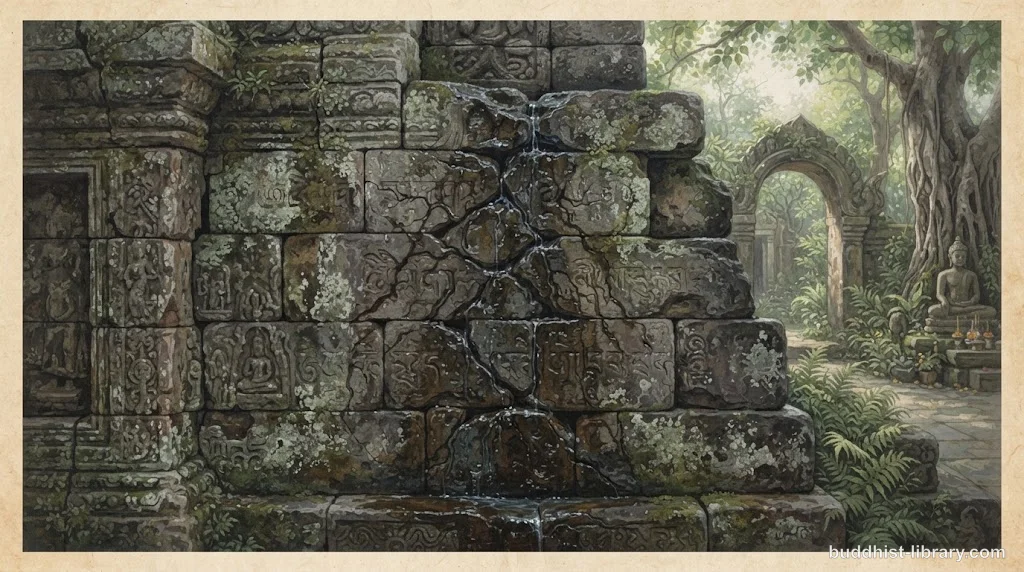
The Pali word āsava literally means “influx” or “outflow”—something that seeps in and corrupts from within. Water slowly seeping through stone, gradually wearing it down. That’s the image, and it’s precise: āsavas aren’t surface-level disturbances. They’re deep currents that color all experience.
The Buddha used this term deliberately. These are the most fundamental defilements—the ones that sustain saṃsāra itself. When they’re fully destroyed, a person becomes an arahat, completely liberated.
In the Pali Canon, the destruction of the āsavas (āsavakkhaya) is the defining characteristic of enlightenment. The Buddha frequently described arahats as those “whose āsavas are destroyed” (khīṇāsava).
How Many Āsavas Are There?
The texts present two lists:
The Three Āsavas (found in many suttas):
- Sensual desire (kāmāsava): the influx of craving for sensory pleasures
- Craving for existence (bhavāsava): the desire to be, to become, to continue existing
- Ignorance (avijjāsava): fundamental not-knowing about the Four Noble Truths and the nature of reality
The Four Āsavas (found in later texts):
- The same three above, plus:
- Wrong views (diṭṭhāsava): the influx of mistaken beliefs, especially belief in a permanent self
The three-āsava scheme is older and more common in early texts. When wrong views are listed separately, it’s often as a subdivision of ignorance.
How Do Āsavas Sustain Suffering?
Āsavas operate at the deepest level of the mind. Think of them as underground springs feeding all your surface reactions.
When you crave a pleasant experience, that’s kāmāsava at work. When you fear death or cling to existence, that’s bhavāsava. When you misperceive reality—seeing permanence where there’s change, self where there’s non-self—that’s avijjāsava distorting your view.
These aren’t occasional visitors—they’re constant. Subtle currents running beneath conscious awareness, shaping how you perceive, what you desire, how you react. Left unaddressed, they guarantee dukkha continues.
The relationship between āsavas and dependent origination is intimate: ignorance (avijjā) as the first link of the twelve-fold chain is essentially the same as avijjāsava. The influxes perpetuate the entire causal sequence that leads to rebirth and suffering.
The Seven Methods for Eliminating Āsavas
The Sabbāsava Sutta (MN 2)—its name literally means “All the Influxes”—presents a comprehensive strategy. The Buddha teaches that different āsavas are eliminated through different means:
-
By seeing (dassanā): Some āsavas are destroyed through insight—directly seeing the Four Noble Truths and the true nature of phenomena. This is the domain of wisdom (paññā).
-
By restraint (saṃvarā): Some are eliminated by guarding the sense doors—not letting unwholesome states arise through careless attention to sights, sounds, smells, tastes, touches, and mental objects.
-
By proper use (paṭisevanā): Using the requisites of life—food, clothing, shelter, medicine—with reflection, not for pleasure but for sustaining the body in the practice.
-
By endurance (adhivāsanā): Patiently bearing difficult conditions: cold, heat, hunger, insults, physical pain. Not indulging aversion.
-
By avoidance (parivajjanā): Steering clear of dangerous situations—wild animals, rough terrain, bad companions, unwholesome environments.
-
By removal (vinodanā): Actively abandoning unwholesome thoughts when they arise, replacing them with wholesome ones. (The Vitakkasanthāna Sutta elaborates five methods for this.)
-
By development (bhāvanā): Cultivating the seven factors of enlightenment—mindfulness, investigation, energy, joy, tranquility, concentration, and equanimity.
No single method does everything. A complete practice engages all seven.
Āsavas vs. Other Defilements
Buddhist psychology has many terms for mental defilements. How do āsavas fit?
- Kilesas (defilements): A broad term covering greed, hatred, delusion, and their many variations. Āsavas are a subset—the deepest kilesas.
- Saṃyojanas (fetters): Ten chains that bind beings to rebirth. Āsavas are the underlying force; fetters are the specific bonds. (See The Ten Fetters.)
- Anusayas (latent tendencies): Dormant proclivities that lie beneath consciousness. Āsavas are active; anusayas are dormant. When an anusaya is triggered, an āsava flows.
The Buddha used different terms for different contexts, but they all point to the same territory: the deep structures of craving and ignorance that perpetuate suffering.
The Relationship Between Āsavas and Nibbāna
In many discourses, the Buddha defines nibbāna negatively—by what it’s not, or what has ceased. One of the most common definitions: nibbāna is the destruction of the āsavas.
When the āsavas are fully eliminated, there’s no more fuel. The fires of greed, hatred, and delusion go out. The cycle stops.
This isn’t annihilation. It’s the end of a process—the influxes that kept the whole mechanism running have dried up. What remains? Peace. Freedom. The unconditioned.
The Buddha’s own awakening is described this way: “Knowledge arose: ‘Destroyed is birth, the holy life has been lived, what had to be done has been done, there is no more coming to any state of being.’ This was the third knowledge I attained in the third watch of the night. Ignorance was destroyed, knowledge arose; darkness was destroyed, light arose—as happens in one who dwells heedful, ardent, and resolute. And this, bhikkhus, is the destruction of the āsavas.”
Key Points
- Āsavas are deep-rooted influxes—not surface reactions but fundamental defilements that sustain suffering and rebirth
- Three or four are listed: sensual desire, craving for existence, ignorance, and (sometimes) wrong views
- They operate constantly, coloring perception and driving behavior beneath conscious awareness
- Seven methods eliminate them: seeing, restraint, proper use, endurance, avoidance, removal, and development
- Their destruction is liberation: when the āsavas are gone, so is the fuel for further becoming
Frequently Asked Questions
What are the four āsavas in Buddhism?
The four āsavas are: sensual desire (kāmāsava), craving for existence (bhavāsava), wrong views (diṭṭhāsava), and ignorance (avijjāsava). Some texts list only three, omitting wrong views as a separate category since it can be considered a form of ignorance.
How do āsavas differ from kilesas (defilements)?
Āsavas are deep-rooted influxes that sustain the cycle of rebirth, while kilesas are general mental defilements. Āsavas are more fundamental—they’re the underlying currents that feed all kilesas. You could say kilesas are the symptoms; āsavas are the disease itself.
Can āsavas be eliminated through meditation alone?
The Sabbāsava Sutta teaches seven methods for eliminating āsavas: seeing (insight), restraint, proper use, endurance, avoidance, removal, and development. Meditation—particularly insight meditation—is crucial, but it must be combined with wisdom, sense restraint, and ethical living. The path is integrated, not one-dimensional.
Are āsavas the same as the three poisons?
Not exactly. The three poisons—greed, hatred, and delusion—are the root unwholesome states. Āsavas are even deeper: they’re the influxes that keep the poisons flowing. Avijjāsava (the influx of ignorance) is closely related to moha (delusion), but āsavas as a category are understood as the most fundamental level of defilement.
How can I tell if I’m making progress in reducing the āsavas?
Direct elimination of āsavas is the work of deep insight, but proximate signs include: less reactive craving for pleasures, reduced anxiety about existence and non-existence, clearer seeing of impermanence and non-self, fewer compulsive mental proliferations. Real progress shows in how you relate to experience, not in peak meditation states. The path is gradual for most—full elimination comes with the attainment of arahatship.
Conclusion
The āsavas don’t announce themselves—they’re too deep for that. You won’t find them in the content of your thoughts but in the way consciousness itself tilts: toward craving, toward becoming, away from what is.
Recognizing them is the first step, but the Buddha didn’t teach suppression or distraction. He taught a systematic path. Guard the senses. Develop wisdom. Cultivate wholesome states. See through the illusion that sustains them.
The destruction of the āsavas isn’t about adding something. It’s about removing the distortions—clearing the channels so that reality can be known as it is, not as craving and ignorance paint it. That clearing is what liberation means.
Read more:
- What Is Avijjā? The Root of Suffering in Buddhism—explores ignorance, the most fundamental āsava and the first link in the chain of dependent origination
- The Sabbāsava Sutta: The Buddha’s Discourse on Eliminating Mental Taints—the canonical text that presents the seven methods for removing all influxes
- What Is an Arahat? Understanding Full Enlightenment in Early Buddhism—describes the liberated being who has fully destroyed the āsavas
📖 Source / license: Sabbāsava Sutta (MN 2), translated by Bhikkhu Bodhi in The Middle Length Discourses of the Buddha
Frequently asked questions
What are the four āsavas in Buddhism?
The four āsavas are: sensual desire (kāmāsava), craving for existence (bhavāsava), wrong views (diṭṭhāsava), and ignorance (avijjāsava). Some texts list only three, omitting wrong views.
How do āsavas differ from kilesas (defilements)?
Āsavas are deep-rooted influxes that sustain the cycle of rebirth, while kilesas are general mental defilements. Āsavas are more fundamental—they're the underlying currents that feed all kilesas.
Can āsavas be eliminated through meditation alone?
The Sabbāsava Sutta teaches seven methods for eliminating āsavas: seeing (insight), restraint, proper use, endurance, avoidance, removal, and development. Meditation is crucial but must be combined with wisdom and ethical living.