The Dhātuvibhaṅga Sutta: Analysis of the Elements

The Dhātuvibhaṅga Sutta presents one of the Buddha’s most direct teachings on dismantling the illusion of self. By analyzing experience into six impersonal elements — earth, water, fire, air, space, and consciousness — and applying four determinations to each, the practitioner cuts through identification and moves toward liberation. This discourse, given to a wanderer named Pukkusāti, offers both philosophical clarity and practical meditation instruction.
What Is the Dhātuvibhaṅga Sutta?
The Dhātuvibhaṅga Sutta (MN 140) — “The Exposition of the Elements” or “Analysis of the Properties” — records a teaching the Buddha gave to someone who had no idea he was talking to the Awakened One.
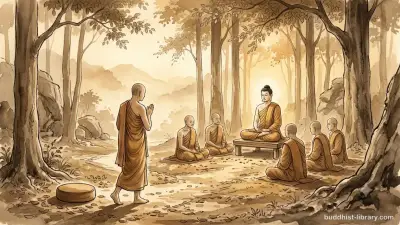
Unlike suttas delivered to crowds, this one is intimate. Pukkusāti, a wanderer who admired the Buddha but had never met him, shared shelter in a potter’s shed with a monk he didn’t recognize.
That monk was the Buddha.
What followed is among the clearest instructions ever given on how to dismantle the illusion of self — element by element, determination by determination.
The Story: A Teacher Unrecognized
Pukkusāti had left home inspired by reports of the Buddha’s wisdom. He was searching for the teacher. He’d never seen his face.
That evening, both men ended up in the same potter’s workshop. The Buddha, recognizing Pukkusāti’s readiness, started teaching — without saying who he was.
Six elements. Four determinations. A method for investigating experience to discover not a self, but impersonal processes running on their own.
Only after the discourse did Pukkusāti ask his companion’s name. When the Buddha revealed who he was, Pukkusāti was struck with awe and regret — he had been sitting casually, not with the formal respect due a fully awakened teacher.
He asked to be ordained immediately. The Buddha agreed, but told him to first find a bowl and robes. On his way to acquire them, Pukkusāti was killed by a wandering cow. The Buddha later confirmed that Pukkusāti had already reached the stage of non-returning (anāgāmi) and would awaken fully in a higher realm.
The teaching was not wasted.
The Six Elements
The Buddha taught that all experience can be analyzed into six elements (dhātu):
1. Earth Element (Paṭhavī-dhātu)
The quality of solidity, firmness, and resistance. In your own body: bones, teeth, flesh, organs — anything with hardness or mass. In the external world: ground, rocks, furniture, walls.
The earth element is not a substance. It’s a quality — the experience of solid pressure, weight, resistance. When you sit, the earth element in your body meets the earth element in the chair. Neither is “you.”
2. Water Element (Āpo-dhātu)
The quality of cohesion, fluidity, and binding. In the body: blood, lymph, saliva, sweat, tears. Anything that flows or holds things together.
Water is what allows earth to cohere into forms instead of scattering. But the water element is not H₂O — it’s the function of binding and flowing, felt directly in experience.
3. Fire Element (Tejo-dhātu)
The quality of temperature — heat and cold. In the body: digestion, metabolism, warmth. The heat that ripens, transforms, and eventually breaks down.
You don’t own your body temperature. It fluctuates with conditions. The fire element does its work regardless of what you want.
4. Air Element (Vāyo-dhātu)
The quality of motion, vibration, and distension. In the body: breath, movement of limbs, circulation, the expansion and contraction of the lungs.
Air is not wind. It’s the experience of movement and pressure — the felt sense of in-breath and out-breath, the pulse, the shifting of posture.
5. Space Element (Ākāsa-dhātu)
The quality of openness, room, and separation. In the body: the cavities of ears, nose, mouth, throat, stomach, intestines. The gaps between organs. The space that allows movement.
Without space, there is no room for anything to happen. Space is often overlooked, but the Buddha emphasized it: the body is not a solid lump but a structure of openings.
6. Consciousness Element (Viññāṇa-dhātu)
Awareness itself — the knowing quality that arises dependent on sense organs and sense objects. Eye-consciousness, ear-consciousness, mind-consciousness.
Consciousness is not a soul. It is conditioned, arises and ceases, and has no owner. It is simply the impersonal process of knowing that occurs when conditions meet.
The Four Determinations
After identifying each element, the Buddha instructed Pukkusāti to apply four contemplations:
- “This is not mine” (n’etaṁ mama)
- “This I am not” (n’eso’ham asmi)
- “This is not my self” (na me so attā)
These three phrases — repeated for each element, internal and external — cut through three levels of clinging:
- Not mine: This element is not my possession. I don’t control it.
- I am not this: My identity is not this element. I am not earth, water, fire, air, space, or consciousness.
- Not my self: This is not an essence, soul, or core identity. It’s just a natural process.
The fourth determination follows naturally: “With right wisdom, I see it as it actually is.” Seeing directly, without distortion, that these are mere conditions — impermanent, dependently arisen, empty of self.
Why This Analysis Matters
This is not philosophy. It’s a meditation practice.
Normally, we experience the body as a unified, personal thing — “my body,” “I am walking,” “I feel hot.” The six-element analysis breaks that illusion by directing attention to what is actually happening:
- Not “I’m sitting,” but the earth element in the body meets the earth element in the chair.
- Not “I’m breathing,” but the air element moves in and out, conditioned by causes.
- Not “I’m aware,” but consciousness arises dependent on contact between sense organ and sense object.
See experience as elements interacting — none owned, none “you” — and the sense of being a solid, permanent self starts cracking.
When that illusion weakens, suffering loses its foothold.
How This Differs from Other Element Teachings
The Bahudhātuka Sutta (MN 115) catalogs eighteen elements, including different types of consciousness and contact. It’s encyclopedic — a complete map of experiential categories.
The Dhātuvibhaṅga Sutta is more focused. It isolates six elements and applies the same insight tool to all of them: not mine, not I, not my self. It’s surgical, not comprehensive.
If the Bahudhātuka Sutta is a detailed anatomy lesson, the Dhātuvibhaṅga Sutta is a scalpel for cutting through identity.
Practicing Element Meditation
You can take up this teaching as a formal meditation practice:
Step 1: Sit comfortably and bring awareness to your body.
Step 2: Notice the earth element — the solid pressure of your sitting bones on the cushion, the weight of your hands, the firmness of bones. Recognize: this is not mine, this I am not, this is not my self.
Step 3: Notice the water element — moisture in your mouth, the fluid quality of your eyes, saliva, the sense of cohesion. Same determination.
Step 4: Notice the fire element — the temperature of your skin, warmth in your belly, coolness at the nostrils. Same determination.
Step 5: Notice the air element — the in-breath and out-breath, the movement of your chest, the pressure of air in your lungs. Same determination.
Step 6: Notice the space element — the openings of your nostrils, the cavity of your mouth, the sense of space inside your body. Same determination.
Step 7: Notice consciousness itself — the simple knowing that all of this is occurring. Same determination: this is not mine, this I am not, this is not my self.
Then reflect: “All of this arises due to causes. None of it is ‘me.’ It’s just nature doing what nature does.”
Practiced sincerely, this leads to disenchantment — not despair, but the clear seeing that there’s nothing here to cling to. And that seeing is the doorway to peace.
The Ending of the Sutta: Dying with Insight
Pukkusāti’s story is poignant. He heard the teaching, understood it deeply, and set out to formalize his commitment by becoming a monk. But he never made it.
A wandering cow — perhaps startled, perhaps aggressive — killed him on the road.
Later, when monks asked what had become of Pukkusāti, the Buddha confirmed: he’d cut through the five lower fetters and been reborn in the Pure Abodes, where non-returners finish the path without coming back to the human realm.
He heard the teaching. He understood. He died on the way to formalize it.
The understanding didn’t need the robes. That’s what seeing clearly does — it holds, regardless of circumstances.
Key Takeaways
- The Dhātuvibhaṅga Sutta teaches the six elements: earth, water, fire, air, space, and consciousness.
- Each element is analyzed with four determinations: not mine, not I, not my self, and seen as it truly is.
- The teaching deconstructs the sense of a unified, personal self into impersonal processes.
- Practicing element meditation leads to disenchantment, dispassion, and liberation.
- The sutta’s recipient, Pukkusāti, attained non-returning through this teaching and awakened fully after death.
Read more:
- What Is Nāmarūpa? Mind and Body in Buddhist Psychology — the relationship between mental and physical elements in dependent origination.
- The Bahudhātuka Sutta: Understanding the Many Elements in Buddhist Psychology — a comprehensive catalog of eighteen elements and their roles in experience.
- Anattā (Non-Self): What the Buddha Really Meant — the broader teaching on non-self that element meditation supports.
📖 Source / license: Majjhima Nikāya 140 (Bhikkhu Bodhi, The Middle Length Discourses of the Buddha; Ṭhānissaro Bhikkhu, dhammatalks.org)
Frequently asked questions
What are the six elements in Buddhism?
The six elements are earth (solidity), water (cohesion), fire (temperature), air (motion), space (openness), and consciousness. The Buddha taught that all experience arises from these elements, none of which is 'self.'
Who was Pukkusāti in the Dhātuvibhaṅga Sutta?
Pukkusāti was a renunciant who met the Buddha without recognizing him. The Buddha taught him this profound analysis of elements, and upon realizing who his teacher was, Pukkusāti set out to become a monk but died on the way, having already attained non-returning.
How is the Dhātuvibhaṅga Sutta different from other element teachings?
While the Bahudhātuka Sutta catalogs many types of elements, the Dhātuvibhaṅga focuses specifically on six elements plus four determinations ('not mine, not I, not my self') as a direct path to seeing through the illusion of self.
How do I practice element meditation?
Observe your direct experience: the solid pressure of earth, the flowing quality of water, warmth and cold of fire, movement of air, open space, and consciousness itself. Recognize that none of these feels like 'you' — they are just natural processes arising and passing.