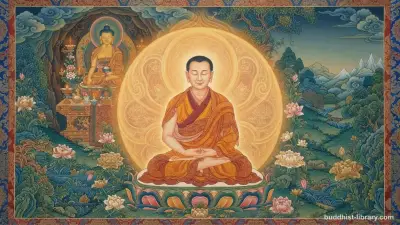
The Four Elements Meditation: Contemplating Earth, Water, Fire, and Air

The Four Elements Meditation (Dhātu Manasikāra) is a classical Buddhist practice that systematically deconstructs the body into earth, water, fire, and air—revealing it as an impersonal assembly of elemental processes rather than a fixed self. By observing these qualities directly, practitioners loosen identification with the body and cultivate insight into non-self (anattā).
The practice appears throughout the Pali Canon. You find it in the Mahāsatipaṭṭhāna Sutta (DN 22) and the Dhātuvibhaṅga Sutta (MN 140), where the Buddha instructs monastics to contemplate the body “internally and externally” as composed of the four great elements. It remains a cornerstone of insight (vipassanā) practice in Theravāda traditions and is echoed in Mahāyāna contemplations on emptiness.
Unlike modern chemistry, the “elements” here are not substances but qualities of experience—solidity, fluidity, temperature, and movement. The practice trains you to see your body not as “me” but as a temporary convergence of earth, water, fire, and air that will eventually disperse back into the world.
What Are the Four Elements (Dhātu)?
The Pali term dhātu means “element,” “property,” or “sphere.” In Buddhist meditation, the four great elements (mahā-bhūta) are:
- Earth (paṭhavī-dhātu) — the quality of solidity, hardness, softness, roughness, and resistance. You feel it in bones, teeth, flesh, skin, and anything that resists pressure.
- Water (āpo-dhātu) — the quality of cohesion, fluidity, wetness, and binding. You feel it in blood, saliva, sweat, lymph, and the moist adhesion that keeps tissues together.
- Fire (tejo-dhātu) — the quality of temperature, heat, and metabolism. You feel it as warmth or coolness in the body, the heat of digestion, the glow after exercise, or the chill of fever leaving.
- Air (vāyo-dhātu) — the quality of movement, vibration, expansion, and contraction. You feel it in the breath, the pulse, the gurgling of digestion, and the tremor of muscles.
These are not metaphysical substances but direct perceptions. When you sit and feel the firmness of your sit-bones, that’s earth. When you notice saliva pooling under your tongue, that’s water. When you sense warmth in your palms, that’s fire. When you feel your chest rise and fall, that’s air.
The Dhātuvibhaṅga Sutta (MN 140) makes this experiential nature explicit: “One reviews the body… ‘In this body there is the earth element, the water element, the fire element, and the air element.’”
Why Contemplate the Elements?
The purpose is insight, not metaphysics. By analyzing the body into impersonal processes, you undermine the instinctive feeling that the body is “me” or “mine.”
Consider: the earth element in your bones came from food, which came from soil. The water in your blood came from rivers and rain. The fire that warms you came from the sun’s energy, metabolized through countless biochemical reactions. The air moving in your lungs came from the atmosphere and will return there in moments.
None of this is uniquely yours. You borrow these elements briefly, and at death (or even moment by moment) they return to their source. As the Mahāsatipaṭṭhāna Sutta puts it, “One contemplates the body as body internally, externally, and both… seeing how the body arises and passes away.”
This reflection cuts through identification. If the body is just a temporary loan of earth, water, fire, and air, where is the “self” you’ve been clinging to?
How the Buddha Taught It
The classic instruction appears in the Mahāsatipaṭṭhāna Sutta (DN 22):
“One reviews this same body… ‘In this body there is the earth element, water element, fire element, and air element.’ Just as a skilled butcher or his apprentice, having killed a cow, would sit at a crossroads cutting it up into pieces, so too a practitioner reviews this same body… in terms of the elements.”
The simile is striking: just as a butcher sees a cow not as “cow” but as parts (legs, ribs, hide), you see the body not as “me” but as elements. The sense of unified ownership dissolves into a process-view.
The Dhātuvibhaṅga Sutta (MN 140) elaborates further, describing both the internal elements (within your body) and the external elements (in the world), and how they are fundamentally the same. Your internal earth is no different in nature from external earth—it’s all part of one process.
Ṭhānissaro Bhikkhu, in his translation notes, emphasizes that this meditation is not about rejection but clear seeing: “You’re not denying the body exists; you’re seeing it for what it actually is—impermanent processes, not a permanent self.”
Step-by-Step Practice Guide
1. Settle into Mindfulness of the Body
Begin with a few minutes of mindfulness of breathing or body scanning to stabilize attention. Let your awareness rest in the whole sense of embodiment—sitting, breathing, present.
2. Systematically Identify the Earth Element
Bring attention to sensations of solidity and resistance:
- Feel the weight of your body pressing down on the seat.
- Notice the hardness of bones under the flesh—shins, elbows, skull.
- Feel the texture of skin, the roughness of calluses, the firmness of muscles.
- Observe the stillness and density in your torso, limbs, and head.
Silently label: “Earth… earth… earth.” Recognize that this solidity is not uniquely yours—it’s borrowed from the food you ate, which came from soil and minerals.
3. Systematically Identify the Water Element
Shift attention to fluidity and cohesion:
- Notice saliva in your mouth, moisture on your tongue.
- Feel the slight dampness of sweat on your palms or forehead.
- Sense the fluid circulation—blood moving, lymph flowing.
- Observe the binding quality that holds tissues together.
Label: “Water… water… water.” Recognize that this moisture came from rivers, rain, and wells—it will leave your body as sweat, urine, and breath, returning to the world.
4. Systematically Identify the Fire Element
Bring attention to temperature and heat:
- Feel warmth in your hands, face, or core.
- Notice coolness in the breath entering your nostrils.
- Sense the metabolic heat digesting food in your belly.
- Observe the glow of exertion after a long sit or the chill of stillness.
Label: “Fire… fire… fire.” Recognize that this warmth came from the sun’s energy, passed through plants and animals, and will radiate back into the air.
5. Systematically Identify the Air Element
Shift attention to movement and vibration:
- Feel the rise and fall of the chest and abdomen with each breath.
- Notice the pulse in your wrists, neck, or temples.
- Sense the gurgling of digestion, the tremor of muscles adjusting posture.
- Observe the expansion and contraction in the lungs.
Label: “Air… air… air.” Recognize that this movement is not “yours”—it’s the same wind that moves trees and clouds, temporarily passing through this body.
6. See the Whole Body as Elements in Flux
Let go of the labels. Rest in open awareness of the body as a shifting interplay of solidity, fluidity, temperature, and motion. Notice how these qualities arise and pass, blend and separate, without a permanent “owner.”
Reflect: “This is not me, not mine, not myself. These are impersonal processes, conditioned and empty of self.”
7. Extend to External Elements (Optional)
Expand awareness beyond your body:
- Feel the earth beneath you (ground, floor).
- Notice the water in the air (humidity, rain sounds).
- Sense the fire in the room (sunlight, warmth from a heater).
- Feel the air moving around you (breeze, ventilation).
Recognize that the elements inside and outside are continuous. The boundary of “my body” is conceptual, not absolute.
Common Challenges and How to Work with Them
“I can’t feel the elements clearly.”
Start simple. The earth element is easiest for most people—just notice weight and hardness. Water and fire are subtler; they become clearer with practice. Air is easiest in the breath. If one element eludes you, stay with the others and return later.
“This feels dry or mechanical.”
That’s okay. This is an analytical meditation, not a devotional or blissful one. The “dryness” is actually useful—it trains you to see the body as a process rather than romanticizing it. If you need warmth, balance this practice with mettā (loving-kindness).
“I feel detached or disconnected.”
That’s a sign the insight is working. Feeling “detached” from the illusion of a solid self is the goal. But if it tips into dissociation or numbness, back off and return to grounding practices like mindful walking or eating. The Buddha taught this meditation within a broader path—don’t isolate it.
“Is this the same as scientific materialism?”
No. Science analyzes matter into atoms and molecules; Buddhism analyzes experience into qualities. You’re not learning chemistry—you’re seeing the body as you actually feel it, moment by moment, and recognizing that these sensations are impersonal and conditioned.
Insight That Arises from This Practice
With sustained practice, several insights naturally emerge:
1. Non-Self (Anattā)
The most direct realization is that the body is not a unified “self.” It’s a assembly of borrowed elements that will disperse. As the Anattalakkhaṇa Sutta (SN 22.59) states, “That which is impermanent is suffering; what is suffering is non-self.”
2. Impermanence (Anicca)
You see the elements constantly shifting—heat rising and cooling, fluids moving, breath coming and going. Nothing in the body stays the same for two consecutive moments.
3. Dispassion (Virāga)
By seeing the body as earth, water, fire, and air, the instinctive clinging loosens. The body is no longer “mine” to possess—it’s a natural process unfolding according to conditions.
4. Equanimity (Upekkhā)
The meditation cultivates balanced awareness. Whether the body is comfortable or uncomfortable, you see it simply as elemental processes arising and passing—nothing to exaggerate or deny.
Ṭhānissaro Bhikkhu writes: “The four elements meditation is designed to uproot the conceit ‘I am the body.’ Once that conceit is abandoned, the path to liberation opens.”
How It Fits into the Broader Path
The four elements meditation is one tool in the Buddha’s graduated training. It appears in the Kāyagatāsati Sutta (MN 119) as part of a sequence of body contemplations, alongside mindfulness of breathing, body parts meditation, and cemetery contemplations.
It pairs well with:
- Mindfulness of Breathing (Ānāpānasati) — the air element in motion grounds you in the present.
- Dependent Origination — seeing how the body arises through conditions (food, air, warmth) illustrates the teaching that nothing arises independently.
- Mettā practice — after deconstructing the body, cultivate warmth toward yourself and others as fellow assemblies of elements.
The Visuddhimagga (Path of Purification), a later Theravāda commentarial text, places this meditation in the chapter on insight (vipassanā) development, noting that it directly counters the delusion of selfhood.
Practical Tips for Integration
Start with one element per session.
In the first week, focus only on earth. In the second, add water. Gradually build up to all four. This prevents overwhelm and deepens familiarity.
Use daily activities as reminders.
When washing your hands, notice water. When walking, notice earth under your feet. When eating, notice fire (digestion). When breathing, notice air. The elements are always present—practice recognizing them outside formal meditation.
Keep sessions short at first.
10–15 minutes is enough to start. As concentration strengthens, extend to 20–30 minutes. The quality of attention matters more than duration.
Reflect after the meditation.
After each session, take a moment to ask: “Did I see the body as ‘me,’ or as impersonal processes?” Even a flicker of this shift is progress.
Balance with other practices.
This meditation can feel stark. Balance it with loving-kindness, gratitude, or devotional practices to keep the path warm and sustainable.
Read more:
- Body Contemplation (Kāyagatāsati) — The broader category of mindfulness practices that includes the four elements meditation, with step-by-step guidance for cultivating body awareness.
- Asubha Meditation: Contemplation of the Body — Another analytical body practice that examines the 32 parts of the body to counter attachment and see the body’s impermanent nature.
- Non-Self (Anattā): What the Buddha Really Meant — The core teaching that the four elements meditation directly illustrates—understanding that nothing in experience constitutes a permanent, independent self.
FAQ
What are the four elements in Buddhist meditation?
The four elements (dhātu) are earth (solidity/resistance), water (cohesion/fluidity), fire (temperature/heat), and air (movement/vibration). These are not chemical elements but experiential qualities perceived directly in the body.
How does the four elements meditation lead to insight?
By analyzing the body into impersonal elemental processes rather than “me” or “mine,” this meditation undermines the illusion of a permanent self. You see that what you call “my body” is simply earth borrowed from the earth, water from water, etc.—none of it permanently yours.
Can beginners practice four elements meditation?
Yes, though it’s easier with some prior experience in body scanning or mindfulness of breathing. The practice requires sustained attention and the ability to distinguish subtle bodily sensations. Start with short sessions (10–15 minutes) and gradually deepen.
Is this the same as Western “four elements” (earth, water, fire, air)?
The terms overlap, but the Buddhist approach is phenomenological, not metaphysical. You’re not contemplating abstract cosmic elements but direct, felt qualities in your own body—hardness, wetness, warmth, and motion.
How long does it take to gain insight from this practice?
Progress varies widely. Some practitioners report moments of disidentification within weeks; for others, it unfolds over months or years. The key is consistency and honesty—not forcing insight but allowing it to arise through clear seeing.
Can this meditation be practiced while walking or in daily life?
Absolutely. Once you learn to recognize the elements in sitting meditation, you can identify them while walking (earth under your feet, air in your lungs), eating (fire digesting food), or washing (water on your skin). This informal practice deepens the insight.
What’s the relationship between this practice and emptiness (śūnyatā) in Mahāyāna?
The four elements meditation in Theravāda focuses on seeing the body as non-self. In Mahāyāna, the same elemental analysis extends to show that even the elements themselves are empty of inherent existence—they arise dependently and lack a separate, independent nature. Both traditions use the practice to cut through clinging.
📖 Source / license: Mahāsatipaṭṭhāna Sutta (DN 22), Dhātuvibhaṅga Sutta (MN 140), Kāyagatāsati Sutta (MN 119). Translations by Bhikkhu Bodhi and Ṭhānissaro Bhikkhu (Access to Insight).
Frequently asked questions
What are the four elements in Buddhist meditation?
The four elements (dhātu) are earth (solidity/resistance), water (cohesion/fluidity), fire (temperature/heat), and air (movement/vibration). These are not chemical elements but experiential qualities perceived directly in the body.
How does the four elements meditation lead to insight?
By analyzing the body into impersonal elemental processes rather than 'me' or 'mine,' this meditation undermines the illusion of a permanent self. You see that what you call 'my body' is simply earth borrowed from the earth, water from water, etc.—none of it permanently yours.
Can beginners practice four elements meditation?
Yes, though it's easier with some prior experience in body scanning or mindfulness of breathing. The practice requires sustained attention and the ability to distinguish subtle bodily sensations. Start with short sessions (10–15 minutes) and gradually deepen.
Is this the same as Western 'four elements' (earth, water, fire, air)?
The terms overlap, but the Buddhist approach is phenomenological, not metaphysical. You're not contemplating abstract cosmic elements but direct, felt qualities in your own body—hardness, wetness, warmth, and motion.