The Sutta Nipāta: Ancient Buddhist Poetry and Wisdom
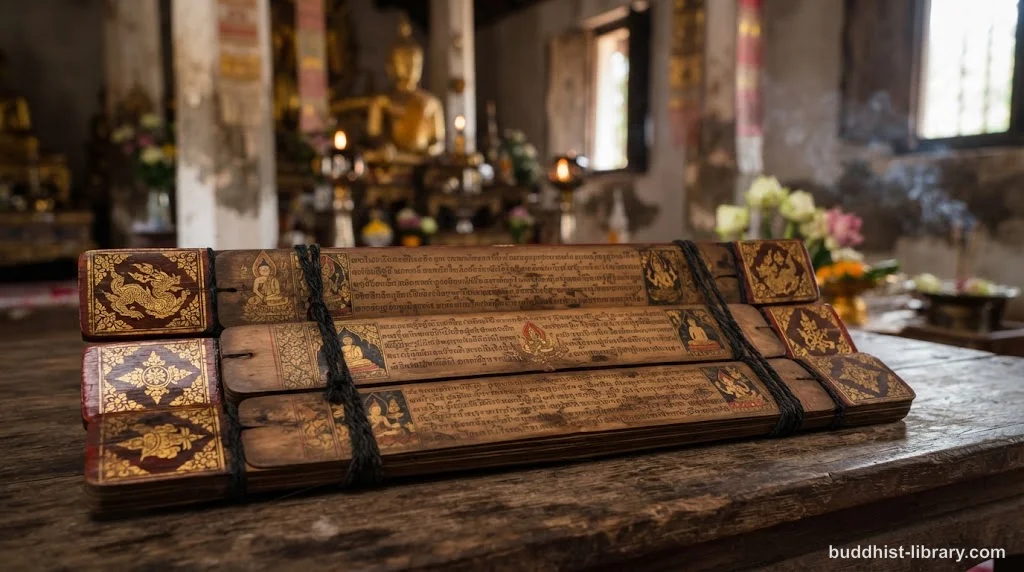
The Sutta Nipāta is a collection of 71 ancient Buddhist discourses in verse form, preserved in the Pali Canon’s Khuddaka Nikāya. Scholars consider it one of the oldest Buddhist texts, containing some of the Buddha’s earliest teachings on ethics, meditation, wisdom, and liberation. Its five chapters range from loving-kindness and renunciation to profound philosophical inquiry.
The Sutta Nipāta stands apart. Where other Buddhist texts give you systematic doctrine or narrative arcs, this one offers raw poetry. Direct. Earthy. Sometimes cryptic. You can feel the oral tradition behind it—these are verses that were chanted, memorized, and carried across ancient India before anyone thought to write them down.
What Makes the Sutta Nipāta Special?
The Sutta Nipāta (literally “Collection of Discourses”) occupies a unique place in Buddhist literature. Linguistic and textual analysis suggests that portions of it—particularly the Aṭṭhaka Vagga (Chapter of Eights) and Pārāyana Vagga (Way to the Beyond)—may preserve some of the earliest strata of Buddhist teaching, predating even the core Nikāyas.
Unlike the prose-heavy suttas found elsewhere, these verses were crafted for memorization and recitation. Ancient monks chanted them, traveling teachers proclaimed them, and communities gathered around their rhythmic wisdom. The poetic form wasn’t mere aesthetics; it was a mnemonic technology, ensuring these teachings survived generations before writing appeared.
You can see the text’s age in its language. Archaic Pali forms. Unusual grammar. Words that don’t appear anywhere else in the canon. All of it points backward to a time before Buddhist teaching settled into the systematic categories we know today. Some verses feel pre-doctrinal—they care more about immediate liberation than fitting into a philosophical system.
The Five Chapters of the Sutta Nipāta
The collection organizes its 71 suttas into five vaggas (chapters), each with its own character and emphasis.
Uraga Vagga — The Serpent Chapter
The first chapter takes its name from its opening sutta, which compares the enlightened person to a snake that has shed its skin. This metaphor of casting off the old—attachments, views, identity—runs through all twelve suttas here.
This chapter includes the famous Metta Sutta (Karaṇīya Metta Sutta), Buddhism’s foundational discourse on loving-kindness. Its verses outline how to cultivate boundless goodwill toward all beings, beginning with the memorable line: “May all beings be happy and secure; may their hearts be wholesome.”
Then there’s the Khaggavisāṇa Sutta (Rhinoceros Sutta). It celebrates solitary wandering with a refrain that became iconic: “wander alone like a rhinoceros.” The imagery doesn’t soften the message. Cut ties. Avoid entanglements. Walk the path unaccompanied.
Cūḷa Vagga — The Small Chapter
Despite its humble name, the “Small Chapter” contains fourteen suttas rich with practical wisdom. The Maṅgala Sutta appears here, listing thirty-eight blessings that constitute true good fortune—not wealth or power, but virtues like generosity, restraint, and wise friendship.
The Ratana Sutta (Jewel Discourse) also resides in this chapter, celebrating the Triple Gem—Buddha, Dhamma, Sangha—through verses of protective power. Traditionally chanted for blessing and protection, its poetry interweaves praise with teaching.
Mahā Vagga — The Great Chapter
The third chapter earns its title “Great” through both length and depth. Its twelve suttas include some of the most philosophically rich material in the entire collection.
Here we find detailed verses on conduct, renunciation, and the dangers of clinging to views. The Sabhiya Sutta presents a seeker asking the Buddha profound questions about the nature of wisdom and liberation. The responses, delivered in measured verse, demonstrate how the Buddha adapted poetic form to transmit complex insights.
Aṭṭhaka Vagga — The Chapter of Eights
Scholars consider the Aṭṭhaka Vagga one of Buddhism’s oldest surviving texts. Its sixteen suttas present teachings in groups of eight verses (hence the name), though the structure sometimes varies.
What makes this chapter remarkable is how philosophically sophisticated it is while using such archaic language. The verses tackle a subtle problem: how even correct views about Dhamma can trap you. They warn against papañca—the mind’s tendency to proliferate concepts—and push you toward direct seeing instead of endless conceptual refinement.
The Guhaṭṭhaka Sutta speaks of dwelling in a cave of views. The Jarā Sutta addresses aging and death with unflinching clarity. The Purābheda Sutta explores what must be understood before the body breaks apart. These are not gentle verses for beginners but profound inquiries into the nature of liberation itself.
Pārāyana Vagga — The Way to the Beyond
The fifth chapter presents a narrative frame: sixteen brahmin students approach the Buddha with questions about the ultimate goal. Each question becomes a sutta, and the Buddha’s responses map the “way to the beyond”—the path to the far shore of liberation.
Like the Aṭṭhaka Vagga, the Pārāyana Vagga preserves extremely early material. Its questions are fundamental: What constitutes true knowledge? How does one cross the flood? What is the highest refuge? The Buddha’s verse responses are terse, direct, and profound.
The chapter concludes with the Upasīva Māṇava Pucchā, where a student asks how one who has reached the goal should be described. The Buddha’s answer gestures toward the ineffable: such a person has gone beyond all measure, beyond conception, beyond the categories of existence and non-existence.
Key Teachings in the Sutta Nipāta
The Ethics of Non-Harm
Throughout the collection, emphasis falls on ahiṃsā (non-harming) and mettā (loving-kindness). The Metta Sutta makes this explicit, but the theme recurs: true spiritual development begins with abandoning violence toward all living beings.
The Danger of Views
A distinctive emphasis in the Aṭṭhaka and Pārāyana chapters is the danger of clinging to views—even correct ones. The text warns against turning Dhamma into just another ideology to defend. Liberation requires letting go of all fixed positions, seeing directly rather than through conceptual filters.
Renunciation and Independence
Many suttas celebrate the renunciant life—not as escape but as freedom. The Rhinoceros Sutta’s refrain to “wander alone” isn’t misanthropy; it’s a call to genuine independence from the networks of dependency, expectation, and compromise that bind us.
Direct Experience Over Authority
The Sutta Nipāta rarely appeals to authority or tradition. Instead, it emphasizes personal verification: see suffering directly, understand its cause, realize cessation, walk the path yourself. This empirical emphasis predates the Buddha’s later, more systematized presentations.
How to Approach the Sutta Nipāta
Start with the Accessible Verses
If you’re new to this text, begin with suttas like:
- Metta Sutta (Snp 1.8) — loving-kindness, clear and applicable
- Maṅgala Sutta (Snp 2.4) — the thirty-eight blessings
- Ratana Sutta (Snp 2.1) — celebrating the Triple Gem
These provide entry points without demanding deep philosophical background.
Then Explore the Deeper Chapters
Once comfortable with the accessible material, move to:
- Uraga Vagga suttas on renunciation and letting go
- Aṭṭhaka Vagga for profound inquiry into views and liberation
- Pārāyana Vagga for the ultimate questions
Read Multiple Translations
The archaic Pali and compressed poetry make translation challenging. Compare translations by Bhikkhu Bodhi, K.R. Norman, and others. Each brings out different nuances.
Reflect on the Poetry, Don’t Just Analyze
These verses weren’t written for academic analysis. They were crafted for chanting, reflection, internalization. Read them aloud. Let them settle in your mind. Come back to them over weeks and months. Their wisdom doesn’t announce itself all at once—it reveals itself gradually, the way good poetry always does.
The Sutta Nipāta in Buddhist Tradition
Within Theravada Buddhism, verses from the Sutta Nipāta appear regularly in daily chanting, especially the Metta Sutta, Maṅgala Sutta, and Ratana Sutta. Monks and laypeople memorize key passages, not as academic exercise but as living practice.
The text has also influenced Buddhist art and iconography. The rhinoceros wandering alone appears in paintings and sculptures. The protective verses (paritta) from the Ratana Sutta are inscribed in temples and recited during ceremonies.
In modern scholarship, the Sutta Nipāta serves as a crucial window into early Buddhism. When scholars want to understand what the Buddha might actually have taught before later systematization, they turn to these ancient verses. The text’s linguistic peculiarities, philosophical emphases, and poetic form all point backward to a very early stratum of the tradition.
Where the Sutta Nipāta Fits in the Pali Canon
The Sutta Nipāta belongs to the Khuddaka Nikāya (Collection of Short Texts), the fifth and most diverse section of the Sutta Piṭaka. The Khuddaka Nikāya contains fifteen to eighteen books (depending on the tradition), including the Dhammapada, Udāna, Itivuttaka, and others.
Among these books, the Sutta Nipāta is distinguished by its age and its verse form. While the Dhammapada also presents verses, the Sutta Nipāta’s longer poetic discourses and archaic language mark it as earlier and more structurally complex.
Understanding its place in the broader canon helps contextualize what you’re reading: this isn’t systematic doctrine like the Dīgha Nikāya’s long discourses or the methodical presentation of the Majjhima Nikāya. It’s raw, early, poetic wisdom—closer to the original oral transmission.
Common Questions About the Sutta Nipāta
Is the Sutta Nipāta only for monastics?
No. While some verses address the renunciant life specifically, many teachings apply universally. The Metta Sutta, Maṅgala Sutta, and teachings on virtue, generosity, and wisdom are entirely relevant to lay practice. Even the more renunciant-focused verses offer insight into letting go and finding freedom within your own life circumstances.
How do I know which translation to use?
Bhikkhu Bodhi’s translation (Wisdom Publications, 2017, The Suttanipāta: An Ancient Collection of the Buddha’s Discourses Together with Its Commentaries) is scholarly, readable, and includes helpful commentary. K.R. Norman’s translation preserves more of the archaic flavor but is harder for beginners. SuttaCentral.net offers free access to multiple translations and the Pali text side-by-side.
Why is some of the language so difficult?
The archaic Pali and compressed poetic form create challenges. These verses were composed 2,500+ years ago in an oral culture, using linguistic forms that later standardized. Don’t expect every line to yield its meaning immediately. Sit with difficult passages, consult commentaries, and allow understanding to unfold over time.
Can I chant the Sutta Nipāta verses?
Absolutely. Chanting is one of the traditional ways to engage with this text. The Metta Sutta, Maṅgala Sutta, and Ratana Sutta are commonly chanted in Theravada communities. You can find recordings online to learn the traditional melodies, or simply read them aloud in your own voice. The rhythm and repetition aid both memorization and contemplation.
How does the Sutta Nipāta relate to meditation practice?
Many verses directly address meditation—how to quiet the mind, let go of distractions, and cultivate wholesome states. The Aṭṭhaka Vagga’s teaching on letting go of views is especially relevant for Vipassanā practice, where seeing clearly requires releasing conceptual frameworks. The Metta Sutta is the foundation of loving-kindness meditation.
Studying the Sutta Nipāta as a Path
You can approach the Sutta Nipāta as literature, as historical artifact, or as living Dhamma. The deepest benefit comes when you treat it as a companion on the path.
Read a sutta slowly. Reflect on how its teaching applies to your life right now. Memorize a few verses that speak to you. Return to them when facing difficulty, doubt, or decision. Let the ancient poetry guide you toward the same liberation it pointed to 2,500 years ago.
The Buddha’s words in the Sutta Nipāta aren’t museum pieces. They’re living instructions for anyone walking the path to freedom—then, now, and in every generation to come.
Read more:
- The Dhammapada: An Introduction to the Buddha’s Verses — another early collection of the Buddha’s teachings in verse form, more accessible than the Sutta Nipāta but equally powerful for daily practice.
- The Metta Sutta: The Buddha’s Discourse on Loving-Kindness — a deep dive into one of the Sutta Nipāta’s most beloved verses, with commentary and practical application for cultivating boundless goodwill.
- What Is the Pali Canon (Tipiṭaka)? Structure and Contents of Early Buddhist Scriptures — understand where the Sutta Nipāta fits within the broader architecture of the Pali Canon and how the early Buddhist texts were organized and preserved.
📖 Source / license: Sutta Nipāta, translated by Bhikkhu Bodhi (Wisdom Publications) and SuttaCentral.net
Frequently asked questions
What is the Sutta Nipāta?
The Sutta Nipāta is a collection of ancient Buddhist verses found in the Khuddaka Nikāya of the Pali Canon. It contains some of the oldest Buddhist poetry, organized into five chapters with 71 suttas covering topics from loving-kindness to the path of the rhinoceros.
Why is the Sutta Nipāta important?
The Sutta Nipāta is considered one of the earliest Buddhist texts, preserving ancient pre-canonical material. Scholars believe portions of it, especially the Aṭṭhaka and Pārāyana chapters, represent some of the Buddha's most original teachings in poetic form.
What is the Rhinoceros Sutta?
The Rhinoceros Sutta (Khaggavisāṇa Sutta) is a famous poem from the Sutta Nipāta that encourages wandering alone like a rhinoceros, independent and self-reliant. It celebrates the solitary life of the renunciant who has cut worldly ties.
How many chapters are in the Sutta Nipāta?
The Sutta Nipāta contains five chapters (vaggas): Uraga Vagga (Serpent), Cūḷa Vagga (Small), Mahā Vagga (Great), Aṭṭhaka Vagga (Octet), and Pārāyana Vagga (Way to the Beyond).
Can laypeople study the Sutta Nipāta?
Absolutely. While some verses address the monastic life, many teachings in the Sutta Nipāta — like the Metta Sutta, Maṅgala Sutta, and teachings on virtue — are directly relevant and accessible to lay practitioners.