Working with Pain in Meditation: Buddhist Approaches to Physical Discomfort
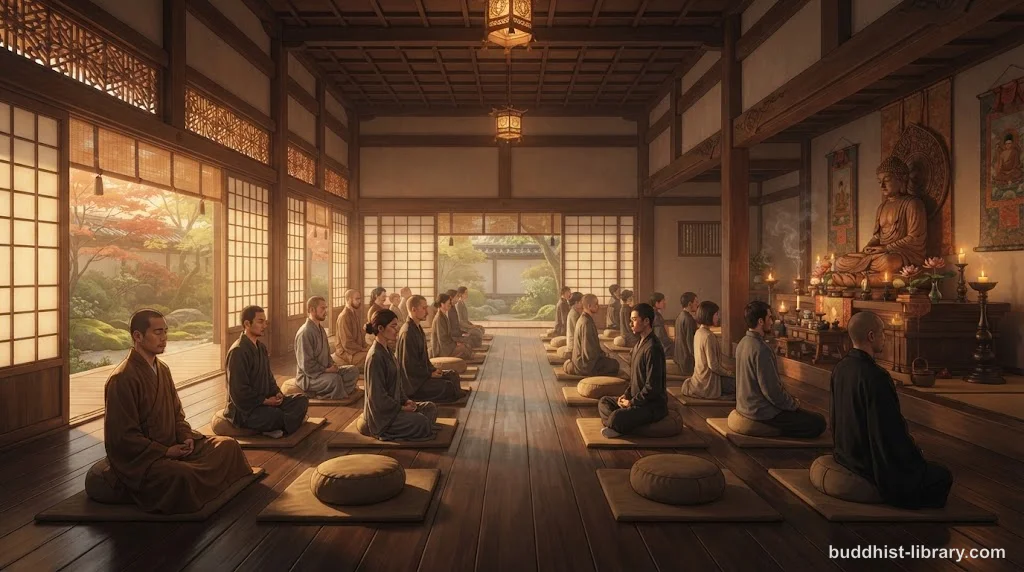
Pain during meditation ranks among the most common challenges practitioners face. The Buddha taught specific methods for working with physical discomfort skillfully—not enduring pain through gritted teeth, not constantly shifting position, but using pain as an object of investigation. This traditional approach transforms what seems like an obstacle into an opportunity for insight into vedanā (feeling), impermanence, and the crucial distinction between raw sensation and the suffering we add to it.
Physical pain in meditation ranges from mild stiffness to sharp sensations in the knees, back, or legs.
The Western tendency? Either power through with stoic determination or immediately adjust at the slightest twinge. The Buddhist approach charts a more practical middle way: pain can teach, but the body has actual limits that wisdom respects.
Why Does Pain Arise During Meditation?
When you sit still for extended periods, several factors contribute to physical discomfort:
- Unfamiliar posture: Most modern practitioners aren’t accustomed to sitting cross-legged on the floor, placing stress on joints, ligaments, and muscles.
- Heightened awareness: Meditation increases sensitivity to bodily sensations that you’d normally ignore during daily activities.
- Tension release: As the mind settles, the body may release held tension, sometimes manifesting as temporary pain or tingling.
- Circulation changes: Reduced movement affects blood flow, especially to the legs and feet.
The suttas acknowledge this reality head-on. In the Satipaṭṭhāna Sutta, the Buddha instructs practitioners to observe “painful feeling” (dukkha vedanā) as part of contemplation of vedanā—one of the four foundations of mindfulness. Pain isn’t a problem to eliminate. It’s a phenomenon to understand.
The Three Types of Vedanā and Pain
The Buddha distinguished three types of vedanā (feeling-tone):
- Pleasant (sukha)
- Painful (dukkha)
- Neither-pleasant-nor-painful (adukkhamasukha)
Physical pain in meditation falls squarely under dukkha vedanā. The Vedanā Saṃyutta delivers a key insight: painful sensations come with the human body. The mental suffering we pile on through aversion, resistance, and mental proliferation (papañca)? That’s optional.
The Buddha used the simile of two arrows. An untrained person experiencing pain gets hit twice—once by the physical sensation (first arrow), then by the mental anguish: “Why me? This is unbearable! I can’t stand this!” (second arrow). The trained practitioner? Only the first arrow lands. They observe the sensation clearly, adding no psychological suffering on top.
Traditional Buddhist Techniques for Working with Pain
1. Investigation of Characteristics
Rather than experiencing pain as a solid block of “knee pain” or “back pain,” investigate its actual qualities:
- Location: Where exactly is the sensation? Does it have clear boundaries or does it radiate?
- Intensity: Is it constant or pulsing? Sharp or dull? Burning or pressing?
- Change: Watch moment-to-moment. Does the sensation stay exactly the same, or does it shift, intensify, diminish?
This investigation reveals impermanence (anicca). Even “constant” pain turns out to be a flowing river of sensations, not a solid thing.
Ajahn Chah taught: “If you investigate, you’ll see that what you call ‘pain’ is just changing sensations. There’s nothing substantial there to hold onto.”
2. Separating Sensation from Story
Notice the difference between:
- Pure sensation: “throbbing pressure in left knee, intensity 6/10”
- Mental proliferation: “This is terrible! My knee is damaged! I can’t meditate! Everyone else looks comfortable! I’m doing this wrong!”
The sensation itself is vedanā. Everything else? Mental reactivity—sankhāra (mental formations) piled on top of raw data.
Distinguish the two clearly, and the suffering component drops.
3. Noting and Labeling
Mental noting can help maintain observer perspective:
- “pain, pain” or “aching, aching”
- “resistance, resistance” (when you notice aversion arising)
- “tension, tension” (when you catch yourself tightening around the sensation)
The noting keeps you in investigation mode rather than identification mode—you’re observing the pain rather than being consumed by it.
4. Breathing with the Sensation
Instead of holding your breath or tensing against pain, deliberately soften around it:
- Direct awareness to the area of discomfort
- Notice the breath moving through or near that region
- With each exhale, release tension around the painful area
- Don’t try to “breathe the pain away”—simply observe with less resistance
This isn’t visualization or imagination; it’s using the breath to maintain a relationship of acceptance rather than contraction with the sensation.
5. Expanding the Field of Awareness
Pain can become all-consuming when awareness narrows to a tight focus. Try widening the lens:
- Become aware of your whole body, with the painful area as just one part of a larger field
- Notice sounds in the environment
- Observe the space around your body
- Include the breath, body, sounds, and pain all together in a spacious awareness
This prevents the pain from occupying 100% of consciousness, reducing its subjective intensity.
When to Adjust and When to Stay
This is the practical question every meditator faces. Here’s the middle-way guidance:
Adjust when:
- Pain is sharp, shooting, or intensifying rapidly
- You feel numbness, tingling that suggests nerve compression
- The pain persists at the same high intensity for more than 10-15 minutes despite investigation
- You recognize the body is genuinely at risk of injury
Stay when:
- Discomfort is mild to moderate and relatively stable
- The sensation is more “challenging” than actually harmful
- You can still maintain some attention on the meditation object
- The urge to move comes more from restlessness than physical necessity
Ajahn Chah’s advice: “Don’t be a slave to either comfort or discomfort. Use wisdom to know the difference between pain that teaches and pain that harms.”
The Mindful Adjustment
When you do need to move:
- Notice the intention to shift before you move
- Move slowly and deliberately, maintaining awareness throughout
- Observe how the mind responds (relief? disappointment that you “gave in”?)
- Settle into the new position and return to your meditation object
This transforms even the adjustment into practice rather than a break from practice.
Working with Chronic Pain Conditions
For practitioners with ongoing pain conditions (arthritis, injuries, chronic illness), meditation doesn’t require sitting through agony:
- Use chairs, benches, or lying down if needed—posture supports practice but isn’t the practice itself
- Start with shorter periods (10-15 minutes) and gradually extend
- Apply the same investigation techniques to familiar chronic pain—even long-term pain can reveal impermanence and teach non-identification
- Combine with medical treatment—meditation is complementary to proper healthcare, not a replacement
The monk Sona, who had been a musician before ordination, struggled with painful feet from excessive walking meditation. The Buddha advised him to tune his practice like tuning a lute—neither too tight nor too loose. This same principle applies to working with pain: find the balance between challenge and sustainability.
Pain as a Teacher of the Three Characteristics
Physical pain is an excellent laboratory for understanding the core Buddhist insights:
Impermanence (anicca): Close observation reveals that pain is never static—it pulses, shifts, intensifies, diminishes. Even “constant” pain is a process, not a thing.
Unsatisfactoriness (dukkha): The body’s unavoidable experience of discomfort points to the first noble truth—even this healthy practice of meditation involves dukkha. This isn’t pessimism but clear seeing.
Non-self (anattā): If you could control the body completely, would you choose pain? The inability to command “Let there be no pain” reveals that the body isn’t fully “yours” to control—it follows its own natural laws.
Thanissaro Bhikkhu notes that pain “strips away the fond conceits we harbor about our bodies and reveals them for the uncooperative, high-maintenance aggregates they are.” This isn’t meant to create hatred of the body but to reduce clinging to it as “me” or “mine.”
Key Points
- Pain in meditation is normal and can be used skillfully as a practice object rather than avoided as an obstacle
- The Buddha distinguished between unavoidable sensation (first arrow) and optional mental suffering (second arrow)
- Investigation of pain’s actual characteristics reveals its impermanent, process-like nature
- Techniques include noting, breathing with sensation, expanding awareness, and separating sensation from story
- The middle way means neither forcing yourself through injury-causing pain nor constantly shifting at the slightest discomfort
- Mindful adjustment—when needed—can itself be part of practice
- Chronic pain practitioners can adapt posture and duration while still applying the same investigation techniques
- Pain teaches the three characteristics: impermanence, unsatisfactoriness, and non-self
Conclusion
Working with pain in meditation isn’t about developing superhuman pain tolerance. It’s not about proving toughness.
It’s about wisdom—learning to observe sensations clearly, to separate physical feeling from mental resistance, and to stay steady when the body inevitably protests.
The Buddha’s teachings don’t promise painless meditation. They promise something more practical: through skillful observation, you can experience pain without drowning in suffering. This training reaches beyond the cushion. You’re building capacity to meet life’s physical challenges—injury, illness, aging—with clarity instead of panic.
As Ajahn Chah put it: “When you understand pain, you don’t suffer from it. The pain is still there, but the suffering—that’s up to you.”
Read more:
- What Is Vedanā? Understanding Feeling in Buddhist Meditation — explores the fundamental role of feeling-tone in meditation practice and dependent origination
- The Satipaṭṭhāna Sutta: Foundations of Mindfulness Explained — details the complete framework of body, feeling, mind, and dhamma contemplation that includes working with painful vedanā
- What Is Kāyagatāsati? Body Contemplation in Buddhist Meditation — presents the systematic methods for developing awareness of the body’s actual nature
📖 Source / license: Satipaṭṭhāna Sutta (MN 10), Vedanā Saṃyutta (SN 36), teachings of Ajahn Chah and Thanissaro Bhikkhu from Access to Insight
Frequently asked questions
Should I push through pain during meditation or adjust my posture?
The Buddha taught the middle way. While some discomfort is normal as the body adjusts, sharp or increasing pain signals potential injury and should be addressed. Adjust mindfully—don't force endurance beyond what's skillful, but don't constantly shift at the first hint of sensation either.
How is pain different from suffering in meditation practice?
Pain is the physical sensation itself (vedanā); suffering is the mental resistance, aversion, and story-making around it. The Buddha taught that while pain may be unavoidable, the suffering we add through reactivity is optional and can be reduced through mindful observation.
Can meditation really help with chronic pain conditions?
While meditation is not a substitute for medical treatment, mindfulness practices have been shown to change the relationship to chronic pain. By observing pain without resistance and separating the physical sensation from mental reactivity, practitioners often experience reduced suffering even when the pain itself remains.
What's the difference between ignoring pain and observing it mindfully?
Ignoring pain means suppressing awareness and pretending it's not there—a form of delusion. Observing mindfully means turning toward the sensation with clear, non-reactive attention, investigating its actual qualities without adding mental commentary or resistance. The first perpetuates avijjā; the second cultivates wisdom.