The Milindapañha: Questions of King Milinda and Nāgasena's Answers
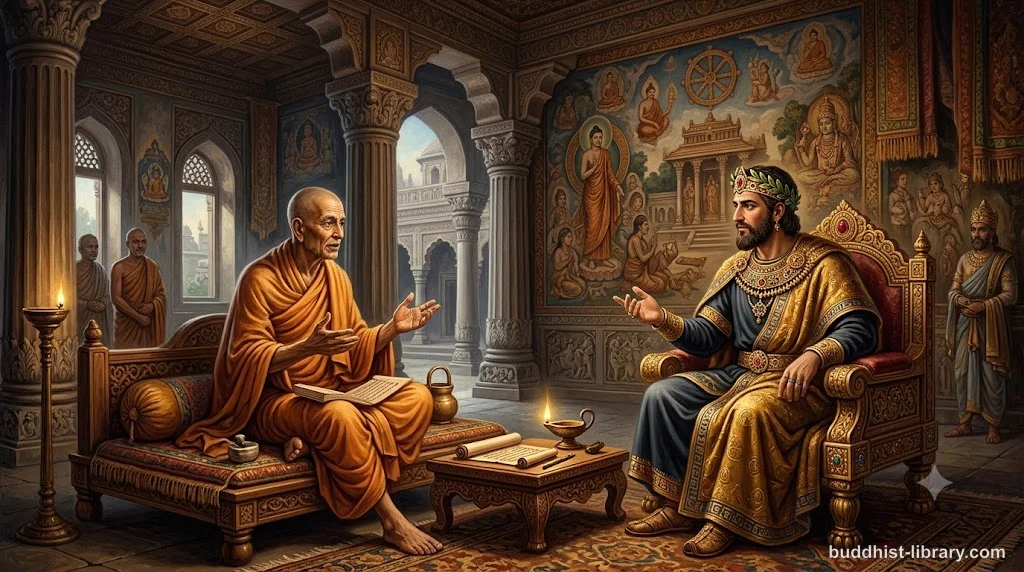
The Milindapañha is a unique Buddhist text preserving philosophical dialogues between the Indo-Greek King Milinda and the monk Nāgasena around 150 BCE. Through sharp questioning and brilliant analogies—from chariots to flames—it clarifies Buddhism’s most challenging doctrines: how rebirth works without a self, what consciousness really is, and why nibbāna isn’t annihilation.
What Is the Milindapañha and Why Does It Matter?
The Milindapañha (“Questions of Milinda”) stands apart in Buddhist literature. It’s not a sermon. It’s a philosophical dialogue—Socratic debate meets Buddhist doctrine. King Milinda (the Greek ruler Menander I who controlled parts of northwestern India) poses penetrating questions that seem to expose contradictions in the teaching. The monk Nāgasena responds with analogies so clear they’ve become classics—the kind that stick in your mind decades after you first hear them.
The text matters because it tackles the very objections modern readers raise: “If there’s no self, who gets reborn? If consciousness doesn’t transmigrate, how does karma follow you? Isn’t nibbāna just death?” Nāgasena’s answers remain the clearest early explanations we have.
Historically, the Milindapañha represents a remarkable moment—Greek philosophical rigor meeting Indian contemplative insight. Though not part of the Pali Canon proper, it’s revered in Theravada Buddhism, especially in Burma and Thailand, where it’s treated as semi-canonical.
Who Was King Milinda?
Milinda (Menander I in Greek sources) was an Indo-Greek king ruling around 150 BCE in what’s now Pakistan and northwestern India. Greek historians remember him as a capable military leader and patron of learning. Buddhist tradition remembers him as a brilliant debater who, after his encounters with Nāgasena, became a supporter of Buddhism.
The dialogues show Milinda as no pushover. He asks hard questions, presses on apparent contradictions, and demands clarity—exactly what you’d expect from someone trained in Greek philosophical method. The text portrays him with respect: intelligent, genuinely seeking truth, willing to be convinced by good arguments.
Whether the historical Menander I actually converted to Buddhism remains debated among scholars. What’s certain is that the figure of Milinda became the prototype for the earnest, intelligent questioner in Buddhist literature.
Who Was Nāgasena?
Nāgasena was a Buddhist monk renowned for his learning and skill in debate. The text tells us he mastered the Tipiṭaka in seven months—an exaggeration signaling extraordinary intelligence—and defeated numerous opponents in philosophical contests before meeting Milinda.
What makes Nāgasena memorable isn’t his encyclopedic knowledge—it’s his teaching skill. He doesn’t lecture. He reaches for everyday things. A chariot has no essence beyond its parts. A flame passed from candle to candle is neither the same nor different. A mango tree grows from a seed, yet the tree isn’t the seed. Simple images that cut through what abstract philosophy tangles.
Nāgasena embodies what the Buddhist tradition calls paññā—wisdom that can meet any challenge, adapt to any listener, and make difficult teachings accessible without dumbing them down.
What Are the Main Questions and Answers?
The Milindapañha is organized around specific puzzles. Here are the most significant:
The Chariot Analogy and Non-Self
Milinda’s question: “If there is no self (anattā), then who is ‘Nāgasena’?”
Nāgasena’s answer: He asks Milinda about his chariot. Is the pole the chariot? The wheels? The axle? The body? No to each. Is there a chariot apart from these parts? No. The chariot is a conventional designation for an assemblage of parts in functional relationship.
Likewise, “Nāgasena” is a convenient label for the five aggregates (body, feeling, perception, mental formations, consciousness) working together. There’s no separate, permanent essence—just the process, just the parts in relationship.
This analogy has become the standard Buddhist explanation of non-self.
Rebirth Without a Self
Milinda’s question: “If there is no self that transmigrates, what gets reborn?”
Nāgasena’s answer: He uses the analogy of a flame. If you light one candle from another, is the second flame the same as the first? No. Is it completely different? No—there’s a causal continuity. Similarly, rebirth is neither the same person nor a completely different person; it’s a continuum of cause and effect.
He also uses the mango tree analogy: a tree grows from a seed. The tree isn’t the seed, yet it didn’t come from anywhere else. Karma works the same way—actions condition future results without requiring a soul to carry them.
Consciousness and Memory
Milinda’s question: “If consciousness (viññāṇa) arises dependent on conditions and ceases when those conditions cease, how do we remember past experiences?”
Nāgasena’s answer: Memory doesn’t require a permanent self. He compares it to a seal pressed in wax—the impression remains after the seal is removed. Past experiences condition present mental formations; memory is a present arising conditioned by the past, not evidence of a persistent entity.
What Is Nibbāna?
Milinda’s question: “Where is nibbāna? Can you point to it? If not, does it even exist?”
Nāgasena’s answer: He uses multiple analogies. Fire exists, but can you point to fire when nothing is burning? Wind exists, but where is it when nothing is moving? Nibbāna exists as the cessation of greed, hatred, and delusion—not a place, not annihilation, but the end of suffering’s causes.
He emphasizes that nibbāna is experienced by those who practice—it’s verified through direct knowledge, not logical proof.
Can Nibbāna Be Described?
Milinda: “If nibbāna can’t be adequately described, how do you know it’s desirable?”
Nāgasena: “Can a person who’s never tasted honey know its taste by description?” Some realities must be experienced. But we can point to its characteristics: unborn, unconditioned, peaceful, deathless. We can also describe what it’s not: not suffering, not impermanent, not conditioned.
The text here acknowledges the limits of conceptual knowledge—wisdom traditions across cultures recognize that ultimate realities exceed description.
Key Teachings in the Milindapañha
- Non-self doesn’t mean non-existence. The chariot analogy shows that conventional reality (persons, things) exists as processes and relationships, even without eternal essences.
- Rebirth is continuity without identity. The flame analogy explains how karma carries forward without a soul—cause and effect need no unchanging substrate.
- Moral responsibility doesn’t require a self. Actions have consequences; the process that commits an action is the process that experiences its results. No separate agent is needed.
- Nibbāna is real but not a thing. It’s the cessation of suffering’s causes—verifiable through practice, not provable through argument.
- Analogies bridge understanding. Nāgasena’s genius lies in finding everyday examples that clarify abstract doctrine. Effective teaching meets listeners where they are.
- Philosophical rigor deepens faith. The text shows that questioning isn’t the enemy of Buddhist practice—it’s how understanding deepens. Doubt properly investigated leads to clarity.
How Is the Milindapañha Structured?
The text consists of seven books, though different versions vary. The core is the first three books:
- Book One: King Milinda’s background, his meeting with Nāgasena, and the initial round of questions establishing the framework.
- Book Two: The deepest philosophical exchanges—non-self, rebirth, consciousness, and the nature of nibbāna.
- Book Three: Ethical questions, the characteristics of a Buddha, the practice of mindfulness, and practical applications of doctrine.
Later books contain additional questions and sometimes veer into more scholastic territory. The first two or three books contain the essential philosophical content.
What Is the Historical and Cultural Context?
The Milindapañha reflects the Greco-Buddhist culture of northwestern India in the centuries after Alexander’s campaigns. Greek rulers, Greek settlers, and Greek philosophical traditions coexisted with Indian religious and intellectual life.
This cultural mix produced unique artifacts—Greco-Buddhist art showing the Buddha in Greek style, bilingual inscriptions, and texts like the Milindapañha that fuse Greek dialectical method with Buddhist doctrine.
Scholars debate the text’s date and authorship. The dialogues may preserve actual exchanges (perhaps summarized and refined), or they may be literary compositions using Milinda and Nāgasena as dramatic characters. Most likely: a core of historical encounter elaborated over time into the text we have.
What’s certain: the Milindapañha shows Buddhism engaging seriously with foreign philosophical challenges and proving its intellectual coherence in that encounter.
Why Read the Milindapañha Today?
Because the questions Milinda asks are the questions many people still ask:
- “If Buddhism denies the self, who am I?”
- “How can rebirth work without a soul?”
- “Isn’t nibbāna just nihilism?”
- “How can Buddhism explain consciousness?”
Nāgasena’s answers remain among the clearest we have. Modern neuroscience—with its picture of consciousness as emergent process rather than unitary substance—actually makes his explanations more relevant, not less.
The text also shows what good philosophical conversation looks like: respectful, precise, committed to clarity over point-scoring. In an age of shallow debate, that matters.
And it’s simply a pleasure to read. Vivid analogies. Tight arguments. Dramatic pacing. This is Buddhist philosophy as living dialogue, not dry scholasticism.
How Does the Milindapañha Relate to the Pali Canon?
The Milindapañha isn’t part of the Tipiṭaka—the closed canon of the Buddha’s teachings and early disciples’ commentaries. It’s a later text, probably composed 400–500 years after the Buddha’s death.
However, in the Burmese and Thai Theravada traditions, it’s often included in editions of the Khuddaka Nikāya (the “Minor Collection”) and treated with great respect. Monks study it, quote it, and use its analogies in teaching.
Why? Because even though it’s not a sutta spoken by the Buddha, it accurately explains the Buddha’s teaching. Its authority comes from its clarity and coherence, not from claims of direct transmission.
This reflects an important principle in Buddhist tradition: what matters ultimately isn’t who said it but whether it accords with the Dhamma—whether it leads to understanding, to dispassion, to cessation of suffering.
Frequently Asked Questions
What is the Milindapañha?
The Milindapañha (“Questions of Milinda”) is an ancient Buddhist text recording philosophical dialogues between the Indo-Greek King Milinda (Menander I) and the Buddhist monk Nāgasena, exploring core Buddhist teachings through sharp questions and memorable analogies.
Who was King Milinda?
King Milinda (Menander I) was a Greek ruler in northwestern India around 150 BCE who became famous for his philosophical debates with Buddhist teachers, particularly the monk Nāgasena.
What are the main topics discussed in the Milindapañha?
The text covers non-self (anattā), rebirth without a transmigrating soul, karma, consciousness, the nature of nibbāna, moral responsibility, and paradoxes of Buddhist doctrine, all explained through practical analogies.
Is the Milindapañha part of the Pali Canon?
While not included in the Tipiṭaka proper, the Milindapañha is considered semi-canonical and is highly valued in Theravada tradition, particularly in Burma and Thailand where it’s regarded as authoritative.
What is the chariot analogy in the Milindapañha?
Nāgasena asks Milinda whether any single part of a chariot (pole, wheels, axle) is the chariot itself, showing that “chariot” is a conventional label for parts in relationship—just as “self” is a label for the aggregates, not a separate entity.
How does the Milindapañha explain rebirth without a self?
Using the flame analogy—lighting one candle from another—Nāgasena shows rebirth as causal continuity without identity. The second flame isn’t the same as the first, nor is it wholly different; similarly, rebirth is a continuum of cause and effect, not the transfer of a soul.
What language was the Milindapañha originally written in?
The Milindapañha survives in Pali (the version most studied), but scholars believe it may have been originally composed in a northwestern Prakrit and later translated into Pali. There are also Chinese, Tibetan, and fragmentary Sanskrit versions.
Conclusion
The Milindapañha remains one of Buddhism’s most accessible and intellectually satisfying texts. Through the dramatic device of royal debate, it tackles the hardest questions about Buddhist doctrine and answers them with clarity, rigor, and brilliance.
Nāgasena’s analogies—the chariot, the flame, the mango tree—have become permanent tools in the Buddhist teaching arsenal because they work. They make the abstract concrete, the paradoxical comprehensible.
For anyone struggling with how rebirth works without a soul, how non-self avoids nihilism, or how nibbāna differs from annihilation, the Milindapañha offers answers refined through centuries of testing.
It’s also a reminder that Buddhism welcomes tough questions. Milinda doesn’t convert because he’s overpowered by authority or mysticism—he’s convinced by clear thinking and good arguments. That rational, investigative spirit remains at Buddhism’s heart.
Read more:
- The Pali Canon (Tipiṭaka): Structure and Contents of Early Buddhist Scriptures — Understand where the Milindapañha fits in the broader corpus of Buddhist texts and how the canon was organized.
- What Is Anattā? Non-Self in Buddhism — Explore the teaching of non-self that Nāgasena defends with the famous chariot analogy.
- What Is Dependent Origination (Paṭiccasamuppāda)? — Learn about the causal principle underlying Nāgasena’s explanations of rebirth and consciousness.
📖 Source / license: Milindapañha (The Questions of King Milinda), translated by Bhikkhu Pesala (online) and I.B. Horner (Pali Text Society); referenced in Bhikkhu Bodhi's introductions to early Buddhist philosophy
Frequently asked questions
What is the Milindapañha?
The Milindapañha ('Questions of Milinda') is an ancient Buddhist text recording philosophical dialogues between the Indo-Greek King Milinda (Menander I) and the Buddhist monk Nāgasena, exploring core Buddhist teachings through sharp questions and memorable analogies.
Who was King Milinda?
King Milinda (Menander I) was a Greek ruler in northwestern India around 150 BCE who became famous for his philosophical debates with Buddhist teachers, particularly the monk Nāgasena.
What are the main topics discussed in the Milindapañha?
The text covers non-self (anattā), rebirth without a transmigrating soul, karma, consciousness, the nature of nibbāna, moral responsibility, and paradoxes of Buddhist doctrine, all explained through practical analogies.
Is the Milindapañha part of the Pali Canon?
While not included in the Tipiṭaka proper, the Milindapañha is considered semi-canonical and is highly valued in Theravada tradition, particularly in Burma and Thailand where it's regarded as authoritative.