The Khuddakapāṭha: Essential Short Readings in Early Buddhism
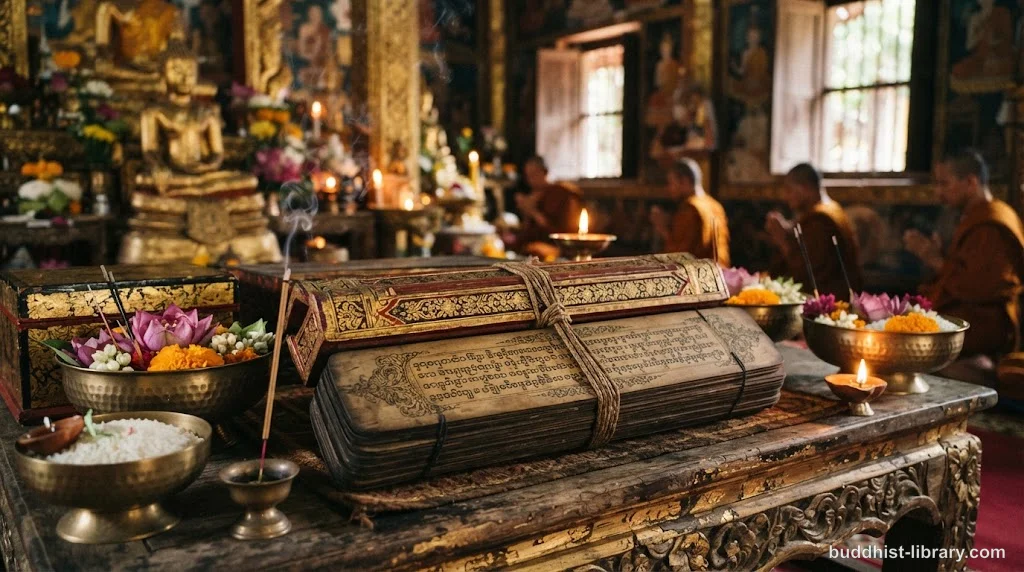
The Khuddakapāṭha is a collection of nine short Buddhist texts that form the essential daily readings in Theravada tradition—including the Three Refuges, Five Precepts, and key protective suttas like the Maṅgala, Ratana, and Metta discourses. These passages serve as both liturgical foundation and practical instruction for monastics and laypeople alike.
The name Khuddakapāṭha literally means “short passages” or “minor readings.” The irony is deliberate. These nine texts represent the core commitments, blessings, and practices that anchor Buddhist life from ordination through daily cultivation—minor in length, primary in function.
What is the Khuddakapāṭha and why does it matter?
The Khuddakapāṭha is the first book of the Khuddaka Nikāya, the “Minor Collection” within the Pali Canon’s Sutta Piṭaka. Despite its placement in the “minor” collection, it holds a primary role: these are the texts every Buddhist encounters first and returns to daily.
Think of the Khuddakapāṭha as Buddhism’s essential handbook—the texts you need to know by heart. While the longer suttas provide detailed teachings, these nine passages distill the practice into compact, recitable form.
The collection likely dates to the early centuries after the Buddha’s passing, compiled as a training manual for new monastics and a reference for established practitioners. Today, these texts are chanted in Pali across Sri Lanka, Myanmar, Thailand, Cambodia, and Laos, often with local language translations.
What are the nine texts of the Khuddakapāṭha?
The Khuddakapāṭha contains exactly nine texts, each serving a distinct purpose:
- Saraṇagamana — The Three Refuges (Buddhaṁ saraṇaṁ gacchāmi…)
- Dasasikkhāpada — The Ten Precepts (includes the Five Precepts for laypeople)
- Dvattiṁsākāra — The Thirty-Two Parts of the Body (meditation on bodily constitution)
- Kumārapañhā — The Questions of the Young Novice (a catechism on basic teachings)
- Maṅgala Sutta — The Discourse on Blessings
- Ratana Sutta — The Discourse on the Triple Gem
- Tirokuḍḍa Sutta — The Discourse on Beings Outside the Walls (merit transference to departed relatives)
- Nidhikaṇḍa Sutta — The Discourse on the Reserve Fund (teachings on generosity and spiritual wealth)
- Metta Sutta — The Discourse on Loving-Kindness
Three of these—the Maṅgala, Ratana, and Metta Suttas—are also found in the Sutta Nipāta, underscoring their importance across the Canon.
Which texts are recited daily and why?
Not all nine texts receive equal emphasis in daily practice. The most frequently recited are:
The Three Refuges and Precepts (Saraṇagamana and Dasasikkhāpada) — These form the foundation of every Buddhist ceremony, whether a brief morning reflection or a formal ordination. Taking refuge in the Buddha, Dhamma, and Saṅgha, combined with the Five Precepts for laypeople or Ten Precepts for monastics, establishes one’s commitment to the path.
The Maṅgala Sutta — This discourse lists thirty-eight blessings (maṅgala) that lead to well-being and progress on the path. It’s recited at housewarmings, weddings, and new ventures as both blessing and reminder of wise conduct. The sutta emphasizes actionable virtues—supporting parents, honoring the wise, right livelihood, generosity, patience—over ritual or superstition.
The Ratana Sutta — A protective discourse (paritta) celebrating the qualities of the Buddha, Dhamma, and Saṅgha. According to tradition, the Buddha taught this sutta to Ānanda for recitation during a plague and famine in Vesālī. It’s chanted during illness, danger, or times of distress, with each verse ending in the refrain: “By this truth, may there be well-being.”
The Metta Sutta — Perhaps the most beloved text in the collection, this sutta teaches the cultivation of loving-kindness (mettā) toward all beings without exception. Its opening verses—“May all beings be happy; may all beings be well”—are recognized even outside Buddhist circles.
These four texts are recited so frequently that many Theravada Buddhists know them by heart in Pali, even if Pali isn’t their native language.
How is the Khuddakapāṭha used in monastic training?
For newly ordained monastics, the Khuddakapāṭha serves as the first curriculum. The Questions of the Young Novice (Kumārapañhā), for instance, is structured as a catechism covering basic doctrinal points:
- “What is one?” — All beings subsist on food.
- “What is two?” — Name-and-form (nāma-rūpa).
- “What is three?” — The three feelings (pleasant, painful, neutral).
- “What is four?” — The Four Noble Truths.
And so on, up to ten. This Q&A format makes memorization straightforward while covering the conceptual framework needed for deeper study.
The Thirty-Two Parts meditation (Dvattiṁsākāra) lists the body’s anatomical components—hair, nails, teeth, skin, flesh, sinews, bones, marrow, organs—to cultivate dispassion (virāga) and counter attachment to the body. Monastics recite this list as a preparatory practice for body contemplation (kāyagatāsati).
What role does the Khuddakapāṭha play in lay practice?
Laypeople engage primarily with the Refuges, Precepts, and the three main protective suttas (Maṅgala, Ratana, Metta). In traditional Theravada cultures, children learn these texts at home or in temple Sunday schools, often before they learn to read.
Morning and evening recitation — Many lay Buddhists recite the Refuges, Precepts, and Metta Sutta as daily devotional practice, either individually or with family. This creates continuity between formal teaching and lived ethics.
Ceremonial use — The Maṅgala and Ratana Suttas are chanted at weddings, funerals, housewarmings, and illness. The Tirokuḍḍa Sutta is specifically recited during memorial services to transfer merit to deceased relatives—a practice rooted in the sutta’s own narrative about hungry ghosts (petas) outside the walls of Rājagaha.
Protective recitation — The term paritta (protection) applies to several Khuddakapāṭha texts. While the Buddha emphasized that true protection comes from virtue and wisdom, reciting these texts mindfully cultivates wholesome mental states—faith, loving-kindness, refuge—that themselves provide psychological and spiritual protection.
The Nidhikaṇḍa Sutta, less commonly recited, teaches that the true “reserve fund” isn’t hidden wealth but the merit accumulated through generosity and virtue, which follows one through life and beyond.
How does the Khuddakapāṭha relate to the broader Pali Canon?
The Khuddakapāṭha acts as a gateway to the Canon. Its nine texts introduce themes elaborated elsewhere:
- The Refuges point to the Buddha’s awakening, the Dhamma’s truth, and the Saṅgha’s realization.
- The Precepts reflect the Right Action and Right Livelihood factors of the Noble Eightfold Path.
- The Maṅgala Sutta’s thirty-eight blessings echo teachings from the Aṅguttara Nikāya on gradual training.
- The Metta Sutta connects to the Four Brahmavihāras developed throughout the Canon.
For those studying the Canon systematically, the Khuddakapāṭha provides the liturgical backbone—what you recite while you study the Dīgha, Majjhima, and Saṃyutta Nikāyas.
Key points about the Khuddakapāṭha
- The Khuddakapāṭha is a collection of nine short, essential Buddhist texts forming the first book of the Khuddaka Nikāya in the Pali Canon.
- It includes foundational recitations: the Three Refuges, Precepts, and major protective suttas (Maṅgala, Ratana, Metta).
- These texts serve both monastic training (as first curriculum for novices) and lay devotional practice (daily recitation, ceremonies, blessings).
- The Maṅgala Sutta lists thirty-eight actionable blessings rooted in virtue, wisdom, and wise conduct rather than ritual.
- The Metta Sutta teaches universal loving-kindness and is among the most widely recited Buddhist texts globally.
- Several texts function as paritta (protective recitation), cultivating wholesome mental states during illness, danger, or loss.
- The Khuddakapāṭha acts as a gateway to the Canon, introducing themes that the longer Nikāyas explore in depth.
Conclusion: short passages, enduring practice
The Khuddakapāṭha’s brevity is its strength. In nine compact texts, it delivers what every Buddhist—monastic or lay—needs to establish and maintain practice: refuge, ethical grounding, blessings, protection, and loving-kindness.
These aren’t merely liturgical formulas. Each recitation is an opportunity to renew commitment, recall the Dhamma, and cultivate wholesome mental states. The Three Refuges remind you where you stand. The Precepts clarify how you act. The Metta Sutta opens your heart. The Maṅgala Sutta points to what truly brings well-being.
For those new to Buddhism, start here. Learn the Refuges and Precepts. Recite the Metta Sutta daily. Let these short passages become the framework that everything else—meditation, study, ethical refinement—grows around.
And for those already on the path, return here. These aren’t beginner texts you outgrow. They’re the foundation you deepen with every recitation.
Read more:
- The Maṅgala Sutta: The Buddha’s Teaching on True Blessings — A detailed exploration of the thirty-eight blessings enumerated in one of the Khuddakapāṭha’s most important texts, showing how virtue and wisdom create genuine well-being.
- The Metta Sutta: The Buddha’s Discourse on Loving-Kindness — An in-depth look at the most beloved text in the collection, with line-by-line commentary on cultivating boundless goodwill toward all beings.
- The Ratana Sutta: Understanding the Discourse on the Triple Gem — How this protective discourse celebrates the Buddha, Dhamma, and Saṅgha while serving as a traditional paritta recitation during times of difficulty.
📖 Source / license: Khuddakapāṭha, translated by Bhikkhu Ñāṇamoli and Bhikkhu Bodhi (SuttaCentral Khp 1–9; Access to Insight editions)
Frequently asked questions
What does Khuddakapāṭha mean?
Khuddakapāṭha means 'short passages' or 'minor readings' in Pali. It refers to a collection of nine foundational Buddhist texts that are considered essential for daily recitation and study.
Is the Khuddakapāṭha part of the Pali Canon?
Yes, the Khuddakapāṭha is the first book of the Khuddaka Nikāya, the fifth and final division of the Sutta Piṭaka in the Pali Canon. It serves as an introductory collection for monastics and laypeople alike.
Why are these texts recited daily in Theravada Buddhism?
These texts contain the core elements of Buddhist practice—the Three Refuges, Five Precepts, protective blessings, and teachings on loving-kindness. Daily recitation reinforces commitment, cultivates wholesome mental states, and maintains connection with the Dhamma.
Can laypeople recite the Khuddakapāṭha texts?
Absolutely. The Khuddakapāṭha was compiled specifically for both monastics and laypeople. The Refuges, Precepts, Maṅgala Sutta, Ratana Sutta, and Metta Sutta are especially important for lay practice and are recited in homes, temples, and ceremonies throughout the Theravada world.