The Sāmaññaphala Sutta: The Fruits of the Contemplative Life
The Sāmaññaphala Sutta (DN 2) is one of Buddhism’s most comprehensive teachings on spiritual development. When King Ajātasattu asks whether the contemplative life yields any visible fruit, the Buddha responds with a detailed map of practice from ethical conduct through deep meditation to complete liberation—showing that Buddhist practice produces real, tangible results in this very life, not just promises of future rewards.
What Is the Sāmaññaphala Sutta?
The Sāmaññaphala Sutta—the “Discourse on the Fruits of the Contemplative Life”—is the second discourse in the Dīgha Nikāya (Collection of Long Discourses). It ranks among the most important and frequently studied suttas in the Pali Canon.
The discourse takes place on a moonlit Uposatha night when King Ajātasattu of Magadha, tormented by guilt over killing his father, visits the Buddha seeking peace. His simple question—“Is there any fruit of the contemplative life visible here and now?”—prompts one of the Buddha’s most complete expositions of the entire path from beginner to arahat.
What makes this sutta exceptional is its systematic presentation. Rather than addressing isolated practices, the Buddha describes how ethical conduct, meditation, and wisdom form an integrated whole, each stage building naturally on what came before.
Why Did King Ajātasattu Ask This Question?
Context matters. Ajātasattu had recently murdered his father, King Bimbisāra, to seize the throne—urged on by the ascetic Devadatta. The weight of patricide crushed him. He sought various teachers asking the same question about visible fruits, receiving only evasive philosophical answers that offered no relief.
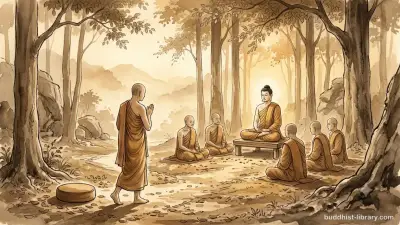
When he finally approached the Buddha, surrounded by 1,250 fully enlightened disciples sitting in perfect silence, Ajātasattu was struck by the palpable peace. This visible fruit—the composure and harmony of the Sangha—impressed him before the Buddha spoke a word.
The king’s question wasn’t academic. He desperately needed to know: can spiritual practice actually help someone like me? The Buddha’s answer was yes—and here’s exactly how.
What Are the Fruits of the Contemplative Life?
The Buddha organizes the fruits into progressive stages, each visible and verifiable:
The Ordinary Fruits: Going Forth and Ethical Conduct
The first fruits appear immediately upon renunciation. A person abandons household life, takes the precepts, and experiences:
- Freedom from social burdens — released from the anxieties of maintaining wealth, reputation, and family obligations
- Respect and support — society honors renunciants and provides requisites
- Clear conscience — living ethically eliminates guilt and remorse
- Simplicity — contentment with basic robes, alms food, and shelter
These aren’t trivial. For someone trapped in cycles of craving and social pressure, the mere relief of ethical living is a genuine fruit. The Buddha takes care to validate these preliminary benefits while pointing to deeper possibilities.
Sense Restraint and Mindfulness
The next fruits arise from guarding the sense doors and maintaining continuous mindfulness:
- Protection from mental proliferation — seeing a form, hearing a sound, one doesn’t spin stories or get caught in reactivity
- Inner stability — constant awareness prevents the mind from being yanked around by sense objects
- Present-moment clarity — mindfulness in all activities (walking, standing, sitting, lying down) produces lucidity
This is where practice becomes transformative rather than merely comfortable. Sense restraint doesn’t mean withdrawal—it means meeting experience directly without the usual overlay of craving and aversion.
Overcoming the Five Hindrances
When sense restraint and mindfulness mature, the five hindrances weaken and eventually cease:
- Sensual desire fades
- Ill will dissolves
- Sloth and torpor lift
- Restlessness and worry settle
- Doubt vanishes
The Buddha uses vivid similes for each hindrance’s removal—like being freed from debt, cured of illness, released from prison, or reaching safety after crossing a dangerous wilderness. These aren’t abstract metaphors; they describe the actual relief practitioners feel when hindrances no longer dominate consciousness.
With hindrances gone, joy and happiness arise—not the agitated pleasure of sense gratification but the deep contentment of a purified mind. This joy becomes the foundation for meditative absorption.
What Are the Jhānas Described in This Sutta?
The Buddha describes the four jhānas in detail—states of deep meditative absorption that produce extraordinary clarity, happiness, and equanimity:
First Jhāna
Secluded from sensuality and unwholesome states, the practitioner enters a state of rapture and pleasure born of seclusion, accompanied by applied and sustained thought. The simile: like a skilled bathman kneading soap powder with water until it’s thoroughly saturated—no part dry, no part dripping.
Second Jhāna
With the stilling of applied and sustained thought, internal confidence and mental unification arise. The mind experiences rapture and pleasure born of concentration, without thought. The simile: like a lake with a spring welling up from within, cool water permeating every part.
Third Jhāna
With the fading of rapture, one dwells in equanimity, mindful and clearly aware, experiencing pleasure in the body. The simile: like blue, red, or white lotuses growing in water, thriving entirely immersed, saturated with coolness.
Fourth Jhāna
With the abandoning of pleasure and pain, and the previous disappearance of joy and distress, one enters a state of pure equanimity and mindfulness, neither pleasant nor painful. The simile: like a person sitting wrapped from head to foot in white cloth—no part uncovered.
These aren’t drug-like trances or temporary highs. The jhānas are stable, wholesome states that purify the mind and make it suitable for insight. Many debate whether jhāna is necessary for liberation, but the Sāmaññaphala Sutta presents them as integral to the path the Buddha taught.
What Are the Three True Knowledges?
From the foundation of fourth jhāna, the mind becomes “purified, bright, unblemished, rid of imperfection, malleable, wieldy, steady, and attained to imperturbability.” This prepared mind can then direct itself toward three higher knowledges:
Knowledge of Past Lives
The practitioner recollects past existences—one, two, five, ten, hundreds, thousands of lives—with their details, circumstances, and conditions. This isn’t memory in the ordinary sense but direct knowledge of the mind’s continuity through saṃsāra.
Knowledge of the Passing Away and Reappearance of Beings
With the divine eye (clairvoyance), one sees beings passing away and reappearing according to their karma—how wholesome and unwholesome actions shape future rebirths. This validates the teaching of karma and rebirth through direct observation rather than faith.
Knowledge of the Destruction of the Āsavas
This is the liberating knowledge. The practitioner directly knows: “This is suffering… this is the origin of suffering… this is the cessation of suffering… this is the path leading to the cessation of suffering.” They directly know: “These are the āsavas (mental effluents/taints)… this is their origin… their cessation… the path to their cessation.”
Knowing and seeing thus, the mind is liberated from the āsavas of sensuality, becoming, and ignorance. With liberation comes the knowledge: “Birth is ended, the holy life fulfilled, the task done. There is nothing further for this world.”
This final fruit—arahatship—is the ultimate answer to King Ajātasattu’s question. Yes, there is a visible fruit of the contemplative life, right here and now: complete freedom from suffering.
How Does the Sutta End?
After this comprehensive teaching, King Ajātasattu takes refuge in the Buddha, Dhamma, and Sangha, becoming a lay follower. He confesses his crime—the murder of his father—acknowledging it openly and asking the Buddha to accept his transgression for the sake of future restraint.
The Buddha accepts his confession. However, the texts note that had Ajātasattu not killed his father, he would have attained stream-entry during this very discourse. Because of that heinous action, the sotāpanna-eye opening was blocked—though confession and refuge still planted seeds for future development.
The king departs joyful and confident. The discourse concludes with one of the most complete presentations of the path in the entire canon—from the first step of ethical conduct to the final fruit of liberation.
What Is the Structure of the Gradual Training?
The anupubbasikkhā (gradual training) in this sutta follows a clear developmental sequence:
Foundation:
- Going forth (renunciation)
- Undertaking the training rules (sīla)
- Sense restraint (indriya-saṃvara)
- Mindfulness and clear comprehension (sati-sampajañña)
- Contentment (santuṭṭhi)
Purification:
- Abandoning the five hindrances
- Cultivating the factors of jhāna
- Attaining the four jhānas
Liberation:
- Developing the three true knowledges
- Destroying the āsavas
- Realizing arahatship
Each stage prepares the ground for the next. You can’t jump to jhāna while hindrances rage. You can’t develop liberating insight with a distracted, unpurified mind. The Buddha’s genius is showing how each fruit naturally gives rise to the next when conditions are right.
How Does This Sutta Compare to Other Gradual Training Texts?
The gradual training appears in multiple suttas, but the Sāmaññaphala Sutta offers the most detailed exposition. Compare:
- Sāmaññaphala Sutta (DN 2): Full progression from going forth through jhānas to the three knowledges and liberation
- Kālāma Sutta (AN 3.65): Focuses on the fruits of abandoning greed, hatred, and delusion
- Mahāsaccaka Sutta (MN 36): Describes the Buddha’s own path to enlightenment, including his mastery of jhāna
- Upāli Sutta (MN 56): Gradual training in the context of converting a Jain householder
The Sāmaññaphala Sutta stands out for its comprehensiveness and systematic presentation. It’s often used as the canonical reference for understanding how the entire path fits together.
What Can Modern Practitioners Learn from This Sutta?
Several points remain immediately relevant:
Practice produces visible results. You don’t need to wait for future lives. Ethical conduct brings peace now. Meditation brings clarity now. Wisdom brings freedom now.
Development is gradual. The sutta shows progression, not instant enlightenment. Each stage builds on earlier work. Trying to skip steps—pursuing jhāna without ethics, or insight without concentration—leads nowhere.
The path is integrated. Sīla, samādhi, and paññā aren’t separate practices you choose among. They’re dimensions of a unified training. Meditation without ethics produces unstable states. Ethics without meditation remains surface-level. Both without wisdom don’t lead to liberation.
Results can be verified. The Buddha doesn’t ask for blind faith. He presents observable fruits at each stage—from the simple relief of living ethically to the unmistakable peace of jhāna to the irreversible freedom of arahatship. The invitation is to test the teaching yourself.
For contemporary practice, the Sāmaññaphala Sutta offers something rare: a complete map.
Not a sectarian interpretation. Not a simplified beginner’s version. The Buddha’s own comprehensive presentation of how practice unfolds from beginning to end.
Key Points
- The Sāmaññaphala Sutta is the Buddha’s most complete presentation of the fruits of spiritual practice in response to King Ajātasattu’s question
- Fruits range from the immediate benefits of ethical living to the ultimate fruit of complete liberation from suffering
- The gradual training progresses systematically: ethical conduct → sense restraint → overcoming hindrances → jhāna → higher knowledge → arahatship
- The four jhānas are described in detail as states of deepening concentration, equanimity, and purification
- The three true knowledges—past lives, karma and rebirth, and destruction of the āsavas—arise from the purified mind of fourth jhāna
- King Ajātasattu took refuge but couldn’t attain stream-entry due to the karma of patricide, showing that even heinous actions don’t prevent future progress through confession and restraint
- The sutta demonstrates that Buddhist practice produces tangible, verifiable results in this very life, not just theoretical promises
Frequently Asked Questions
What does Sāmaññaphala mean?
Sāmaññaphala means “fruits of the contemplative life” in Pali. It refers to the visible, tangible benefits that arise from Buddhist practice—from peace of mind and ethical conduct to deep meditative states and ultimate liberation.
Who asked the Buddha about the fruits of practice?
King Ajātasattu of Magadha, who had recently committed patricide by killing his father King Bimbisāra. Tormented by guilt, he sought the Buddha to ask whether there were any visible fruits of the spiritual life here and now.
What are the gradual training steps in this sutta?
The gradual training (anupubbasikkhā) progresses through: going forth and taking precepts, sense restraint, mindfulness and clear comprehension, contentment, overcoming the five hindrances, attaining the four jhānas, and developing the three true knowledges culminating in liberation.
How is the Sāmaññaphala Sutta relevant today?
This sutta offers a complete roadmap of spiritual development that remains practical today. It shows how ethical living, meditation, and wisdom work together to produce tangible results—not just theoretical benefits, but real peace, clarity, and freedom in this very life.
Why couldn’t King Ajātasattu attain stream-entry?
Despite hearing this profound teaching, Ajātasattu’s recent patricide—one of the five heinous actions that create immediate karmic obstruction—prevented the arising of stream-entry during the discourse. His confession and refuge-taking still benefited him, planting seeds for future progress, but the weight of that particular karma blocked immediate breakthrough.
Are the jhānas necessary for liberation?
This is debated within Buddhist traditions. The Sāmaññaphala Sutta presents jhāna as part of the standard path, and the three knowledges are said to arise specifically from the base of fourth jhāna. Some traditions hold that dry insight (vipassanā without jhāna) can lead to arahatship, while others maintain that at least access concentration or first jhāna is required. The canonical presentation here clearly values jhāna as integral to the path.
Read more:
- The Dīgha Nikāya: The Buddha’s Long Discourses Explained — Explore the collection this sutta belongs to and understand its place among the Buddha’s longest teachings
- The Gradual Training in Buddhism: The Buddha’s Step-by-Step Path — A detailed examination of the anupubbasikkhā structure that forms the backbone of this discourse
- What Are the Jhānas? Understanding Meditative Absorption in Buddhism — In-depth guide to the four jhānas described in the Sāmaññaphala Sutta hānas described in the Sāmaññaphala Sutta
📖 Source / license: Sāmaññaphala Sutta (DN 2), translated by Bhikkhu Bodhi in The Long Discourses of the Buddha (Wisdom Publications, 1995) and by Ṭhānissaro Bhikkhu on Access to Insight. Pali text available on SuttaCentral.
Frequently asked questions
What does Sāmaññaphala mean?
Sāmaññaphala means 'fruits of the contemplative life' in Pali. It refers to the visible, tangible benefits that arise from Buddhist practice—from peace of mind and ethical conduct to deep meditative states and ultimate liberation.
Who asked the Buddha about the fruits of practice?
King Ajātasattu of Magadha, who had recently committed patricide by killing his father King Bimbisāra. Tormented by guilt, he sought the Buddha to ask whether there were any visible fruits of the spiritual life here and now.
What are the gradual training steps in this sutta?
The gradual training (anupubbasikkhā) progresses through: going forth and taking precepts, sense restraint, mindfulness and clear comprehension, contentment, overcoming the five hindrances, attaining the four jhānas, and developing the three true knowledges culminating in liberation.
How is the Sāmaññaphala Sutta relevant today?
This sutta offers a complete roadmap of spiritual development that remains practical today. It shows how ethical living, meditation, and wisdom work together to produce tangible results—not just theoretical benefits, but real peace, clarity, and freedom in this very life.