The Dīgha Nikāya: The Buddha's Long Discourses Explained
The Dīgha Nikāya—the “Collection of Long Discourses”—is the first division of the Sutta Piṭaka in the Pali Canon, containing 34 of the Buddha’s most extensive and detailed teachings. These discourses offer comprehensive explorations of meditation, ethics, cosmology, and the path to liberation, presented through narratives, dialogues, and systematic instructions that make profound teachings accessible and memorable.
What Is the Dīgha Nikāya?
The Dīgha Nikāya (DN) is one of the five Nikāyas—major collections—that make up the Sutta Piṭaka, the second “basket” of the Tipiṭaka. The name comes from dīgha (long) and nikāya (collection), reflecting the length of its individual discourses rather than the size of the collection itself.
While the Dīgha contains only 34 suttas—far fewer than the Saṃyutta Nikāya’s thousands of short discourses or the Majjhima Nikāya’s 152 middle-length teachings—these are the most extensive texts in the Canon. Some suttas span dozens of pages in translation, offering detailed narratives and comprehensive explanations.
The collection is divided into three vaggas (divisions):
- Sīlakkhandhavagga (Division of Moral Practice) — 13 suttas focused on ethics, meditation, and wisdom
- Mahāvagga (Great Division) — 10 suttas including major teachings on cosmology and the Buddha’s life
- Pāthikavagga (Pāthika Division) — 11 suttas addressing various philosophical and practical topics
Why Are These Discourses So Long?
The length isn’t padding. These discourses expand because certain teachings demand it.
Comprehensive instruction. The Mahāsatipaṭṭhāna Sutta doesn’t mention mindfulness in passing—it walks you through every contemplation, method, and application. Complete, step-by-step. Nothing abbreviated.
Narrative context. Storytelling needs room to breathe. The Mahāparinibbāna Sutta follows the Buddha’s final months across multiple towns, tracking his teachings, his declining health, his preparation of disciples. That context changes how you understand impermanence.
Complex questions demand thorough answers. When wanderers from other traditions posed detailed philosophical challenges, brief replies wouldn’t cut it. The Buddha needed space to dismantle wrong views piece by piece and build right understanding from the ground up.
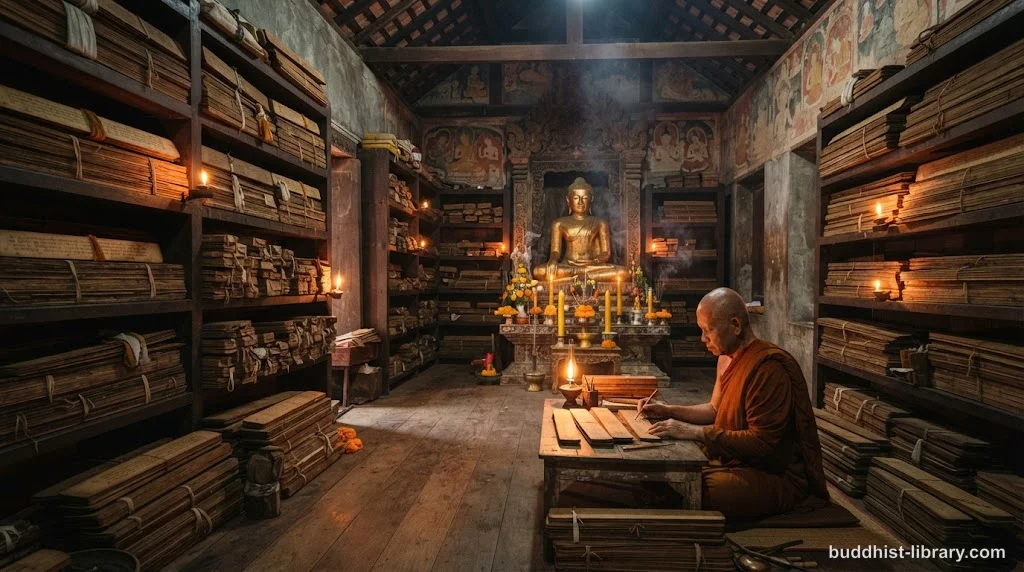
Memory before writing. Before palm leaves and printing presses, these teachings lived in memory. Repetition, vivid imagery, systematic organization—these weren’t stylistic choices. They were survival strategies that let oral transmission work across generations.
Key Suttas in the Dīgha Nikāya
While all 34 discourses reward study, several stand as cornerstones of Buddhist understanding:
The Brahmajāla Sutta (DN 1, “The All-Embracing Net of Views”) systematically examines and refutes 62 philosophical views that can trap practitioners. It demonstrates the Buddha’s penetrating analysis of wrong understanding while establishing the proper approach to Dhamma practice. Read more about the Brahmajāla Sutta.
The Sāmaññaphala Sutta (DN 2, “The Fruits of the Contemplative Life”) presents King Ajātasattu’s question about the visible benefits of spiritual practice, leading to the Buddha’s famous exposition of the gradual training—from moral conduct through meditative absorptions to final knowledge and liberation.
The Mahāparinibbāna Sutta (DN 16) chronicles the Buddha’s final journey, last teachings, passing into final nibbāna, and the events following his death. It’s both historical narrative and profound instruction on impermanence, community, and continuing the practice without the teacher’s physical presence.
The Mahāsatipaṭṭhāna Sutta (DN 22) offers the most detailed presentation of mindfulness meditation in the Canon, expanding on the shorter Satipaṭṭhāna Sutta (MN 10) with additional material on the Four Noble Truths.
The Sigālovāda Sutta (DN 31) provides practical ethical guidance for laypeople, addressing relationships with parents, teachers, spouse, friends, employees, and spiritual teachers—a complete code for household life.
The Aggañña Sutta (DN 27) uses cosmological narrative to address questions about social hierarchy, ultimately undermining caste claims by showing that true nobility comes from conduct, not birth.
What Topics Does the Dīgha Nikāya Cover?
The range is remarkably broad:
Meditation and Mental Development
Several suttas provide detailed meditation instructions:
- Complete presentations of samatha and vipassanā practice
- Systematic guides to the jhānas and formless attainments
- Instructions on mindfulness of breathing and body contemplation
- Methods for developing the four brahmavihāras
Ethics and Lay Practice
The Dīgha contains essential guidance for ethical living:
- Detailed explanations of the five precepts and monastic discipline
- Instructions on right livelihood and household management
- Teachings on generosity (dāna) and its fruits
- Practical ethics for relationships and social responsibilities
Cosmology and Worldview
Some suttas explore the Buddhist understanding of existence:
- Accounts of world-systems, cycles of expansion and contraction
- Descriptions of the six realms and rebirth
- Explanations of karma and its results
- The relationship between actions and their long-term consequences
Philosophical Clarity
Many discourses address wrong views and establish right understanding:
- Refutations of eternalism, annihilationism, and other extreme views
- Clear presentations of dependent origination
- Explanations of the three marks of existence
- The proper understanding of self and non-self (anattā)
The Buddha’s Life and Teaching Career
Historical narratives provide context:
- The Buddha’s encounters with kings, wanderers, and disciples
- Stories illustrating key points through real situations
- The final journey and passing
- Instructions for preserving the teaching
How Should You Approach the Dīgha Nikāya?
Start with accessible suttas. New to the collection? Begin with the Sigālovāda Sutta (lay ethics) or Mahāsatipaṭṭhāna Sutta (mindfulness)—both practical and direct. Save the Brahmajāla Sutta’s philosophical complexity for later.
Read complete suttas. Excerpts won’t do it. The Dīgha rewards reading each discourse straight through. Narrative flow matters. Contextual details matter. The systematic development from opening to conclusion carries meaning that snippet anthologies obliterate.
Use reliable translations. Maurice Walshe’s The Long Discourses of the Buddha (Wisdom Publications) remains the standard complete English translation. Bhikkhu Bodhi has tackled several key suttas with meticulous notes. SuttaCentral gives you multiple translations side-by-side with the Pali—essential for checking ambiguous passages.
Cross-reference with other sources. One sutta, multiple angles. Check traditional commentaries. Compare the Chinese Āgama parallels. Different transmission lines preserved different emphases, and those variations often illuminate what a single version leaves unclear.
Reflect and apply. These are practice instructions, not museum pieces. After reading, sit with the question: What does this mean for my meditation? For how I handle conflict at work? What can I verify directly, right now, through my own experience?
The Relationship to Other Collections
Understanding how the Dīgha fits within the larger Canon helps contextualize its teachings:
Overlaps and parallels. Some Dīgha suttas have shorter versions in the Majjhima or Saṃyutta Nikāyas. Comparing these versions shows how the Buddha adapted teachings to different audiences and occasions.
Complementary material. While the Dīgha excels at comprehensive presentations, the Aṅguttara Nikāya offers numerical lists that organize teachings differently, and the Saṃyutta Nikāya groups related topics for thematic study.
Chinese Āgama parallels. Most Dīgha suttas have parallels in the Chinese Dīrghāgama, showing that these long discourses were valued across early Buddhist schools. Studying parallels reveals both the core teachings preserved universally and the variations that developed in different transmission lines.
Common Misunderstandings
“Longer means more important.” Wrong. Some of the Buddha’s most devastating teachings—like the Dhammacakkappavattana Sutta (first sermon)—pack liberation into a few pages. Length here serves pedagogy, not hierarchy.
“It’s only for scholars.” This reputation is unearned. Yes, some suttas get philosophically dense. But the Mahāsatipaṭṭhāna Sutta is a meditation manual you can follow step-by-step. The Sigālovāda Sutta gives workplace and family ethics anyone can apply. Scholarly apparatus surrounds these texts; the texts themselves speak plainly.
“Cosmological passages are optional.” Many modern readers skip the cosmology, dismissing it as cultural baggage. That’s a mistake. These passages make specific points—about impermanence, about karma’s long arc, about how worldly pleasure disappoints no matter which realm you chase it in. The cosmology is the vehicle; the Dhamma point is what you’re there for.
“One reading is enough.” You wouldn’t say that about Shakespeare or the Daodejing. First reading gives you the map. Subsequent readings—especially after months of practice—show you what the map was pointing at.
Key Themes Running Through the Collection
Several central ideas appear repeatedly across the long discourses:
The gradual training. Many suttas present the systematic path from ethical conduct through concentration to liberating wisdom. This structure—appearing in multiple discourses—underscores that awakening follows a natural sequence of development, not sudden mystical transformation.
The importance of right view. The Dīgha contains extensive discussions of views—what we believe about the world, self, and practice. Right view (sammā diṭṭhi) isn’t mere opinion but accurate understanding that conditions all other aspects of the path.
The Buddha’s skillful teaching methods. Throughout these discourses, we see the Buddha adapting his presentation to different audiences—kings, monks, wanderers, laypeople. The same core truths appear in various formulations, demonstrating skillful means.
Impermanence and its implications. The teaching on impermanence (anicca) runs through narratives, instructions, and arguments. The Mahāparinibbāna Sutta makes this especially vivid—even the Buddha himself was subject to aging and death.
Community and continuity. Unlike collections focused purely on individual practice, the Dīgha addresses communal questions: How should the Saṅgha organize? How do laypeople support practice? What happens when the teacher is gone? These discourses envision Buddhist practice as both personal and collective.
Practical Application
How do the long discourses inform actual practice?
For meditation. Use the Mahāsatipaṭṭhāna Sutta as a systematic guide to mindfulness practice. Work through each contemplation—body, feelings, mind, dhammas—understanding both the instructions and their purpose.
For ethics. Let the Sigālovāda Sutta guide your relationships. When facing workplace dilemmas, consider what right livelihood actually requires. When family conflicts arise, reflect on the reciprocal duties outlined there.
For study. When encountering difficult concepts elsewhere—dependent origination, the aggregates, sense bases—check if the Dīgha has a detailed exposition. Often a long discourse provides the comprehensive explanation that clarifies a brief reference.
For reflection. The narratives offer material for contemplation. Sit with the Mahāparinibbāna Sutta’s account of the Buddha’s death. What does it reveal about impermanence? About teacher-student relationships? About community?
Why the Dīgha Nikāya Matters Today
Sound bites dominate. Attention spans shrink. Why, then, commit to long discourses?
Because depth beats speed. Quick tips don’t produce awakening. The Dīgha gives you complete instruction—thorough, methodical, nothing skipped. Followed properly, this leads somewhere real.
Because context changes meaning. The narratives show teachings arising from actual situations—specific questions from specific people at specific moments. You see what the Buddha taught, yes. But also why, to whom, and how he shifted approach depending on who was listening.
Because the path is integrated, not modular. Follow a gradual training discourse from start to finish and you’ll understand how ethics enables concentration, how concentration clarifies wisdom. Chop the teaching into isolated practices and the connections vanish.
Because these are the source, not the summary. Modern books interpret. The Dīgha preserves what the earliest communities remembered and transmitted with extraordinary care across 2,500 years. Reading these connects you to the root, not the commentary on the commentary.
Because it’s complete. Ethics, meditation, wisdom, community guidance—the Dīgha contains a full practice curriculum. You could build an entire spiritual life from these 34 discourses and lack nothing essential.
Conclusion
The Dīgha Nikāya offers what most Buddhist literature doesn’t: complete presentations. Not fragments. Not summaries. Whole teachings, preserved with their narrative context and systematic instructions intact.
These long discourses demand time. They also repay it. Meditation practitioners find detailed instructions they can actually follow. Students get systematic frameworks that show how pieces connect. Anyone drawn to the Buddha’s teaching discovers that length, properly used, delivers depth you can’t get any other way.
Start with one sutta that matches your current questions. Read it all the way through. Reflect. Return to it later. Let length work for you instead of against you.
For over 2,500 years, practitioners have turned to these 34 discourses and found everything needed for the path from suffering to liberation. The tradition continues because the teachings work. Give them the time they ask for, and find out yourself.
Read more:
- The Majjhima Nikāya: The Buddha’s Middle Length Discourses Explained — Explore the collection of middle-length suttas that balance brevity with detail, offering complete teachings in more compact form than the Dīgha.
- What Is the Pali Canon (Tipiṭaka)? Structure and Contents of Early Buddhist Scriptures — Understand how the Dīgha Nikāya fits within the larger structure of the Pali Canon and the relationship between the three “baskets” of Buddhist scripture.
- The Saṃyutta Nikāya: Understanding the Buddha’s Connected Discourses — Discover the thematically organized collection that groups thousands of short suttas by topic, complementing the Dīgha’s comprehensive approach with focused teachings on specific themes.
📖 Source / license: Dīgha Nikāya, translated by Maurice Walshe (The Long Discourses of the Buddha, Wisdom Publications), Bhikkhu Bodhi (The Great Discourse on Causation), and available on SuttaCentral and Access to Insight
Frequently asked questions
What makes the Dīgha Nikāya different from other Nikāyas?
The Dīgha Nikāya contains the longest discourses in the Pali Canon, offering comprehensive and detailed teachings. While other Nikāyas organize material thematically or numerically, the Dīgha presents complete narratives and extended explanations, making complex teachings accessible through stories and dialogues.
How many suttas are in the Dīgha Nikāya?
The Dīgha Nikāya contains 34 suttas divided into three divisions (vaggas). Despite having fewer suttas than other Nikāyas, these discourses are the most extensive in length, covering diverse topics from meditation and ethics to cosmology and the Buddha's life.
Do I need to read the Dīgha Nikāya in order?
No, the suttas in the Dīgha Nikāya can be read independently. While there's a traditional order, each discourse stands alone. Beginners often start with famous suttas like the Mahāsatipaṭṭhāna Sutta or Mahāparinibbāna Sutta before exploring others based on their interests.
Is the Dīgha Nikāya only for Theravada Buddhists?
While preserved in Theravada tradition, the Dīgha Nikāya contains early Buddhist teachings valued across all traditions. Many suttas have parallels in Chinese Āgamas studied in East Asian Buddhism, and the core teachings on mindfulness, ethics, and wisdom are universal to Buddhist practice.