The 16 Steps of Ānāpānasati: A Complete Guide to Mindfulness of Breathing
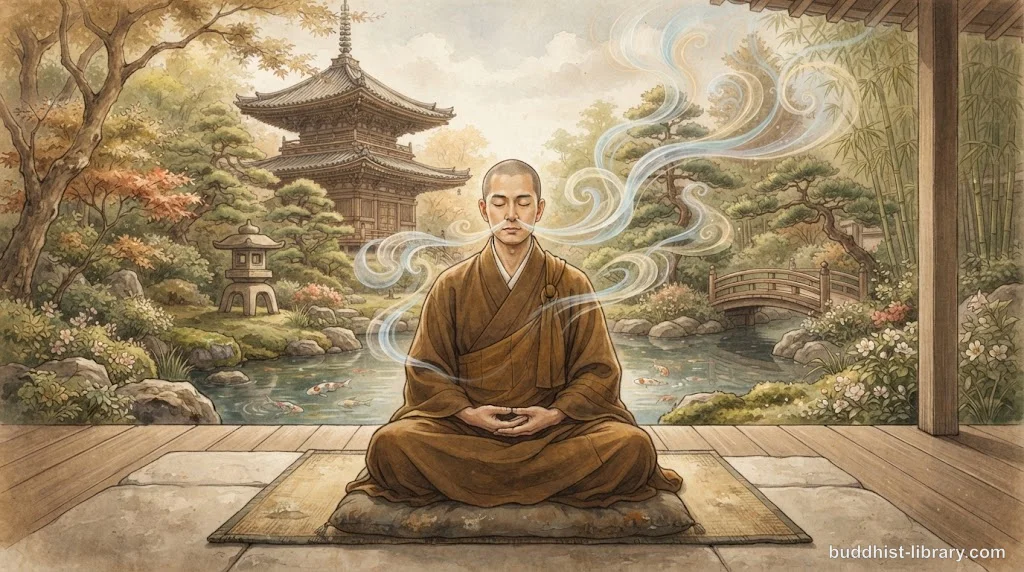
The Buddha taught a complete meditation method in 16 progressive steps — the Ānāpānasati practice — that takes you from simple breath awareness to full liberation. These steps aren’t separate techniques but a unified path: you start by calming the body, then train the mind, investigate reality’s nature, and finally let go of what binds you to suffering.
The Buddha called mindfulness of breathing “the path to enlightenment” and praised it more than any other meditation subject. In the Ānāpānasati Sutta, he didn’t just teach breath meditation as a calming exercise — he revealed a complete map from your first conscious inhalation to the moment you see through the illusion of self.
What Are the 16 Steps of Ānāpānasati?
The 16 steps divide into four tetrads (groups of four), each corresponding to one of the Satipaṭṭhāna foundations of mindfulness:
- Steps 1–4: Body contemplation (kāyānupassanā) — stabilize attention through breath awareness
- Steps 5–8: Feeling contemplation (vedanānupassanā) — recognize the hedonic tone coloring experience
- Steps 9–12: Mind contemplation (cittānupassanā) — observe mental states directly
- Steps 13–16: Mental objects contemplation (dhammānupassanā) — penetrate the nature of reality
The Buddha made clear these aren’t 16 isolated practices. You don’t “complete” step 1 and move on. Rather, each step deepens naturally as concentration matures. The early steps establish the foundation; the later ones emerge when conditions ripen.
The First Tetrad: Calming the Body (Steps 1–4)
Step 1: Knowing the Long Breath
“Breathing in long, one knows: ‘I breathe in long.’ Breathing out long, one knows: ‘I breathe out long.’”
This sounds absurdly simple. It is. And it’s harder than it sounds.
You’re not controlling the breath — just recognizing it. If the breath is long, you know it’s long. If short, you know it’s short. The instruction cultivates bare attention without preference. Most beginners immediately start manipulating: “Should I breathe deeper? Slower?” No. Let the breath breathe itself; you just watch.
This trains the foundational skill of knowing what’s actually happening versus what you want to happen. That gap — between reality and preference — is where most suffering lives.
Step 2: Knowing the Short Breath
“Breathing in short, one knows: ‘I breathe in short.’ Breathing out short, one knows: ‘I breathe out short.’”
Same instruction, different breath. Sometimes the breath is shallow and quick — perhaps you’re agitated, or the meditation is deep and the breath has grown subtle. You note the reality without judgment.
Over time, you’ll notice breath rhythms shift based on mental state: anxiety shortens it, calm lengthens it, absorption makes it nearly imperceptible. You’re building a living laboratory of mind-body connection.
Step 3: Experiencing the Whole Body of Breath
“One trains thus: ‘I shall breathe in experiencing the whole body [of breath].’ One trains thus: ‘I shall breathe out experiencing the whole body [of breath].’”
Now you expand awareness. Instead of watching breath at a single point (nostrils, chest, abdomen), you feel the entire breathing process — from the first touch of air at the nose tip through the expansion of lungs to the final release.
This is where concentration starts solidifying. Sustaining whole-body awareness requires continuous attention. Distractions still arise, but you’re training to hold a wider field without fragmenting.
Some teachers interpret “whole body” as the entire physical body, not just the breathing body. Both readings work. The key is continuity: maintaining unbroken awareness through the complete breath cycle.
Step 4: Calming the Bodily Formation
“One trains thus: ‘I shall breathe in tranquilizing the bodily formation.’ One trains thus: ‘I shall breathe out tranquilizing the bodily formation.’”
“Bodily formation” (kāya-saṅkhāra) means the breath itself — the primary physical process that conditions the body. As attention stabilizes, the breath naturally grows finer, smoother. Tension releases. The body settles.
You’re not forcing relaxation. You’re allowing the nervous system to down-regulate as mindfulness takes over from habitual reactivity. This is where samādhi (concentration) begins to show its power: peace that doesn’t depend on circumstances.
Many practitioners stay with these first four steps for months or years. There’s no rushing. A stable foundation here makes everything else possible.
The Second Tetrad: Understanding Feelings (Steps 5–8)
Step 5: Experiencing Joy (Pīti)
“One trains thus: ‘I shall breathe in experiencing joy.’ One trains thus: ‘I shall breathe out experiencing joy.’”
When the body is calm and attention is steady, a natural pleasure arises — pīti, often translated as “rapture” or “joy.” This isn’t manufactured happiness or positive thinking. It’s the mind’s organic response to being free from conflict.
Pīti can be subtle (a gentle warmth) or overwhelming (waves of bliss, involuntary laughter, energy surging through the body). The Buddha distinguished five levels of intensity. All are welcome; none should be clung to.
The instruction is to know it while it’s present — not to chase it when it fades. This step teaches a crucial lesson: even pleasant meditation states are impermanent. Clinging to bliss creates as much suffering as resisting pain.
Step 6: Experiencing Happiness (Sukha)
“One trains thus: ‘I shall breathe in experiencing happiness.’ One trains thus: ‘I shall breathe out experiencing happiness.’”
Sukha is subtler than pīti. Where rapture is energetic and fizzy, happiness is contentment — a deep, quiet satisfaction. Pīti eventually fades; sukha remains as concentration deepens.
You’re learning to recognize feeling-tone (vedanā) — the pleasant, unpleasant, or neutral quality that colors every moment. Normally this happens unconsciously, driving craving and aversion below awareness. Making it conscious interrupts that automaticity.
This step is pivotal. You’re no longer just concentrated; you’re investigating the nature of experience itself.
Step 7: Experiencing the Mental Formation
“One trains thus: ‘I shall breathe in experiencing the mental formation.’ One trains thus: ‘I shall breathe out experiencing the mental formation.’”
“Mental formation” (citta-saṅkhāra) refers to feelings and perceptions — the conditioned mental processes. You’re now watching how feelings arise and pass, how perception colors raw sensation, how the mind builds an interpreted world from bare data.
This is a transition step from the samatha (calm) emphasis of early stages toward vipassanā (insight). You see that mental experience isn’t a solid, continuous self; it’s a cascade of rapid formations, each dependent on conditions.
Contemplating these formations directly reveals their constructed nature. What you took as “me” is actually an impersonal process.
Step 8: Calming the Mental Formation
“One trains thus: ‘I shall breathe in tranquilizing the mental formation.’ One trains thus: ‘I shall breathe out tranquilizing the mental formation.’”
Just as the breath calmed in step 4, now the emotional-perceptual mind calms. Reactivity to pleasant and unpleasant feeling lessens. The mind grows quieter, more spacious.
This is where jhānic absorption becomes accessible for many practitioners. The deepest calm states (third and fourth jhāna) correspond to this step. But absorption isn’t required — even a noticeable reduction in mental turbulence counts.
At this stage, many meditators experience profound peace and might wonder: “Is this enlightenment?” It isn’t. Peace is wonderful, but the path continues. The next two tetrads turn peace into liberating wisdom.
The Third Tetrad: Knowing the Mind (Steps 9–12)
Step 9: Experiencing the Mind
“One trains thus: ‘I shall breathe in experiencing the mind.’ One trains thus: ‘I shall breathe out experiencing the mind.’”
Now you observe the mind (citta) directly — not its contents (thoughts, feelings) but the mind as a process. Is it contracted or expansive? Dull or luminous? Agitated or still?
You’re developing meta-awareness: consciousness aware of itself. This creates a crucial gap between you and your mental states. You’re not the anxious mind; you’re the awareness that knows anxiety. That distinction is freedom’s beginning.
Step 10: Gladdening the Mind
“One trains thus: ‘I shall breathe in gladdening the mind.’ One trains thus: ‘I shall breathe out gladdening the mind.’”
When the mind is sluggish or doubtful, you incline it toward joy by recollecting wholesome states — generosity you’ve practiced, ethical conduct, past meditation successes. This isn’t self-deception; it’s strategic use of memory to counter hindrances.
This step acknowledges that insight practice can be dry and difficult. The path isn’t grim endurance. Cultivating gladness keeps the heart open and the practice sustainable.
Step 11: Concentrating the Mind
“One trains thus: ‘I shall breathe in concentrating the mind.’ One trains thus: ‘I shall breathe out concentrating the mind.’”
Here you gather the mind into one-pointedness. Distractions have lessened; you can sustain focus for extended periods. This isn’t the forced concentration of early practice — it’s effortless collectedness, like water settling into stillness.
Strong samādhi is the platform for insight. A scattered mind can’t see deeply. A concentrated mind penetrates.
Step 12: Liberating the Mind
“One trains thus: ‘I shall breathe in liberating the mind.’ One trains thus: ‘I shall breathe out liberating the mind.’”
“Liberating” (vimocayaṃ) means releasing the mind from whatever currently binds it — a hindrance, a clinging to pleasure, identification with a mood. You’re not achieving final liberation here; you’re practicing the micro-liberations that train the skill.
Each time you let go of a distraction, a preference, an identity (“I’m a good meditator,” “I’m bad at this”), you weaken the habit of clinging. Liberation becomes familiar, not exotic.
The Fourth Tetrad: Investigating Reality (Steps 13–16)
Step 13: Contemplating Impermanence
“One trains thus: ‘I shall breathe in contemplating impermanence.’ One trains thus: ‘I shall breathe out contemplating impermanence.’”
You observe directly: the breath arises and ceases. Feelings arise and cease. Thoughts, perceptions, sensations — every element of experience is visibly in flux.
This isn’t philosophical reflection. You’re watching impermanence happen, breath by breath. The visceral realization that nothing lasts undermines the craving to hold onto anything. If it can’t be kept, why grasp?
Aniccā (impermanence) is the first of the three characteristics of existence. Seeing it clearly leads to the other two.
Step 14: Contemplating Fading Away (Virāga)
“One trains thus: ‘I shall breathe in contemplating fading away.’ One trains thus: ‘I shall breathe out contemplating fading away.’”
Virāga means dispassion or fading of lust. As you see impermanence deeply, passion for conditioned things naturally wanes. This isn’t nihilistic rejection — it’s a clear-eyed seeing that pursuing what cannot last brings suffering.
The greedy mind quiets. Craving loses its grip.
You’re not suppressing desire; you’re seeing through the illusion that drove it.
Step 15: Contemplating Cessation (Nirodha)
“One trains thus: ‘I shall breathe in contemplating cessation.’ One trains thus: ‘I shall breathe out contemplating cessation.’”
Cessation has layers. On one level, you observe how each breath stops — and yet another arises. The stopping is momentary nibbāna (nirvana), a taste of peace beyond conditions.
On a deeper level, you see the cessation of craving itself. When desire stops, suffering stops. This is the Third Noble Truth made experiential.
Some interpret this step as entering the cessation of perception and feeling (nirodha-samāpatti), an advanced attainment. But even recognizing the cessation of a single moment of craving is profound.
Step 16: Contemplating Relinquishment (Paṭinissagga)
“One trains thus: ‘I shall breathe in contemplating relinquishment.’ One trains thus: ‘I shall breathe out contemplating relinquishment.’”
The final step is letting go — not as a one-time event but as a continuous release. You relinquish clinging to views, to identity, to the meditation itself, to the idea of being someone who practices.
This is the culmination. Every breath becomes an opportunity to put down the burden of self-making. The Buddha described enlightenment as “the relinquishing of all acquisitions.” This step is the training.
What remains when relinquishment is complete? The unconditioned. Freedom. The path’s end.
How the 16 Steps Work Together
The genius of this system is its integration. You don’t abandon early steps; they support the later ones. Even after years of practice, you return to step 1: knowing the long breath. The depth changes; the instruction remains.
The tetrads mirror the four foundations of mindfulness, which the Buddha called “the direct path to nibbāna.” Ānāpānasati encompasses that entire path using one object — the breath — as the through-line.
This makes it extraordinarily accessible. You don’t need special conditions, complicated techniques, or external objects. The breath is always present, always changing, always teaching.
Common Misconceptions
“I need to progress through steps in order.”
Not quite. While the sequence is pedagogically sound, meditation rarely unfolds linearly. You might experience fading away (step 14) before achieving perfect bodily calm (step 4). Let the steps inform your practice without becoming a rigid checklist.
“The 16 steps are Theravāda-only.”
The Ānāpānasati Sutta is Pāli Canon, yes. But variations appear across traditions — Chinese Chan, Japanese Zen, and Tibetan Buddhism all include structured breath meditation methods. The underlying principles — calm, clarity, insight, release — are universal.
“This is just concentration, not insight.”
The first eight steps emphasize samatha, but steps 9–16 are pure vipassanā. The Buddha designed this as a complete vehicle. Many practitioners develop deep insight exclusively through this practice, never formally doing other vipassanā techniques.
“I can skip to the insight steps.”
Technically possible, but unstable. Without the concentration developed in steps 1–8, insight tends to be intellectual rather than transformative. The mind needs stability to see clearly. Rushing the foundation means rebuilding it later.
Practical Suggestions for Your Practice
Start with the first tetrad. Spend weeks or months just on steps 1–4. Build the habit of sustained breath awareness. Everything else depends on this.
Use the instructions as contemplations, not commands. You’re not manufacturing states; you’re recognizing what’s already happening. If joy isn’t present, don’t fake it — notice that it’s absent. That’s also data.
Let transitions happen naturally. You can’t force yourself into step 9. When concentration is mature, the mind naturally starts observing itself. Trust the process.
Return to basics when lost. Confused in the later steps? Go back to step 1. The simple act of knowing the breath reorients everything.
Find a teacher for steps 9–16. While these instructions are clear, the territory of insight can be destabilizing. A qualified teacher who knows this practice helps navigate challenges and confirm progress.
Read the sutta itself. This guide is secondary. The Ānāpānasati Sutta itself, in a good translation (Ñāṇamoli/Bodhi or Ṭhānissaro), provides context and inspiration that no commentary can replace.
The Promise of This Practice
The Buddha didn’t exaggerate when he praised ānāpānasati. Done with consistency and sincerity, this single practice can lead all the way to liberation. Thousands of practitioners across centuries have confirmed this.
But even short of full enlightenment, the 16 steps deliver tangible benefits: reduced anxiety, improved concentration, emotional regulation, insight into suffering’s causes, and moments of genuine peace. The path works at every level.
You don’t need perfect conditions. You don’t need hours each day. You need only two things: the willingness to pay attention to the breath, and the patience to keep returning when attention wanders.
Everything else unfolds from that.
Read more:
- The Ānāpānasati Sutta: The Buddha’s Teaching on Mindfulness of Breathing — Read the original discourse that contains these 16 steps, including the Buddha’s explanations of how breath meditation fulfills all four foundations of mindfulness and leads to awakening.
- What Is Samādhi? Understanding Concentration in Buddhist Meditation — Explore the concentration (samādhi) that the first eight steps cultivate, an essential foundation for both calm and insight practices.
- The Satipaṭṭhāna Sutta: Foundations of Mindfulness Explained — Understand the four foundations framework that organizes the 16 steps of ānāpānasati and forms the complete path to liberation. iberation.
📖 Source / license: Ānāpānasati Sutta (MN 118, Majjhima Nikāya 118), translated by Bhikkhu Ñāṇamoli and Bhikkhu Bodhi. Also Samyutta Nikāya 54 (Ānāpāna Saṃyutta). Commentary references Thanissaro Bhikkhu's 'With Each and Every Breath' and Bhikkhu Anālayo's 'Satipaṭṭhāna: The Direct Path to Realization.'
Frequently asked questions
Do I need to master all 16 steps before seeing benefits?
No. Even practicing the first four steps — simply being aware of the breath — brings immediate calm and concentration. The 16 steps form a natural progression, but benefits accrue at every stage. Most practitioners work with the early steps for years before the later insights arise spontaneously.
What's the difference between steps 1–4 (body) and steps 5–8 (feelings)?
Steps 1–4 develop samādhi (concentration) by anchoring attention to the physical breath and calming bodily tension. Steps 5–8 shift to vedanā (feeling-tone) — the pleasant, unpleasant, or neutral quality that colors every experience. This begins the transition from calm to insight.
Can I practice the 16 steps without a teacher?
The first eight steps are generally safe for solo practice with good instruction (like this guide or Access to Insight resources). Steps 9–16 involve insight into impermanence, non-self, and letting go — while accessible through sincere practice, a qualified teacher becomes invaluable for navigating the deeper territory and avoiding common pitfalls.
How long does it take to complete all 16 steps?
There's no fixed timeline. Some practitioners spend months or years developing stable concentration (steps 1–8) before insight practices (steps 9–16) naturally unfold. The Buddha designed this as a complete path to awakening, which traditionally unfolds over a lifetime — though concentrated retreat practice can accelerate the process considerably.