What Is the Difference Between Samatha and Vipassanā Meditation?
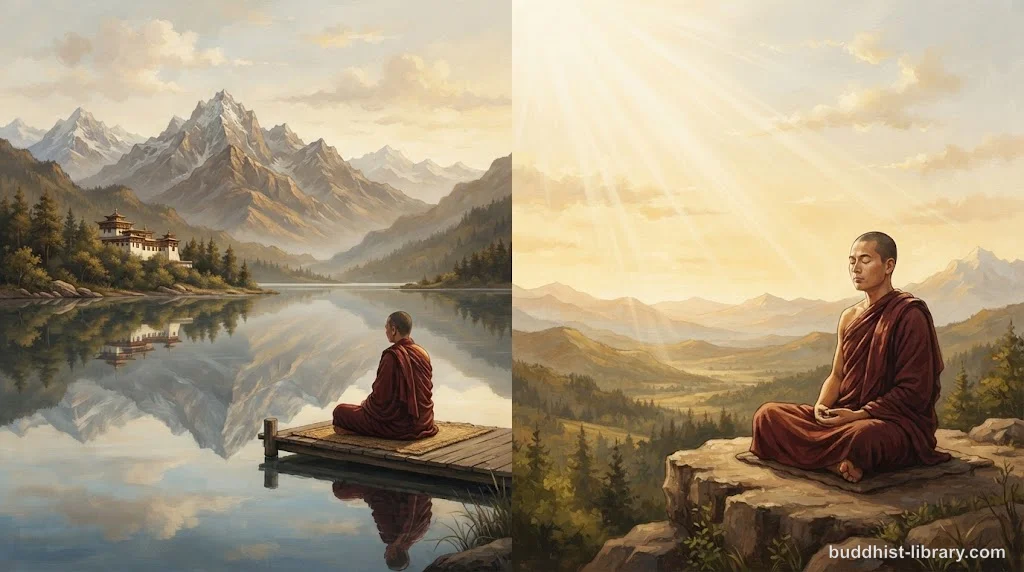
Samatha meditation develops mental calm and concentration by focusing on a single object, while vipassanā meditation cultivates insight into the true nature of reality by observing the arising and passing of phenomena. Samatha stabilizes the mind; vipassanā liberates it through wisdom.
The distinction between these two approaches forms one of Buddhism’s fundamental meditation frameworks. Understanding when and how to use each can transform your practice.
What Does Samatha Mean?
Samatha (Pali: samatha, Sanskrit: śamatha) means “tranquility” or “calm abiding.” It refers to meditation practices that develop deep concentration by unifying the mind on a single object.
In samatha practice, you choose one meditation object and return to it repeatedly. Common objects include:
- The breath (ānāpānasati)
- A kasina (colored disc or elemental quality)
- A recollection (buddhānussati — recollection of the Buddha’s qualities)
- Loving-kindness (mettā)
The goal is ekaggatā — one-pointedness of mind. As concentration strengthens, mental chatter quiets. Distractions fade. The mind becomes stable, clear, and increasingly absorbed in its object.
With sustained samatha practice, meditators can access the jhānas — profound states of meditative absorption characterized by joy, tranquility, and complete mental unification. The Visuddhimagga describes eight progressive jhānas, each deeper than the last.
What Does Vipassanā Mean?
Vipassanā (Pali and Sanskrit) means “clear seeing” or “insight.” It refers to meditation practices that investigate the nature of reality directly — observing how phenomena arise, change, and pass away.
Rather than focusing on a single stable object, vipassanā examines the process of experience itself. You observe:
- Body sensations (kāyānupassanā)
- Feelings — pleasant, painful, or neutral (vedanānupassanā)
- Mind states (cittānupassanā)
- Mental objects and patterns (dhammānupassanā)
The Satipaṭṭhāna Sutta (MN 10) lays out the framework — four foundations of mindfulness. Through sustained observation, you begin to see, not just believe, the three characteristics:
- Anicca (impermanence) — everything changes
- Dukkha (unsatisfactoriness) — clinging to what changes brings suffering
- Anattā (non-self) — there is no permanent, independent self
This isn’t philosophy. It’s direct seeing that erodes the delusions binding us to suffering.
Where samatha calms, vipassanā liberates.
How Do Samatha and Vipassanā Differ in Practice?
The differences show up clearly in how you work with your meditation object:
Focus vs. Investigation
Samatha: You return to the same object repeatedly, ignoring distractions. If you’re watching the breath and a pain arises, you note it briefly and return to the breath. The practice develops stability by excluding everything except your chosen anchor.
Vipassanā: You investigate whatever arises. If pain appears, you turn your attention to the pain — observing its intensity, location, how it changes moment to moment. Every sensation, thought, and emotion becomes an object of inquiry.
States vs. Insight
Samatha: Success is measured by the quality of concentration — sustained attention, mental pliancy, joy, and eventually jhānic absorption. You’re cultivating refined states of consciousness.
Vipassanā: Success is measured by deepening insight into impermanence, suffering, and non-self. The goal isn’t pleasant states but clear seeing. A vipassanā session might be uncomfortable if it reveals patterns you’ve been avoiding — that discomfort is part of the process.
Temporary vs. Transformative
Samatha: The peace and clarity developed through concentration are powerful but temporary. When you stop practicing, the mind gradually returns to its habitual patterns. Samatha doesn’t uproot the underlying causes of suffering.
Vipassanā: Insight has a cumulative, irreversible quality. Once you’ve directly seen impermanence in your own experience, that understanding persists. As the stages of insight mature, they lead to path moments (magga) and fruition (phala) — permanent shifts in understanding that progressively liberate the mind.
The Relationship Between Concentration and Insight
The Buddha taught these as complementary, not opposed. The Visuddhimagga describes two approaches:
- Samatha vehicle (samatha-yānika): Develop jhāna first, then emerge and apply that concentrated mind to insight practice
- Vipassanā vehicle (vipassanā-yānika): Develop just enough concentration (access concentration or first jhāna) to stabilize the mind, then move directly into insight
Both paths converge. Deep concentration makes the mind supple and powerful for insight work. And as insight deepens, it naturally brings a refined quality of concentration (vipassanā-samādhi) — though this is distinct from jhānic absorption.
As Ṭhānissaro Bhikkhu writes in With Each and Every Breath: “Concentration and discernment go together. You can’t develop insight without a certain steadiness of mind. And you can’t maintain concentration unless you understand what you’re doing.”
Which Meditation Method Should You Practice?
This depends on your goals, temperament, and context.
Choose samatha-focused practice if:
- You’re beginning meditation and need to stabilize attention
- Your mind is chronically scattered or anxious
- You’re preparing for intensive vipassanā work
- You want to access jhānic states for their own sake
Choose vipassanā-focused practice if:
- You have some baseline concentration
- You’re drawn to understanding the nature of mind and reality
- Your goal is liberation rather than temporary peace
- You have guidance from a teacher in a vipassanā tradition
Most effective: Use both strategically. Many teachers recommend beginning each session with samatha to collect and settle the mind, then transitioning to vipassanā investigation once stability is established.
Different Buddhist traditions emphasize these differently:
- Theravāda meditation manuals (like the Visuddhimagga) give detailed maps of both jhāna development and insight stages
- Mahasi Sayadaw’s tradition (Burma) teaches “dry insight” — vipassanā with minimal jhāna development
- Pa Auk Sayadaw’s tradition emphasizes mastering all eight jhānas before vipassanā
- Thai Forest tradition (Ajahn Chah, Ajahn Mun) often integrates both fluidly
There is no single “correct” sequence. The Buddha taught both vehicles because students differ. What matters is finding an approach that works for your mind and having skilled guidance.
Key Points: Understanding Samatha and Vipassanā
- Samatha cultivates concentration and tranquility by unifying the mind on one object
- Vipassanā develops wisdom by investigating the changing nature of all phenomena
- Samatha produces temporary states of calm; vipassanā leads to irreversible insight
- Samatha excludes distractions; vipassanā investigates everything that arises
- Both work together: concentration stabilizes the mind for insight; insight refines concentration
- The Buddha taught both as valid paths, adaptable to different temperaments and goals
- Liberation requires insight, but samatha provides powerful support
Frequently Asked Questions
Can I practice samatha and vipassanā together?
Yes. The traditional approach uses samatha to develop concentration, then applies that stability to vipassanā practice. Many teachers recommend beginning each session with 10–15 minutes of samatha (breath focus) to settle the mind, then transitioning to open vipassanā observation. This combines the benefits of both.
Which meditation should beginners start with?
Most teachers recommend starting with samatha to build concentration and mental stability. A scattered mind struggles to sustain the close observation vipassanā requires. However, some traditions (like Mahasi Sayadaw’s) teach vipassanā from the beginning, developing “momentary concentration” through the noting technique. The best choice depends on your temperament and access to qualified guidance.
Does samatha lead to enlightenment by itself?
No. While samatha develops profound states of concentration (jhānas), only vipassanā cultivates the wisdom (paññā) that leads to liberation. The Buddha described the jhānas as tools, not the destination. Without insight into impermanence, suffering, and non-self, concentration alone cannot uproot craving and ignorance — the fetters that bind beings to saṃsāra.
How much concentration do I need before starting vipassanā?
Traditions differ. The minimum is access concentration (upacāra samādhi) — the ability to sustain attention on an object for several minutes without major distraction. Some teachers recommend first jhāna. Others, like Mahasi Sayadaw, teach vipassanā with only basic stability, letting concentration and insight develop together. If your mind wanders constantly within seconds, more samatha will make insight practice far more productive.
Can vipassanā practice make me anxious or destabilize me?
Yes, if undertaken prematurely or without proper support. Vipassanā can surface suppressed emotions and reveal uncomfortable truths about the mind. This is why many traditions emphasize samatha first — it builds the stability to navigate challenging insights. If you experience persistent distress, anxiety, or dissociation during meditation, consult a qualified teacher. Balance practice with wholesome activity, community, and if needed, professional support.
What’s the relationship between vipassanā and mindfulness?
Vipassanā is a form of mindfulness — specifically, mindfulness applied to understand the three characteristics. The Satipaṭṭhāna Sutta (the discourse on the foundations of mindfulness) is the primary canonical source for vipassanā practice. However, “mindfulness” in contemporary usage often blends samatha and vipassanā without distinction. Classical vipassanā goes beyond bare attention to cultivate insight into impermanence, suffering, and non-self.
Conclusion: Two Wings of Practice
The distinction between samatha and vipassanā clarifies what different meditation techniques are designed to do. Samatha is like learning to hold a camera steady — the image becomes clear, but what you photograph depends on where you point it. Vipassanā is investigating what the camera reveals — the impermanent, unsatisfying, and selfless nature of all phenomena.
Neither is complete alone. Concentration without wisdom produces temporary calm but no liberation. Wisdom without concentration lacks the mental stability to penetrate deeply. Together, they form the two wings that carry the practitioner toward awakening.
If you’re beginning, build a foundation in samatha. Once your mind can rest on the breath for five to ten minutes, start exploring vipassanā. Learn from qualified teachers who understand both approaches. And remember: the Buddha’s goal was never to create meditators skilled at entering pleasant states, but to show the path out of suffering entirely.
Read more:
- Samatha and Vipassanā: The Two Wings of Buddhist Meditation — A detailed exploration of how calm and insight practices work together in the Buddhist path.
- What Is Samādhi? Understanding Concentration in Buddhist Meditation — Learn about the different levels of concentration and how they support both samatha and vipassanā.
- The Satipaṭṭhāna Sutta: Foundations of Mindfulness Explained — The Buddha’s primary teaching on vipassanā, detailing the four foundations of mindfulness practice. mindfulness practice. ur foundations of mindfulness practice.
📖 Source / license: Visuddhimagga (The Path of Purification) by Buddhaghosa; Satipaṭṭhāna Sutta (MN 10)
Frequently asked questions
Can I practice samatha and vipassanā together?
Yes. The traditional approach uses samatha to develop concentration, then applies that stability to vipassanā practice. Many teachers recommend samatha as a foundation, though some begin directly with vipassanā.
Which meditation should beginners start with?
Most teachers recommend starting with samatha to build concentration and mental stability. However, some traditions teach vipassanā from the beginning. The best choice depends on your temperament and guidance from a qualified teacher.
Does samatha lead to enlightenment by itself?
No. While samatha develops profound states of concentration (jhānas), only vipassanā cultivates the wisdom that leads to liberation. Samatha is a powerful support, but insight into the three characteristics is necessary for awakening.